











 Secure payments
Standard refund policy
Trade Assurance
Secure payments
Standard refund policy
Trade Assurance
| Product Type | Memory Module |
|---|---|
| Compliance Standards | RoHS,WEEE |
| Memory Capacity | 8 GB |
| Memory Technology | DDR4 |
| Product Voltage | 1.2V |
| RAM Speed | 2666MHz |
| RAM Standard | DDR4-2666/PC4-21300 |
| Error Identifying | ECC |
| Signal Type | Unbuffered |
| Column Access Strobe (CAS) | CL19 |
| Rank | Single Rank x8 |
| Quantity of Pins | 288-pin |
| RAM Genre | UDIMM |
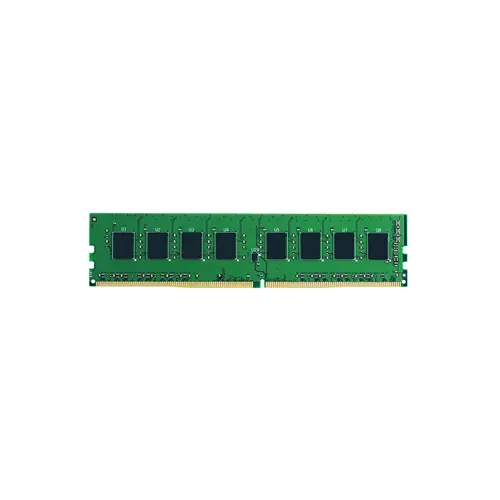
This unbuffered ECC UDIMM is purpose-built for entry-level servers and small-business NAS or virtualization platforms that require data integrity without registered buffering, with its single-rank x8 configuration delivering optimal signal integrity and reduced electrical loading on the memory controller. The integrated ECC automatically corrects single-bit errors in real time, making it a reliable choice for always-on workloads such as file services, light database applications, and virtualized environments where uptime and data accuracy are paramount.
1. ECC correction silently detects and fixes single-bit memory errors in real time, preserving data integrity for mission-critical server applications where even silent corruption is unacceptable.
2. 8 GB capacity provides enough headroom per module to run multiple virtual machines or container workloads concurrently without immediate oversubscription on entry-level server nodes.
3. 2666 MHz speed ensures solid memory bandwidth for data-intensive server tasks, helping reduce CPU idle cycles when handling simultaneous requests in a hyper-converged setup.
4. Unbuffered signal type eliminates the register clock latency found in RDIMMs, offering marginally faster request completion that benefits latency-sensitive microservices and lightweight database transactions.
5. Single Rank x8 design reduces electrical loading on the memory channel, enabling stable multi-DIMM population at rated speed in small-business server boards for dependable 24/7 operation.
In small business servers and entry-level workstations, the Micron MTA9ASF1G72AZ-2G6E1 UDIMM with ECC brings enterprise-grade data protection without the cost of registered memory. Its error-correcting code is essential when running a virtualized cluster with multiple lightweight hypervisors—a single bit flip in a financial transaction log or a customer database record can cascade into silent data corruption, undetected by standard desktop memory, and lead to costly downtime. ECC catches and corrects such errors in real time, preserving data integrity around the clock. The single‑rank x8 organization running at DDR4‑2666 delivers clean signal topology and lower electrical load, which translates directly to stable operation when populating multiple DIMMs per channel in a ZFS storage server or a Redis in‑memory database. High bandwidth and low latency keep frequently accessed datasets instantly responsive, so analytics queries and caching layers never bottleneck on memory I/O. Operating at just 1.2 V, the module also reduces thermal stress inside compact 1U chassis, preventing throttling during sustained write‑intensive tasks. For the IT manager balancing reliability with budget, this unbuffered ECC memory offers an ideal mix of mission‑critical data integrity, efficient thermal performance, and straightforward plug‑and‑play installation in platforms like Intel Xeon E‑series or AMD Ryzen Pro‑based servers.
General Virtualization
For a virtualized host using this 8 GB DDR4-2666 ECC UDIMM, populate all available memory channels with identical modules to eliminate bottlenecks. A typical dual-socket entry server with four channels per CPU benefits from eight modules (64 GB total), allowing comfortable overcommit for light to medium VMs. Always install modules in matched sets and consult the server’s population order to maintain reliable ECC protection and balanced NUMA access.
In-Memory Database
In-memory databases demand both capacity and data integrity, making ECC essential. While a single 8 GB DIMM is undersized, you can build a resilient pool by fully populating all channels—for instance, eight modules provide 64 GB, suitable for smaller Redis or Memcached instances. For larger datasets, scale horizontally across nodes rather than overloading a single server, and ensure the memory speed matches the CPU’s maximum supported frequency to avoid latency penalties.
High-Performance Computing (HPC)
HPC workloads require maximum memory bandwidth and error resilience. Install one 8 GB UDIMM per channel to achieve a balanced configuration (e.g., four modules in a quad-channel platform for 32 GB). This populates every channel without exceeding the CPU’s rank limits, sustaining peak 2666 MT/s throughput. For MPI-based clusters, standardize on this module across compute nodes to simplify sparing and guarantee consistent performance in tightly coupled parallel jobs.
Rigorously tested, compatible with ECC UDIMM servers: Dell PowerEdge T140, T340, HPE ML30 Gen10, Lenovo ST50.
Q: Can I mix this MTA9ASF1G72AZ-2G6E1 with other memory modules of different brands or speeds?
A: Mixing modules is strongly discouraged for server environments. Unbuffered ECC UDIMMs require identical speed, rank, latency, and IC density to maintain signal integrity and prevent memory errors.
Q: Is this memory compatible with my system?
A: This module is compatible with platforms supporting DDR4-2666 ECC Unbuffered DIMMs, such as Intel Xeon E-2100/2200 series (C246/C242 chipset) or AMD Ryzen Pro with ECC-capable motherboards.
Q: What is the recommended DIMM population order for optimal performance?
A: Always follow your server board’s manual. Generally, populate identical modules per channel starting with the farthest slot from the CPU. For a single rank x8 UDIMM, one module per channel maximizes performance.
Q: Does this module support overclocking or XMP profiles?
A: No, this server-grade JEDEC-compliant module does not support overclocking or XMP profiles. It operates exclusively at fixed JEDEC standard timings and voltage for maximum reliability.
Q: What warranty and typical failure rate can I expect?
A: It includes a 1-year warranty. Typical annualized failure rate for Micron server UDIMMs is well below 0.5% under specified operating conditions, reflecting high reliability and rigorous qualification.