











 Secure payments
Standard refund policy
Trade Assurance
Secure payments
Standard refund policy
Trade Assurance
| Product Type | Memory Module |
|---|---|
| Memory Capacity | 8 GB |
| Memory Technology | DDR4 |
| Product Voltage | 1.2V |
| RAM Speed | 2666MHz |
| RAM Standard | DDR4-2666/PC4-21300 |
| Error Identifying | ECC |
| Signal Type | Unbuffered |
| Column Access Strobe (CAS) | CL19 |
| Rank | Single Rank x8 |
| Quantity of Pins | 288-pin |
| RAM Genre | UDIMM |
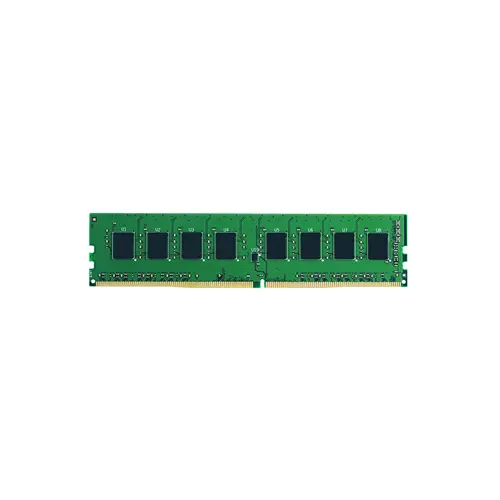
This UDIMM module features ECC error correction and an unbuffered signal type, making it ideally suited for entry-level servers, network-attached storage, or professional workstations that prioritize data integrity in light virtualization and memory-sensitive applications. Its single-rank x8 configuration and CL19 latency ensure stable, low-latency operation at 2666MHz while maintaining full compatibility with platforms requiring 1.2V DDR4 UDIMM memory.
1. ECC detection and correction eliminates single-bit memory faults, preserving data integrity for mission-critical server applications that cannot tolerate silent corruption.
2. Unbuffered UDIMM architecture reduces command latency compared to registered alternatives, giving latency-bound edge services and micro-servers a responsiveness advantage.
3. The DDR4-2666 transfer rate delivers ample throughput to sustain multiple concurrent virtual machines, preventing memory bandwidth starvation during peak consolidation.
4. Single-rank x8 organization imposes lighter electrical loading on the memory controller, which maintains stable high-frequency operation essential for always-on server environments.
5. An 8 GB capacity strikes a balance that accommodates efficient container orchestration and lightweight virtualization, maximizing workload density per node in cost-sensitive deployments.
Understanding that you are evaluating the Micron MTA9ASF1G72AZ-2G6E1Z, this DDR4-2666 UDIMM is purpose-built for entry-level servers and small office virtualization platforms where data integrity and cost efficiency intersect. Its four defining engineering characteristics directly address your real-world pain points.
The integrated ECC continuously detects and corrects single-bit memory errors before they cascade. In a virtualized cluster running multiple lightweight guests or a containerized application stack, unpredictable bit flips can silently corrupt VM snapshots and lead to inexplicable service crashes—ECC transforms this risk into non-negotiable uptime. The unbuffered architecture further eliminates the register latency found in RDIMMs, delivering the snappier, lowest-latency response essential for memory databases like Redis handling frequent, small transactions where every nanosecond counts. Operating at an energy-conscious 1.2V, the module halves power draw compared to older 1.5V DDR3, which profoundly reduces thermal buildup inside compact 1U microservers and NAS systems that run 24/7, slashing cooling costs and extending service life. Finally, the single-rank x8 configuration minimizes electrical loading on the memory bus, guaranteeing stable 2666MHz operation even with all DIMM slots populated. This means your dedicated backup server or surveillance NVR maintains consistent bandwidth during simultaneous write streams without the signal compromise often seen with denser dual-rank kits, securing your critical workflows effortlessly.
This 8GB DDR4-2666 ECC unbuffered DIMM targets entry-level servers and workstations where data integrity is critical. For capacity planning across typical workloads, consider the following configurations.
General Virtualization
Match DIMMs identically across all memory channels to enable ECC and balanced interleaving. A 4 × 8GB (32GB) configuration supports approximately 8–10 light VMs; scale to 8 × 8GB (64GB) for higher consolidation ratios, maintaining single-rank parity.
In-Memory Database
Populate all available slots with identical 8GB ECC UDIMMs to maximize protected capacity—64GB using eight modules on supported platforms. This fits smaller Redis or Memcached instances where data durability is paramount; for larger datasets, consider switching to registered DIMMs for higher density.
High-Performance Computing (HPC)
Prioritize memory bandwidth by installing one DIMM per channel. On a quad-channel platform, a minimum of four 8GB modules ensures full channel interleaving; for compute-node builds, eight modules deliver both capacity and maximum throughput while ECC guards against bit flips during long simulations.
Server-class DDR4 ECC UDIMM rigorously tested for Dell PowerEdge T140, R240, HPE DL20 Gen10, Lenovo ST250, and compatible systems.
Q: Can I mix this MTA9ASF1G72AZ-2G6E1Z with other memory modules of different brands or speeds?
A: Technically possible, but not recommended. Mixing brands or speeds forces the memory controller to run at the lowest common speed and may compromise ECC integrity and system stability, especially in server environments.
Q: Is this memory compatible with my Intel or AMD server platform?
A: It is compatible with Intel Xeon E-2100/E-2200 and select AMD Ryzen Pro platforms that support unbuffered ECC UDIMMs. Verify your motherboard’s QVL for DDR4-2666 ECC UDIMM support before purchasing.
Q: What is the recommended DIMM population order for optimal performance?
A: Follow your server motherboard manual. Typically, populate identical single-rank ECC UDIMMs in symmetrical channels, starting with the furthest slot from the CPU for each channel to enable balanced memory interleaving and full ECC functionality.
Q: Does this module support overclocking or XMP profiles?
A: No. As an ECC UDIMM designed for server stability, it strictly adheres to JEDEC DDR4-2666 standards (CL19) without XMP. The 1.2V fixed voltage and error correction preclude overclocking functionality.
Q: What warranty and typical failure rate can I expect?
A: This module includes a 1-year warranty. Typical annualized failure rate (AFR) for this enterprise-grade Micron ECC UDIMM is well under 0.5% under normal operating conditions, ensuring high reliability for 24/7 workloads.