











 Secure payments
Standard refund policy
Trade Assurance
Secure payments
Standard refund policy
Trade Assurance
| Product Type | Memory Module |
|---|---|
| Memory Capacity | 8 GB |
| Memory Technology | DDR4 |
| Product Voltage | 1.2V |
| RAM Speed | 2666MHz |
| RAM Standard | DDR4-2666/PC4-21300 |
| Error Identifying | ECC |
| Signal Type | Registered |
| Column Access Strobe (CAS) | CL19 |
| Rank | Dual Rank x8 |
| Quantity of Pins | 288-pin |
| RAM Genre | RDIMM |
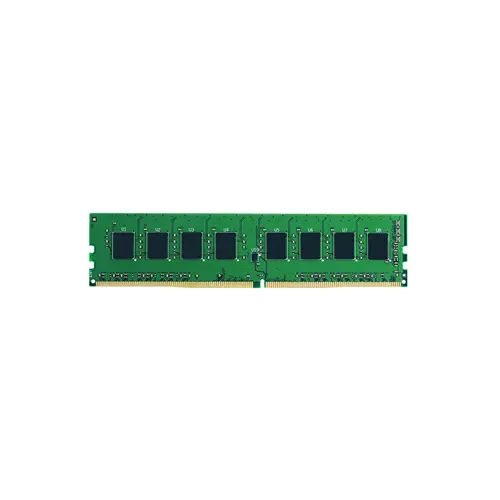
This 8GB DDR4-2666 Registered ECC RDIMM is purpose-built for server platforms, delivering critical data integrity for virtualization, in-memory databases, and enterprise workloads where reliability is non-negotiable. Its dual-rank x8 organization and registered signal topology enhance memory interleaving performance while ensuring robust signal stability in high-density deployments.
1. ECC error correction detects and repairs single-bit memory faults on the fly, preserving data integrity for financial transaction processing and long-running virtualization hosts.
2. Registered buffer reduces electrical load on the system memory controller, allowing stable high-capacity configurations that underpin large-scale private cloud and hypervisor deployments.
3. Dual Rank x8 organization leverages rank interleaving to saturate memory channels efficiently, raising request concurrency for in-memory databases and heavy consolidation ratios.
4. 2666MT/s transfer rate furnishes a modest yet predictable bandwidth ceiling, matching the steady throughput needs of multi-tenant application servers without introducing unnecessary power spikes.
5. 1.2V low operating voltage curtails per-DIMM thermal output and rack-level power budgets, directly improving total cost of ownership in hyperscale and colocation data halls.
For your virtualization cluster running a dozen mission-critical VMs, the MTA18ASF1G72PDZ-2G6B1 RDIMM is not just memory—it is your data-integrity anchor and performance stabilizer. Its ECC technology continuously detects and corrects single-bit errors caused by background radiation, effectively preventing silent data corruption that could crash a hypervisor, poison a financial transaction, or silently rot a database index. That protection is non-negotiable when you cannot afford even one undetected bit flip in an in-memory analytics workload. The Registered (RDIMM) design buffers the command/address bus, enabling a single server board to populate 12, 16, or 24 identical modules without signal degradation—so you can scale to a dense memory pool for Redis or SAP HANA without training intermittent memory errors. Dual Rank x8 organization further lifts throughput because the memory controller can interleave accesses across two internal rank planes, feeding more data per clock to a virtualized SQL Server or Cassandra node hungry for parallel I/O. At DDR4-2666 with a low 1.2 V supply, this module balances high-bandwidth delivery, thermal restraint in tightly packed data-center sleds, and the predictable latency (CL19) that keeps response times flat even under full consolidation pressure.
General Virtualization
For modest virtualization hosts running a handful of light VMs, these 8GB Registered ECC modules can be deployed in a balanced multi‑channel configuration—for example, six identical DIMMs in a dual‑socket server with six channels per socket to yield 48GB total. ECC and registered signaling directly enhance uptime and stability, which are critical in virtualized environments. For any production workload forecasted to grow beyond lightweight services, however, planning should favor 16GB or 32GB RDIMMs to avoid premature memory exhaustion.
In‑Memory Database
In‑memory databases like Redis or SAP HANA thrive on low latency and large capacity. The dual‑rank x8 design of this DIMM provides solid bandwidth through interleaving, but the 8GB per stick severely limits usable dataset size—making it suitable only for development, caching tiers, or small test instances. A production deployment should consolidate capacity by selecting 32GB or 64GB RDIMMs while keeping ranks populated for performance, and always retain ECC to guard against bit errors corrupting live data.
High‑Performance Computing
HPC workloads demand both bandwidth and fault resilience. Populate one 8GB RDIMM per memory channel to achieve maximum bandwidth in a balanced configuration, and benefit from the module’s dual‑rank structure for improved command‑interleaving efficiency. While this approach yields reliable, well‑performing nodes for lighter simulations or educational clusters, larger HPC jobs will quickly hit the capacity wall; plan for higher‑density registered DIMMs if per‑node memory footprints exceed a few dozen gigabytes.
Rigorously tested RDIMM, compatible with Dell PowerEdge R750, HPE DL380 Gen10, Lenovo SR650, and more.
Q: Can I mix this MTA18ASF1G72PDZ-2G6B1 with other memory modules of different brands or speeds?
A: Mixing is not recommended in server environments. Mismatched RDIMMs may cause signal integrity issues, ECC conflicts, or system instability. For reliable operation, use identical modules validated on the platform’s qualified vendor list.
Q: Is this memory compatible with my Intel Xeon Scalable or AMD EPYC server platform?
A: This DDR4-2666 ECC Registered RDIMM is compatible with platforms supporting 1.2V, 288-pin RDIMMs, including Intel Xeon Scalable (Gen 1/2) and AMD EPYC 7001/7002 series. Always verify against your motherboard or system QVL for specific approval.
Q: What is the recommended DIMM population order for optimal performance?
A: Follow the server board manual. Typically, populate identical DIMMs across memory channels, starting with the first slot of each channel (e.g., A1, B1, C1) to enable balanced interleaving and maximize bandwidth while preserving ECC functionality.
Q: Does this module support overclocking or XMP profiles?
A: No. As a JEDEC-compliant ECC Registered server module, it does not support overclocking or XMP profiles. It operates at the standard DDR4-2666 JEDEC specification to guarantee mission-critical stability and data integrity.
Q: What warranty and typical failure rate can I expect?
A: This module includes a one-year warranty. Server-grade ECC RDIMMs are built for high reliability with an extremely low annualized failure rate (AFR), typically <0.1% under specified operating conditions and proper cooling.