











 Secure payments
Standard refund policy
Trade Assurance
Secure payments
Standard refund policy
Trade Assurance
| Product Type | Memory Module |
|---|---|
| Memory Capacity | 8 GB |
| Memory Technology | DDR4 |
| Product Voltage | 1.2V |
| RAM Speed | 2933MHz |
| RAM Standard | DDR4-2933/PC4-23400 |
| Error Identifying | ECC |
| Signal Type | Registered |
| Column Access Strobe (CAS) | CL21 |
| Rank | Single Rank x8 |
| Quantity of Pins | 288-pin |
| RAM Genre | RDIMM |
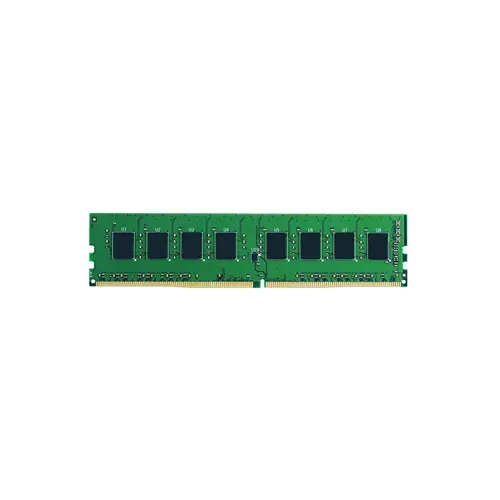
This 8GB DDR4-2933 registered ECC module (PC4-23400, CL21, single-rank x8) is engineered for server platforms, providing critical data integrity for virtualization and in-memory database workloads. Its registered signal type ensures stable operation in high-density configurations, while ECC protection corrects single-bit errors to prevent downtime in mission-critical environments.
1. ECC protection detects and corrects single-bit memory errors in real time, safeguarding financial transactions and virtual machine data integrity against silent corruption.
2. Registered signal buffering stabilizes command and address lines under fully loaded server banks, enabling dense configurations without compromising memory reliability.
3. 2933MHz transfer rate supplies consistent bandwidth headroom for concurrent database queries and hypervisor memory overcommit in multi-tenant environments.
4. Single Rank x8 architecture minimizes electrical loading per DIMM, allowing the memory controller to sustain higher frequencies across all populated channels.
5. CL21 timing delivers predictable latency under sustained server workloads, helping maintain uniform response times for latency-sensitive enterprise applications.
When your virtualization cluster hosts dozens of mission-critical VMs, an undetected bit flip in memory isn’t a theoretical risk—it’s a business continuity threat. The Micron MTA9ASF1G72PZ-2G9E1T is an 8 GB DDR4-2933 RDIMM engineered precisely for these environments, combining four defining characteristics that directly address server pain points. Its integrated ECC continuously corrects single-bit errors, preventing silent data corruption that could crash an in-memory database like Redis or SAP HANA during peak transaction loads. The registered buffer decouples the memory controller from the DRAM chips, enabling you to populate all channels with multiple DIMMs—essential for dense VMware or KVM hosts where 256 GB and beyond must remain stable 24/7 under mixed workloads. Operating at 2933 MT/s with a single-rank x8 organization, this module delivers the high bandwidth that analytics platforms and virtual desktops demand, while reducing electrical loading on the memory bus. The result is lower command latency, predictable response times, and the headroom to scale memory capacity without sacrificing signal integrity. In a financial services VM farm or a healthcare EHR cluster, that translates directly into consistent uptime, transaction accuracy, and data reliability you can trust.
This 8GB DDR4-2933 Registered ECC RDIMM is intended for servers. Below are capacity planning recommendations for typical server workloads.
General Virtualization
Balance DIMMs across memory channels for best bandwidth and interleaving. In a 2-socket server with 6 channels per CPU, install one 8GB DIMM per channel for 12 modules (96GB). This configuration supports 25–30 light VMs comfortably. Use identical modules to preserve ECC and RAS consistency.
In-Memory Database
Maximize capacity by fully loading slots while retaining ECC integrity. For example, twelve 8GB modules provide 96GB, sufficient for a moderate Redis or in-memory analytics instance. The registered design maintains signal stability at 2933MT/s even with full population; set this speed in BIOS for low-latency data access.
High-Performance Computing
Stick to one DIMM per channel (1DPC) to sustain the full 2933MT/s without speed derating. In an 8-channel platform, eight modules yield 64GB at peak bandwidth, ideal for memory-bound MPI or simulation codes. Avoid dual-DIMM-per-channel setups that drop to 2666MT/s unless capacity clearly outweighs bandwidth demands.
This rigorously tested DDR4 server memory is compatible with Dell PowerEdge R760, R750, HPE ProLiant DL380 Gen10, and more.
Q: Can I mix this MTA9ASF1G72PZ-2G9E1T with other memory modules of different brands or speeds?
A: Mixing RDIMMs from different brands or with varying speeds is not recommended. The system will downclock all modules to the slowest common speed and may compromise signal integrity, potentially leading to instability and uncorrectable errors in a server environment.
Q: Is this memory compatible with my system? I am using an Intel Xeon Scalable platform.
A: This DDR4-2933 registered ECC module is validated for Intel Xeon Scalable and AMD EPYC platforms that support 2933 MT/s RDIMMs. Please consult your server board's Qualified Vendor List (QVL) to confirm compatibility with the specific CPU and BIOS revision.
Q: What is the recommended DIMM population order for optimal performance?
A: For dual-socket servers, populate identical DIMMs in sets of 8 across all memory channels per CPU, following the board's silkscreen order (e.g., A1, B1, C1, D1, etc.). This ensures balanced interleaving and maximum memory bandwidth on each processor.
Q: Does this module support overclocking or XMP profiles?
A: No. This is an enterprise-grade RDIMM engineered to JEDEC specifications at a fixed 2933 MT/s and latency of CL21. Overclocking and XMP are not supported, as it is designed for 24/7 data integrity and reliability in server environments.
Q: What warranty and typical failure rate can I expect for this Micron module?
A: This module includes a 1-year warranty. Like most enterprise DDR4 RDIMMs, it has an annualized failure rate (AFR) well below 1% under specified operating conditions, provided proper cooling and correct installation practices are followed.