











 Secure payments
Standard refund policy
Trade Assurance
Secure payments
Standard refund policy
Trade Assurance
| Product Type | Memory Module |
|---|---|
| Memory Capacity | 8 GB |
| Memory Technology | DDR4 |
| Product Voltage | 1.2V |
| RAM Speed | 2933MHz |
| RAM Standard | DDR4-2933/PC4-23400 |
| Error Identifying | ECC |
| Signal Type | Registered |
| Column Access Strobe (CAS) | CL21 |
| Rank | Single Rank x8 |
| Quantity of Pins | 288-pin |
| RAM Genre | RDIMM |
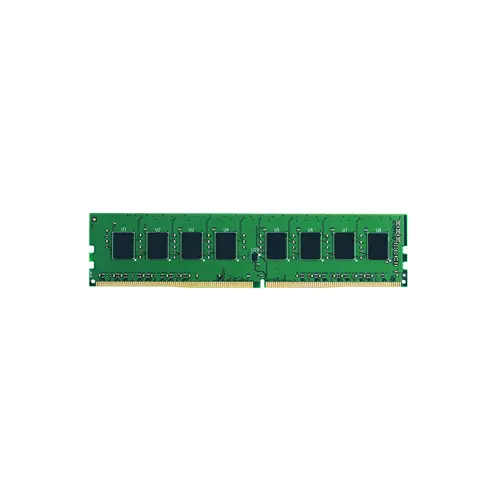
This DDR4-2933 Registered DIMM with ECC is purpose-built for entry-level server platforms handling virtualization and memory-dependent applications such as in-memory databases, where data integrity is non-negotiable. Its single-rank x8 configuration at 1.2V delivers stable 2933MT/s with CL21 latency while the registered signal buffering and ECC correction minimize electrical loading and bit errors, ensuring reliable scalability in multi-DIMM deployments.
1. ECC correction detects and corrects single-bit memory errors on the fly, preserving data integrity for mission-critical enterprise applications where even minor corruption is unacceptable.
2. Registered signal buffering stabilizes command and address lines, allowing densely populated server boards to run large memory configurations without compromising system stability.
3. The 2933 MT/s transfer rate elevates memory bandwidth, shortening query response times in virtualized databases and accelerating large-scale in-memory processing.
4. Low 1.2 V operation cuts energy consumption and thermal output per DIMM, helping hyperscale data centers reduce cooling overhead and operational power costs.
5. Single Rank x8 organization presents a lighter electrical load to the memory controller, enabling higher sustained clock rates and improved signal integrity for latency-sensitive workloads.
The Micron MTA9ASF1G72PZ-2G9E6VG is an 8GB DDR4-2933 registered ECC memory module purpose-built for enterprise servers. Its Error-Correcting Code (ECC) proactively corrects single-bit errors caused by cosmic radiation or electrical noise, which is non-negotiable in virtualization clusters where a silent data corruption can cascade across dozens of tenant VMs and bring services to a halt. The registered (RDIMM) buffer stabilizes the electrical interface, allowing you to fully populate memory channels for maximum capacity without signal degradation—a critical requirement when running memory-resident databases like SAP HANA that demand instantaneous access to large datasets. The module’s single-rank x8 configuration and 2933MT/s speed strike an ideal balance of high bandwidth and low latency, dramatically accelerating transaction throughput in financial analysis or in-memory caching systems. Operating at a low 1.2V, it also trims power draw across dense server racks, directly cutting operational expenses. For IT administrators managing always-on environments, this memory translates directly into demonstrable reliability, faster query performance, and a lower total cost of ownership.
General Virtualization
For virtualized environments, install one 8GB RDIMM per memory channel to balance access across channels. In a typical dual-socket server with six or eight channels per CPU, six to eight identical modules per processor (48–64GB) provide sufficient capacity for dozens of medium-sized VMs while maintaining full memory speed. Populate both sockets symmetrically to ensure optimal performance for NUMA-aware hypervisors.
In-Memory Database
Maximize capacity by populating all channels with two DIMMs per channel (2DPC) if the server allows, yielding up to 128GB per socket with these 8GB modules. For redundancy, use memory mirroring or lockstep modes; this reduces usable capacity but leverages ECC to protect critical data sets. Ensure all installed DIMMs are identical in rank and speed to avoid configuration issues.
High-Performance Computing (HPC)
Install one 8GB RDIMM per channel to sustain the 2933MT/s frequency, avoiding the speed drop that often occurs with 2DPC. Populate every channel identically to enable full interleaving and maximum bandwidth for simulation codes and parallel computing tasks. The single-rank x8 design and CL21 latency offer a good balance between signaling integrity and response time.
This rigorously tested server module ensures compatibility with Dell PowerEdge R760, HPE ProLiant DL380 Gen10, Lenovo ThinkSystem SR650, and more.
Q: Can I mix this MTA9ASF1G72PZ-2G9E6VG with other memory modules of different brands or speeds?
A: Mixing this Registered ECC DDR4 module with other brands or different speeds is strongly discouraged. Mismatched DIMMs can lead to system instability, memory errors, or boot failures. For reliable operation, always use identical part numbers across all channels.
Q: Is this memory compatible with my system?
A: This RDIMM is compatible with servers using Intel Xeon Scalable or AMD EPYC platforms that support DDR4-2933 Registered ECC memory. Verify with your motherboard’s qualified vendor list. Consult your server documentation for CPU-specific memory support.
Q: What is the recommended DIMM population order for optimal performance?
A: For dual-socket servers, populate identical DIMMs in balanced channel configurations, typically starting with the white slots first as per your motherboard manual. Follow the OEM’s population guidelines to maximize throughput and interleaving.
Q: Does this module support overclocking or XMP profiles?
A: No. As a Registered ECC server memory module, it strictly adheres to JEDEC DDR4-2933 specifications. It does not support overclocking, XMP, or any manual frequency tuning for stability reasons. This ensures maximum data integrity and 24/7 reliability.
Q: What warranty and typical failure rate can I expect?
A: This Micron module comes with a 1-year warranty. The annualized failure rate (AFR) is extremely low, typically below 0.1%, thanks to rigorous testing and high-quality components. Enterprise-grade memory ensures long-term reliability in demanding server environments.