











 Secure payments
Standard refund policy
Trade Assurance
Secure payments
Standard refund policy
Trade Assurance
| Product Type | Memory Module |
|---|---|
| Memory Capacity | 8 GB |
| Memory Technology | DDR4 |
| Product Voltage | 1.2V |
| RAM Speed | 2933MHz |
| RAM Standard | DDR4-2933/PC4-23400 |
| Error Identifying | ECC |
| Signal Type | Registered |
| Column Access Strobe (CAS) | CL21 |
| Rank | Single Rank x8 |
| Quantity of Pins | 288-pin |
| RAM Genre | RDIMM |
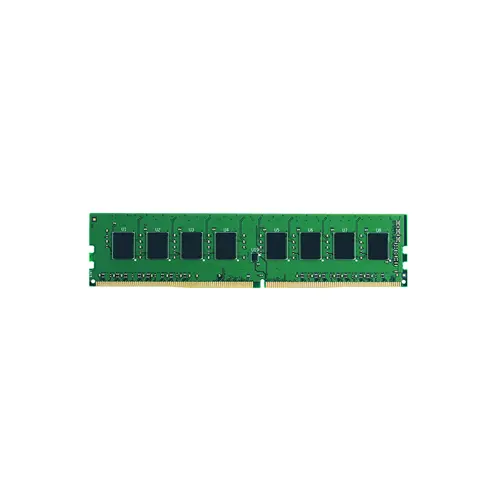
This registered DDR4-2933 RDIMM, with ECC and a single-rank x8 configuration, ensures robust data integrity and stable signal buffering for scalable server deployments. Its low 1.2V operating voltage and CL21 latency make it exceptionally well-suited for memory-intensive workloads such as virtualization and in-memory databases where reliability and consistency are critical.
1. ECC protection silently corrects single-bit errors, preserving data integrity for transactional databases and financial workloads where even a subtle memory fault is unacceptable.
2. Registered signal buffering stabilizes electrical loads across densely populated memory channels, enabling the server to scale to higher capacities without sacrificing command and address integrity.
3. 2933 MT/s throughput elevates memory bandwidth, reducing latency in virtualized environments and accelerating large dataset processing under sustained multi-tenant access.
4. Single-rank x8 organization lowers the electrical burden on the memory controller, ensuring the platform maintains its maximum frequency stability when every slot is filled to meet aggressive consolidation targets.
5. An 8 GB capacity per module offers a precise building block for rightsizing memory in lightweight container hosts or branch-office hypervisors, balancing cost efficiency with essential operational headroom.
In the data center, where uptime and accuracy are non-negotiable, the Micron MTA9ASF1G72PZ-2G9J3 RDIMM transforms how your infrastructure performs. Its four core attributes directly address the pain points of IT architects running virtualization clusters and in-memory databases.
The first is ECC error correction. When you are consolidating dozens of virtual machines on a single host, a single bit-flip caused by background radiation can silently corrupt a hypervisor or a financial transaction log. ECC detects and corrects these errors in real time, preventing random crashes that cost you hours of troubleshooting and lost revenue. Second, the Registered signal buffer might not sound exciting, but it means stability at scale. If you need to populate all 24 DIMM slots in a 2U server for a massive Redis or SAP HANA instance, unbuffered memory would strain the memory controller and cause signal degradation. The register reclaims that electrical margin, letting you run large, dense configurations reliably under 24/7 load.
The 2933 MT/s speed feeds the hungry CPU cores during high-concurrency queries, while the single-rank x8 organization reduces the electrical load and interleaving latency compared to dual-rank alternatives. For a latency-sensitive in-memory database, this translates into faster random access and more consistent transaction response times. This is not just a module on a spec sheet—it is the difference between a platform that delivers on every SLA and one that forces you to explain yet another unexpected outage.
General Virtualization
For a balanced virtualized host, populate at least six identical 8GB RDIMMs per CPU to leverage all memory channels, delivering 48GB for moderate VM density. Always install modules in matched sets according to the server’s population order to maintain optimal throughput and avoid NUMA imbalance. Scale to 12 or more DIMMs when hosting memory-intensive VMs to keep ballooning and swapping to a minimum.
In-Memory Database
Low-latency in-memory workloads demand the highest bandwidth, so install one DIMM per channel (e.g., 8x 8GB for an eight-channel platform) to maximize frequency and minimize access times. Populate all channels identically and opt for single‑rank modules like this one; they allow the memory controller to run at full 2933 MT/s with CL21 under heavy load. For larger datasets, plan a granular capacity upgrade path by adding a second equivalent kit across the remaining channels.
High‑Performance Computing (HPC)
HPC clusters benefit from per‑core bandwidth, so configure nodes with one RDIMM per channel and tune BIOS for pure throughput over capacity. The registered (buffered) design of this module enables stable signal integrity in dense multi‑DIMM setups often seen in rack‑mount HPC nodes. Use identical part numbers across the entire compute fabric to guarantee reproducible floating‑point results and straightforward lifecycle management.
Rigorously tested Micron 8GB DDR4-2933 RDIMM; validated for Dell PowerEdge R750, HPE ProLiant DL380 Gen10, and Lenovo ThinkSystem SR650.
Q: Can I mix this MTA9ASF1G72PZ-2G9J3 with other memory modules of different brands or speeds?
A: Mixing ECC Registered DIMMs of different brands or speeds is not recommended. It can cause instability or uncorrectable errors. For reliable operation, always populate servers with identical part numbers across all channels.
Q: Is this memory compatible with my server system, particularly Intel Xeon Scalable or AMD EPYC platforms?
A: Yes, this DDR4-2933 RDIMM is compatible with servers based on Intel Xeon Scalable (2nd Gen and later) and AMD EPYC 7002/7003 series, provided the motherboard explicitly supports ECC Registered DDR4-2933 memory.
Q: What is the recommended DIMM population order for optimal performance in a server?
A: For optimal performance, populate identical DIMMs across all memory channels per CPU, starting with the first slot of each channel (e.g., slots A1, B1, C1, etc.). Always follow the population guidelines in your server motherboard manual.
Q: Does this module support overclocking or XMP profiles?
A: No, this is a JEDEC-compliant server-grade ECC Registered DIMM running at 2933MHz. It does not support overclocking or Intel XMP profiles, by design ensuring maximum data integrity and 24/7 operational stability.
Q: What warranty and typical failure rate can I expect from this memory?
A: This module includes a 1-year warranty. As a server-grade RDIMM built to stringent specifications, its typical annualized failure rate (AFR) is well below 0.5% under normal operating conditions, ensuring high reliability.