











 Secure payments
Standard refund policy
Trade Assurance
Secure payments
Standard refund policy
Trade Assurance
| Product Type | Memory Module |
|---|---|
| Compliance Standards | RoHS |
| Memory Capacity | 8 GB |
| Memory Technology | DDR3 |
| Product Voltage | 1.5V |
| RAM Speed | 1333MHz |
| RAM Standard | DDR3-1333/PC3-10600 |
| Error Identifying | ECC |
| Signal Type | Registered |
| Column Access Strobe (CAS) | CL9 |
| Rank | Dual Rank x4 |
| Quantity of Pins | 240-pin |
| RAM Genre | RDIMM |
This 8GB DDR3-1333 RDIMM with ECC and registered signaling is purpose-built for entry-level servers and small-scale virtualization hosts, where data integrity and stable operation under moderate memory loads are critical. Its dual-rank x4 organization and CL9 latency deliver a balanced mix of capacity interleaving and responsiveness, making it a reliable choice for memory-resident databases or lightweight hypervisor deployments.
1. The registered signal type buffers command and address signals, enabling stable operation across densely populated server boards with multiple DIMMs per channel.
2. ECC protection detects and corrects single-bit errors in real time, preventing silent data corruption in transactional databases and long-running analytics workloads.
3. A dual rank x4 organization interleaves memory accesses for higher aggregate bandwidth, sustaining throughput when multiple virtual machines compete for I/O resources.
4. The 8 GB capacity per module hits a density sweet spot for mid‑range virtualization hosts, balancing cost‑per‑gigabyte with enough headroom for moderate consolidation ratios.
5. DDR3‑1333 speed delivers sufficient transfer rates for legacy enterprise applications, maintaining compatibility with older server platforms while keeping power budgets predictable.
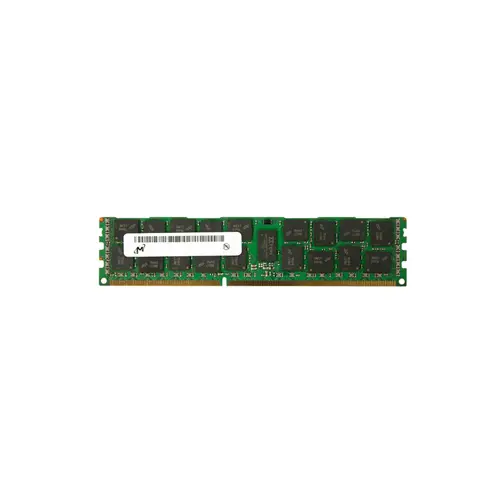
In mission-critical server environments, the MT36JSF1G72PZ-1G4M1FF Registered DDR3 DIMM is engineered to eliminate the compromises that cause downtime. ECC technology corrects single-bit errors; in a virtualized cluster, a cosmic ray bit flip can silently corrupt financial transactions or hypervisor data, turning a minor fault into a cascading failure. The Registered buffer stabilizes signal integrity across densely populated channels, allowing a VM host to support more guests without performance degradation. The dual-rank x4 architecture, running at 1333MHz, enables interleaved access to maximize bandwidth for in-memory databases like Redis or SAP HANA, where every nanosecond of latency impacts query throughput. An 8GB capacity at 1.5V provides the density to keep critical datasets resident, preventing costly disk swaps under peak loads. For database servers and large-scale virtualization farms, this memory delivers data integrity, uninterrupted uptime, and consistently low-latency performance.
General Virtualization
For a DDR3-1333 ECC Registered DIMM platform, aim for balanced density and redundancy. Install identical 8 GB RDIMMs across all memory channels—typically six or twelve modules per CPU for triple-channel architectures—to maximize bandwidth and support mixed workloads. Capacity planning should target 64–192 GB per host, leaving headroom for failover and future virtual machine growth while ensuring memory is not the bottleneck.
In-Memory Database
Low latency and data integrity are critical; populate all memory channels symmetrically with 8 GB RDIMMs to deliver uniform performance. Aim for 128 GB or more per server, configuring the DIMMs in the highest supported speed without mixing ranks per channel, to keep entire datasets in RAM and minimize swap reliance.
High-Performance Computing
HPC jobs demand both bandwidth and capacity. Use a fully balanced configuration—fill all available slots with identical 8 GB dual-rank RDIMMs to sustain the rated 1333 MT/s across all channels. Capacity targets typically range from 96 GB to 384 GB per node, matching per-core memory requirements of MPI tasks and avoiding disk I/O penalties.
Strictly tested server RAM, compatible with Dell PowerEdge R620/R720, HP ProLiant DL380p Gen8, Lenovo ThinkServer RD430.
Q: Can I mix this MT36JSF1G72PZ-1G4M1FF with other memory modules of different brands or speeds?
A: Mixing with other DDR3 Registered ECC modules is possible but not recommended. The system will clock down to the slowest module, and mismatched brands may cause subtle compatibility issues.
Q: Is this memory compatible with my system?
A: This 8GB DDR3-1333 Registered ECC RDIMM is compatible with servers using Intel Xeon 5500/5600 series or AMD Opteron 6100 series platforms. Please verify your motherboard's qualified vendor list.
Q: What is the recommended DIMM population order for optimal performance?
A: For dual-socket servers, populate identical DIMMs per channel starting with the slots furthest from the CPU. Follow the platform’s memory population guide for balanced interleaving.
Q: Does this module support overclocking or XMP profiles?
A: No. This is a server-grade Registered ECC module strictly adhering to JEDEC DDR3-1333 standards. Overclocking and XMP are not supported and would compromise data integrity.
Q: What warranty and typical failure rate can I expect?
A: This module includes a one-year warranty. Its failure rate is extremely low under proper enterprise conditions, meeting stringent server reliability standards.