











 Secure payments
Standard refund policy
Trade Assurance
Secure payments
Standard refund policy
Trade Assurance
| Product Type | Memory Module |
|---|---|
| Compliance Standards | RoHS |
| Memory Capacity | 8 GB |
| Memory Technology | DDR3 |
| Product Voltage | 1.35V |
| RAM Speed | 1333MHz |
| RAM Standard | DDR3-1333/PC3-10600 |
| Error Identifying | ECC |
| Signal Type | Registered |
| Column Access Strobe (CAS) | CL9 |
| Rank | Dual Rank x4 |
| Quantity of Pins | 240-pin |
| RAM Genre | RDIMM |
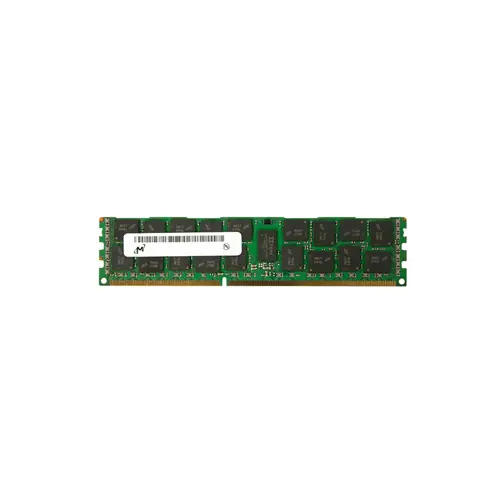
This is a server-grade DDR3 RDIMM specifically designed for enterprise platforms running memory-intensive workloads like virtualization and in-memory databases. Its registered ECC architecture with a dual-rank x4 organization ensures robust data integrity and signal stability in high-density deployments, while the low 1.35V operating voltage improves energy efficiency at a 1333MHz CL9 latency.
1. ECC error correction detects and corrects single-bit memory errors in real time, preventing silent data corruption during long-running database transactions and financial calculations.
2. Registered signal buffering stabilizes the command and address buses across fully populated server boards, enabling reliable operation even with high-density memory configurations.
3. Dual Rank x4 organization allows interleaved access across internal banks, sustaining higher bandwidth saturation under heavy multi-tenant virtualization loads.
4. 1.35V low-voltage operation reduces per-DIMM power draw, which lowers thermal stress and data center cooling demands when scaling to rack-level deployments.
5. Eight-gigabyte module capacity expands total memory footprint efficiently, giving IT administrators headroom to run more virtual machines without replacing existing hardware.
The MT36KSF1G72PZ-1G4M1HI is a server-grade 8GB DDR3-1333 RDIMM packing four pivotal features that directly solve real-world enterprise pains. First, ECC error correction silently fixes single-bit flips caused by cosmic radiation—critical in virtualization clusters where a flipped bit can corrupt a virtual disk or crash a production VM without warning. Second, the Registered buffer stabilizes address and command signals, letting you populate all DIMM slots for massive memory capacity; this prevents the signal collapse that plagues unbuffered modules in large database servers. Third, the Dual Rank x4 configuration interleaves memory banks to increase bandwidth and reduce latency, a tangible acceleration for in-memory databases like Redis or SAP HANA processing millions of transactions. Finally, operating at just 1.35V instead of 1.5V lowers thermal output and power draw across a rack, shrinking your cooling bill and extending hardware lifespan. These four characteristics turn a spec into a bedrock of uptime and performance.
This memory module is a DDR3-1333 Registered ECC RDIMM (1.35V), purpose‑built for server platforms. Capacity planning must leverage its ECC and registered signaling for data integrity and stable multi‑channel operation.
General Virtualization
Populate at least one identical 8 GB module per memory channel to maintain full interleaving and bandwidth. On a typical dual‑socket server with four channels per CPU, install eight modules (64 GB total) to balance virtual machine density, performance, and cost. This uniform configuration guarantees ECC protection across all resident workloads.
In‑Memory Database
Maximize capacity by filling every DIMM slot. With three modules per channel, a dual‑processor system can reach 96 GB using twelve 8 GB RDIMMs, allowing large datasets to stay entirely in RAM. Keep all modules identical to prevent timing mismatches and preserve registered clock synchronization under heavy load.
High‑Performance Computing
Use a single module per channel to sustain the full 1333 MHz clock speed without throttling. An eight‑module (64 GB) layout across two sockets delivers the highest sustained memory bandwidth for parallel compute tasks. The dual‑rank x4 organization further exploits bank‑level parallelism, raising effective throughput in HPC workflows.
Tested and proven server memory for Dell PowerEdge R720, HP ProLiant DL380p Gen8, IBM System x3650 M4, and more.
Q: Can I mix this MT36KSF1G72PZ-1G4M1HI with other memory modules of different brands or speeds?
A: Mixing brands or speeds is not recommended. This is an ECC Registered DIMM; mismatched modules can cause signal integrity issues, timing conflicts, and system instability in servers. Always use identical part numbers.
Q: Is this memory compatible with my system?
A: It is compatible with dual-processor or single-processor servers using Intel Xeon E5-2400/2600 v1/v2 series or AMD Opteron 6300 platforms that support DDR3-1333 Registered ECC memory. Please verify your motherboard's qualified vendor list.
Q: What is the recommended DIMM population order for optimal performance?
A: Follow your server board manual. Generally, populate identical DIMMs per channel, starting with the slots farthest from the CPU. Balanced configuration across all memory channels ensures maximum bandwidth and interleaving.
Q: Does this module support overclocking or XMP profiles?
A: No. This is a JEDEC-compliant DDR3-1333 Registered ECC module, designed for enterprise stability. It runs at fixed timings (CL9) and voltage (1.35V) without XMP or overclocking support.
Q: What warranty and typical failure rate can I expect?
A: This module includes a one-year warranty. As enterprise-grade Micron RDIMM, it has an extremely low annualized failure rate (AFR) under 0.5%, ensuring high reliability for critical workloads.