











 Secure payments
Standard refund policy
Trade Assurance
Secure payments
Standard refund policy
Trade Assurance
| Product Type | Memory Module |
|---|---|
| Memory Capacity | 8 GB |
| Memory Technology | DDR3 |
| Product Voltage | 1.35V |
| RAM Speed | 1333MHz |
| RAM Standard | DDR3-1333/PC3-10600 |
| Error Identifying | ECC |
| Signal Type | Registered |
| Column Access Strobe (CAS) | CL9 |
| Rank | Dual Rank x4 |
| Quantity of Pins | 240-pin |
| RAM Genre | RDIMM |
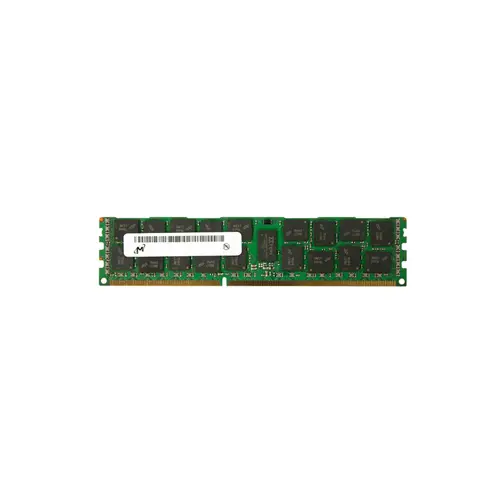
This DDR3-1333 Registered ECC memory module is engineered for server platforms handling virtualization, in-memory databases, and other mission-critical workloads where data integrity is non-negotiable. Its 1.35V low-voltage operation reduces thermal and power overhead, while the Dual Rank x4 organization with ECC ensures robust signal integrity and end-to-end error correction under heavy, sustained memory loads.
1. Error correction code detects and corrects single-bit memory faults, ensuring uninterrupted data accuracy for transactional databases and long-running analytics.
2. Registered buffering decouples the command and address bus from electrical loads, allowing stable high-capacity configurations in multi-socket virtualized servers.
3. Dual-rank population amplifies bank interleaving, sustaining consistent bandwidth under heavy mixed-workload contention across multiple tenants.
4. This per-module capacity hits the ideal memory-to-core ratio for lightweight containerized workloads, maximizing instance density without overspending on power.
5. Low-voltage operation trims per-DIMM energy draw and waste heat, directly improving rack-level power usage effectiveness in always-on data centers.
The MT36KSF1G72PZ-1G4M1 is an 8GB DDR3-1333 RDIMM engineered for server workloads where downtime is not an option. Its four defining characteristics directly address the pain points of data centers and enterprise IT. First, ECC technology acts as a silent guardian against silent data corruption caused by cosmic ray-induced bit flips; in a virtualized cluster hosting dozens of VMs, a single uncorrected error can crash multiple services, but ECC ensures data integrity end-to-end. Second, the registered (buffered) architecture stabilizes signal integrity when populating multiple DIMMs per channel, a necessity for memory-hungry hypervisors that demand huge, reliable footprints. Third, the dual-rank x4 organization leverages rank interleaving to boost sustained bandwidth—critical for in-memory databases like Redis or SAP HANA where microsecond latency spikes directly degrade query performance. Finally, the low 1.35V operating voltage dramatically reduces power consumption and thermal load in dense server racks, shrinking OpEx while preserving reliability.
General Virtualization
This 8GB DDR3-1333 Registered ECC DIMM is ideal for entry-level virtualization hosts running light to moderate VM loads. For a typical hypervisor hosting five to eight low-resource VMs, deploying four to six identical modules ensures dual- or triple-channel operation while maintaining a healthy memory buffer for ballooning and failover. Always populate in matched sets aligned with the server's memory channel count to avoid performance penalties.
In-Memory Database
In-memory databases demand raw capacity and data integrity, making ECC RDIMMs non-negotiable. A single 8GB stick serves as a building block; populate all available channels with identical modules, targeting a minimum of 64GB for development instances and 128GB or more for production. Dual-rank x4 configurations like this one improve bank-level parallelism, boosting transaction throughput under high concurrency.
High-Performance Computing (HPC)
HPC workloads prize memory bandwidth and stability over sheer capacity per core. Install these modules in fully balanced, per-channel configurations — typically one DIMM per channel — to maximize speed and maintain signal integrity. For dual-socket nodes, a six- or eight-module setup delivers strong bandwidth for medium-scale simulations, while ECC protection guards against silent data corruption during multi-day compute runs.
Rigorously tested DDR3 RDIMM; compatible with Dell R720, R620, HP DL380p Gen8, and more.
Q: Can I mix this MT36KSF1G72PZ-1G4M1 with other memory modules of different brands or speeds?
A: Mixing is not recommended for server environments. Registered DIMMs require matched ranks, timings, and voltage to ensure signal integrity. Different specs may force the system to fall back to the lowest common speed or cause instability.
Q: Is this memory compatible with my system?
A: This DDR3-1333 PC3-10600 ECC Registered DIMM is designed for servers using Intel Xeon 5500/5600 series or AMD Opteron 4100/4200 platforms. Verify your board supports 1.35V 8GB 2Rx4 RDIMMs.
Q: What is the recommended DIMM population order for optimal performance?
A: Follow the server motherboard manual to populate channels symmetrically. Typically, install identical DIMMs starting with the first slot of each memory channel to enable interleaving and maximize throughput.
Q: Does this module support overclocking or XMP profiles?
A: No. This is an enterprise-grade ECC Registered DIMM built for 24/7 stability, not overclocking. It operates at standard JEDEC specs only and does not include XMP profiles.
Q: What warranty and typical failure rate can I expect?
A: This Micron module comes with a 1-year warranty. Enterprise memory features very low failure rates in validated systems, typically well under 0.5% annually during its rated lifespan under normal operating conditions.