











 Secure payments
Standard refund policy
Trade Assurance
Secure payments
Standard refund policy
Trade Assurance
| Model | MT18KSF1G72AZ-1G4D1 |
|---|---|
| Product Type | Memory Module |
| Compliance Standards | RoHS |
| Memory Capacity | 8 GB |
| Memory Technology | DDR3 |
| Product Voltage | 1.35V |
| RAM Speed | 1333MHz |
| RAM Standard | DDR3-1333/PC3-10600 |
| Error Identifying | ECC |
| Signal Type | Unbuffered |
| Column Access Strobe (CAS) | CL9 |
| Rank | Dual Rank x8 |
| Quantity of Pins | 240-pin |
| RAM Genre | UDIMM |
This Micron DDR3-1333 UDIMM with ECC is ideally suited for entry-level servers and workstations running memory-intensive workloads such as virtualization and small-scale databases, where its dual-rank x8 configuration enhances interleaving for improved bandwidth and its unbuffered architecture ensures low latency. The 1.35V low-voltage operation reduces power consumption while Error Correcting Code (ECC) delivers critical data integrity, and the CAS 9 latency keeps response times tight under sustained load.
1. ECC protection silently corrects single-bit errors, preserving data integrity in always-on server environments where memory faults can corrupt financial or medical records.
2. Unbuffered architecture trims access latency, benefiting lightweight virtualization hosts that need deterministic response times without the cost of registered memory.
3. Low-voltage operation reduces power draw per DIMM, directly lowering electricity and cooling expenses in dense rack deployments running round the clock.
4. Dual-rank x8 organization keeps rank interleaving active, sustaining memory bandwidth when multiple virtual machines compete for the data bus.
5. 1333 MHz speed provides a balanced bandwidth envelope for file serving and collaboration workloads, keeping concurrent user requests flowing smoothly.
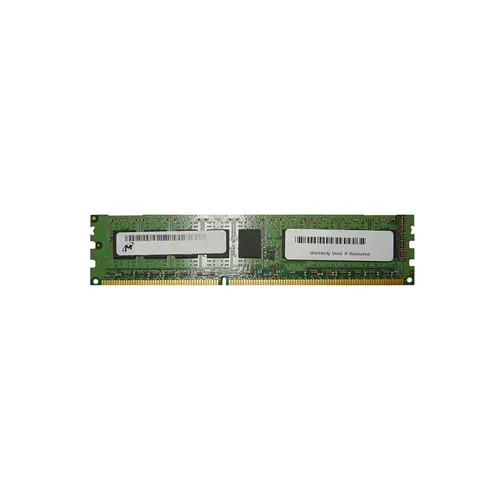
The MT18KSF1G72AZ-1G4D1 is an 8 GB DDR3-1333 ECC UDIMM, a server‑grade memory module built for single‑socket servers, NAS systems, and entry‑level workstations where data integrity and power efficiency are non‑negotiable. Its ECC capability means every bit is protected against random single‑bit flips caused by cosmic radiation or electrical noise — errors that silently corrupt financial calculations, hypervisor states, or a ZFS checksum tree. In a 24/7 virtualisation cluster, a single undetected memory error can crash a hypervisor and take down a dozen guest VMs, directly translating into revenue loss. Here, ECC turns an invisible threat into a handled exception. The 1.35 V low‑voltage design drives down thermal load and operating cost in dense micro‑server farms, while the dual‑rank x8 organisation interleaves two internal ranks to sustain high command‑to‑data throughput under queued workloads. For an in‑memory database like Redis or a write‑intensive log server, dual rank reduces memory controller stall cycles, delivering measurably faster response times under concurrent access. Because it is unbuffered, latency stays minimal — exactly what a latency‑sensitive mail server or a small‑scale VMware Essentials host demands. This module closes the gap between true server RDIMMs and desktop memory: you gain professional error correction and energy savings without the cost and power overhead of registered logic, keeping your always‑on services safe, efficient, and affordable.
Server Memory – DDR3 ECC Unbuffered DIMM (8GB, 1333MHz, 1.35V)
General Virtualization
This 8GB UDIMM with ECC is ideal for lightweight hypervisors (e.g., VMware ESXi on single-socket Xeon E3 systems). Populate all four DIMM slots identically to reach 32GB, enabling 10–15 low-resource VMs while ECC prevents silent data corruption.
In-Memory Database
For Redis or Memcached clusters, maximize capacity by installing dual-rank x8 modules in every available channel, aiming for 64–128GB. ECC is mandatory here to protect in-flight transactional data against single-bit errors that could corrupt the dataset.
High-Performance Computing
Configure symmetric 4-module 32GB setups with matched Dual Rank DIMMs to leverage interleaving and bandwidth. The low 1.35V operation reduces thermal load in dense compute nodes, improving stability during memory-intensive MPI and OpenMP parallel workloads.
This rigorously tested server memory is compatible with Dell PowerEdge R210 II, T110 II, HP ProLiant ML310e Gen8, and more.
Q: Can I mix this MT18KSF1G72AZ-1G4D1 with other memory modules of different brands or speeds?
A: Mixing is not recommended for server environments. Different brands, speeds, or ranks may cause instability or ECC errors. For guaranteed reliability, install identical 8GB DDR3L ECC UDIMMs throughout the system.
Q: Is this memory compatible with my Intel or AMD server platform?
A: It is compatible with server/workstation boards supporting DDR3L ECC Unbuffered DIMMs, such as Intel Xeon E3 v2/v3 series or select AMD Opteron 3000 platforms. Verify your board accepts 1.35V 240-pin ECC UDIMMs.
Q: What is the recommended DIMM population order for optimal performance?
A: Follow your server motherboard manual. Typically, populate identical ECC UDIMMs in blue or first-channel slots per CPU to enable dual-channel mode and balanced memory interleaving. Do not leave empty slots between populated channels.
Q: Does this module support overclocking or XMP profiles?
A: No. This is a JEDEC-standard DDR3L ECC UDIMM running at 1333MHz CL9. It does not include XMP profiles and is not designed for overclocking; stability and data integrity are prioritized over frequency manipulation.
Q: What warranty and typical failure rate can I expect?
A: This module is backed by a one-year limited warranty. MT-brand server UDIMMs exhibit a very low annualized failure rate (AFR) under proper thermal conditions, typically below 0.5% in controlled data center environments.