











 Secure payments
Standard refund policy
Trade Assurance
Secure payments
Standard refund policy
Trade Assurance
| Product Type | Memory Module |
|---|---|
| Memory Capacity | 8 GB |
| Memory Technology | DDR3 |
| Product Voltage | 1.5V |
| RAM Speed | 1333MHz |
| RAM Standard | DDR3-1333/PC3-10600 |
| Error Identifying | ECC |
| Signal Type | Registered |
| Column Access Strobe (CAS) | CL9 |
| Rank | Dual Rank x4 |
| Quantity of Pins | 240-pin |
| RAM Genre | RDIMM |
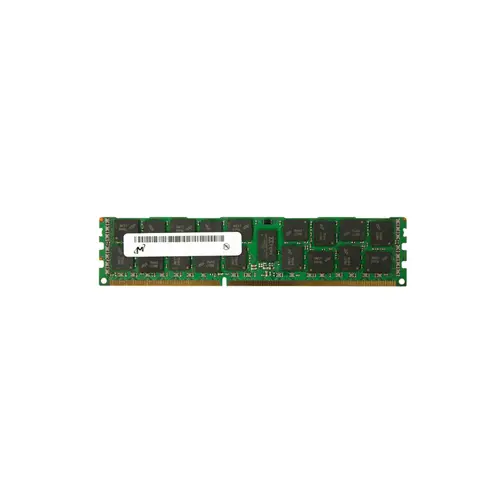
This 8GB DDR3-1333 RDIMM with ECC and registered signal technology is purpose-built for server environments, delivering critical data integrity for virtualization platforms and in-memory databases. Its dual-rank x4 organization optimizes memory bank interleaving to reduce latency, while CL9 timing and registered buffering ensure stable operation under sustained, heavy workloads.
1. ECC memory corrects single-bit errors and detects multi-bit faults, safeguarding mission-critical database transactions from silent data corruption in always-on server environments.
2. Registered buffering offloads the memory controller, enabling large server memory footprints with heightened signal integrity for 24/7 virtualized workloads.
3. Dual Rank x4 design boosts bank-level parallelism, keeping memory channels fully utilized to maintain virtual machine responsiveness during consolidation spikes.
4. A substantial 8GB module density maximizes memory slots in rack servers, raising the total RAM ceiling for dense cloud hosting and large in-memory caches.
5. The 1333 MT/s data rate delivers cost-effective bandwidth for balanced compute and storage workloads, ideal for hyper-converged infrastructure nodes.
The Micron MT36JSZF1G72PZ-1G4DZBB is an 8GB DDR3-1333 RDIMM purpose-built for server environments where data integrity and uptime are non-negotiable. Its ECC technology corrects single-bit errors on the fly, a capability that becomes critical inside in-memory databases like SAP HANA or Redis. Without ECC, a cosmic-ray-induced bit-flip could silently corrupt a financial transaction or crash a live pricing engine, translating directly into lost revenue. The registered signal architecture buffers command and address lines, dramatically stabilizing the memory bus. This means you can fully populate every slot of a VMware ESXi virtualization host without signal degradation, so dozens of virtual machines run reliably during peak loads instead of suffering unexplained hangs. Complementing this, the dual-rank x4 organization interleaves data across multiple banks, reducing latency when your database server handles thousands of concurrent queries. Combined with CL9 timing, the module delivers balanced, predictable responsiveness. For your data center, this translates to uncompromising data accuracy, maximum capacity scalability, and continuous, error-free operation for the services that keep your business alive.
General Virtualization
For general virtualization hosts, Registered ECC DDR3-1333 modules provide the reliability required for multi-tenant environments. While 8 GB is a modest per-module capacity, populate at least 6 to 12 identical RDIMMs to achieve 48–96 GB, enabling smooth operation of dozens of lightweight VMs. Distribute modules evenly across all memory channels to maximize interleaved bandwidth and avoid NUMA imbalances.
In-Memory Database
In-memory databases demand data integrity and consistently low latency, making ECC Registered memory essential. A single 8 GB RDIMM is insufficient for production datasets; instead, fully populate all memory channels with matching dual-rank x4 modules—often 16 or 24 pieces—to reach 128–192 GB. This configuration eliminates channel contention and ensures the entire dataset fits in fault-tolerant memory for sub-millisecond access.
High-Performance Computing (HPC)
HPC workloads benefit from the wide memory buses of multi-channel servers, so install identical 8 GB RDIMMs in fully balanced groups per socket. Typical nodes use 12 or 24 modules for 96–192 GB, sustaining high throughput on double-precision simulations. The Registered ECC design maintains signal integrity at scale, while uniform dual-rank DIMMs keep memory access times predictable under sustained floating-point workloads.
Rigorously tested DDR3 server memory; compatible with Dell PowerEdge R720, HP DL380p Gen8, IBM x3650 M4.
Q: Can I mix this MT36JSZF1G72PZ-1G4DZBB with other memory modules of different brands or speeds?
A: Mixing RDIMMs of different brands or speeds is not recommended. The server will clock all modules down to the slowest speed, and subtle timing differences may cause instability, especially with ECC Registered memory in mission‑critical environments.
Q: Is this memory compatible with my Intel Xeon E5 series server?
A: This DDR3-1333 ECC Registered DIMM is compatible with Intel Xeon E5 platforms using the C600 chipset. Please verify that your board supports 1.5V RDIMMs and consult the qualified vendor list for your specific server model.
Q: What is the recommended DIMM population order for optimal performance?
A: Populate identical DIMMs in sets of three per memory channel to enable triple-channel mode. Refer to your server board’s manual for slot numbering, typically filling blue slots first to balance loads across memory controllers.
Q: Does this module support overclocking or XMP profiles?
A: No. As a registered ECC server memory module, it adheres strictly to JEDEC DDR3-1333 specifications. Overclocking and XMP are not supported and would undermine the data integrity features required for enterprise workloads.
Q: What warranty and typical failure rate can I expect?
A: This module is covered by a one-year warranty. Enterprise‑grade RDIMMs typically exhibit an annualized failure rate well below 0.5% under normal operating conditions when properly cooled and not overclocked.