











 Secure payments
Standard refund policy
Trade Assurance
Secure payments
Standard refund policy
Trade Assurance
| Product Type | Memory Module |
|---|---|
| Compliance Standards | RoHS |
| Memory Capacity | 8 GB |
| Memory Technology | DDR3 |
| Product Voltage | 1.35V |
| RAM Speed | 1333MHz |
| RAM Standard | DDR3-1333/PC3-10600 |
| Error Identifying | ECC |
| Signal Type | Registered |
| Column Access Strobe (CAS) | CL9 |
| Rank | Dual Rank x4 |
| Quantity of Pins | 240-pin |
| RAM Genre | RDIMM |
This DDR3-1333 registered ECC memory module, operating at a low 1.35V, is engineered for server platforms requiring uncompromising data integrity in virtualized environments and memory-intensive databases. The dual-rank x4 organization combined with registered signaling provides superior signal stability and increased capacity per channel, while ECC error correction proactively safeguards against single-bit data corruption in mission-critical workloads.
1. ECC protection detects and corrects single-bit errors in real time, safeguarding transactional data integrity essential for financial databases and mission-critical enterprise workloads.
2. Registered signal type buffers command and address lines, enabling large memory populations across multiple DIMMs per channel without compromising signal stability in dense rack servers.
3. Dual Rank x4 organization interleaves memory accesses to keep server memory channels fully saturated, reducing latency under heavy virtualization and multi-tenant workloads.
4. 8 GB capacity per module provides ample headroom for virtual machine density, allowing more simultaneous instances without immediate need for costly hardware scale-out.
5. 1333 MHz speed delivers consistent bandwidth suited to balanced enterprise applications, sustaining reliable throughput for content delivery and mid-tier database operations.
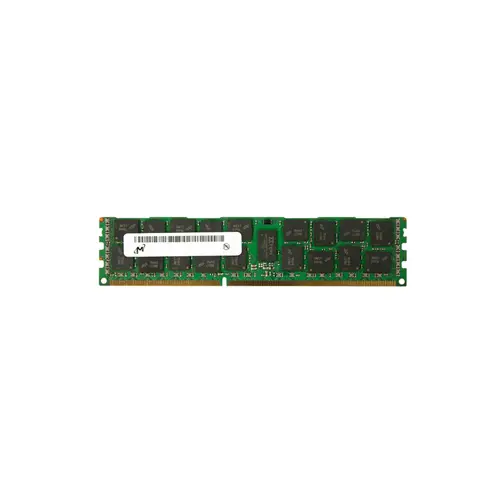
The Micron MT36KSF1G72PZ-1G4D1A is an 8GB DDR3L RDIMM purpose-built for server environments. Four critical features define its real-world importance. ECC actively detects and corrects bit errors, preventing silent data corruption that could crash your virtual machine farm or corrupt a financial database log. Registered buffering stabilizes signal integrity across fully populated memory channels; it lets you confidently deploy 24 DIMMs in a dual-socket VMware host, ensuring predictable performance for all guest VMs. The Dual Rank x4 design employs rank interleaving to boost effective bandwidth, which is vital for in-memory databases like Redis or SAP HANA handling thousands of concurrent transactions—lower latency directly fuels faster insights. Finally, the 1.35V low-voltage operation cuts memory power consumption by approximately 20%, shrinking your data center electricity and cooling costs while reducing thermal stress for greater long-term reliability. Every watt and every bit matters in 24/7 operations.
General Virtualization
For general virtualization hosts, configure memory channels symmetrically to maximize bandwidth and NUMA efficiency. Start with a minimum of four 8 GB RDIMMs (32 GB total) per populated CPU socket—one per channel in a typical quad‑channel platform—to handle a moderate density of VMs. The 1.35 V low‑voltage operation helps reduce power and cooling costs in always‑on servers, while registered ECC ensures data integrity for multi‑tenant workloads.
In‑Memory Database
In‑memory databases demand the largest possible capacity with reliable latency. Populate all available DIMM slots with these 8 GB dual‑rank RDIMMs to reach hundreds of gigabytes; dual‑rank x4 modules offer a balanced mix of capacity and signal integrity under heavy load. Fill every memory channel identically to prevent performance imbalances, and use matched kits to guarantee stable, error‑free operation for critical transactional data.
High‑Performance Computing
HPC clusters require high sustained bandwidth and fault resilience. Install one 8 GB registered DIMM per channel across all CPU sockets—typically eight modules in a dual‑socket, four‑channel system—to achieve full channel interleaving and peak throughput. The ECC and registered design stabilize large‑scale simulations over long runs, while the PC3‑10600 speed and CL9 timing provide deterministic, low‑latency data access for compute‑bound applications.
Rigorously tested server memory, compatible with Dell PowerEdge R720, HP ProLiant DL380p Gen8, Lenovo ThinkServer RD430, and similar platforms.
Q: Can I mix this MT36KSF1G72PZ-1G4D1A with other memory modules of different brands or speeds?
A: Mixing is not recommended. This registered ECC RDIMM must be paired with identical modules. Different brands, speeds, or ranks can cause signal integrity issues and system instability in servers.
Q: Is this memory compatible with my system?
A: This DDR3-1333 registered ECC module is designed for Intel Xeon E5-2400/E5-2600 v1/v2 and AMD Opteron 6300/4300 series platforms. Verify your server board supports 1.35V low-voltage RDIMMs with 8GB capacity.
Q: What is the recommended DIMM population order for optimal performance?
A: Populate identical modules per channel starting with the slot furthest from the processor. Follow your server motherboard's guide for balanced memory configurations across all memory channels to maintain optimal bandwidth and reliability.
Q: Does this module support overclocking or XMP profiles?
A: No, server registered memory strictly adheres to JEDEC standards for stability. Overclocking and XMP profiles are not supported, ensuring 24/7 reliable operation at rated 1333MHz CL9 with ECC.
Q: What warranty and typical failure rate can I expect?
A: This module comes with a one-year warranty. Typical annualized failure rate for enterprise-class registered memory is below 0.5%, backed by rigorous manufacturing testing. Advance replacement is provided for verified defects.