











 Secure payments
Standard refund policy
Trade Assurance
Secure payments
Standard refund policy
Trade Assurance
| Product Type | Memory Module |
|---|---|
| Compliance Standards | RoHS |
| Memory Capacity | 8 GB |
| Memory Technology | DDR3 |
| Product Voltage | 1.5V |
| RAM Speed | 1333MHz |
| RAM Standard | DDR3-1333/PC3-10600 |
| Error Identifying | ECC |
| Signal Type | Registered |
| Column Access Strobe (CAS) | CL9 |
| Rank | Dual Rank x4 |
| Quantity of Pins | 240-pin |
| RAM Genre | RDIMM |
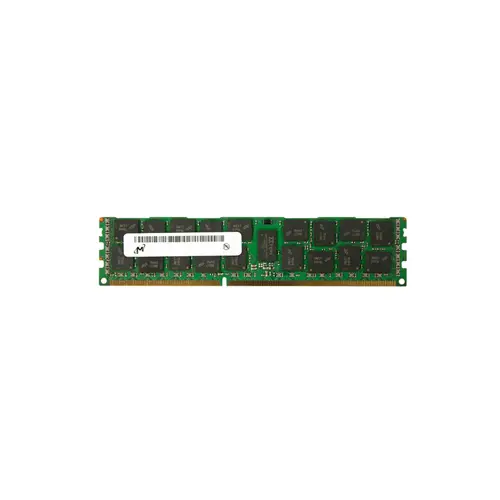
This 8GB DDR3-1333 RDIMM with ECC and registered buffering is purpose-built for legacy servers and workstations running memory-intensive workloads such as virtualization and in-memory databases. Its dual-rank x4 organization and CL9 latency optimize interleaving and bandwidth efficiency, while the registered signal architecture stabilizes multi-DIMM configurations and the ECC ensures end-to-end data integrity for mission-critical operations.
1. ECC memory detects and corrects single-bit errors silently, safeguarding data integrity for critical database transactions and long-duration scientific computations.
2. Registered signal type buffers command and address lines, enabling large-scale memory configurations with unwavering electrical stability across heavily populated server racks.
3. Dual Rank x4 organization amplifies bank-level parallelism, feeding multi-core server CPUs efficiently to sustain high throughput under intense virtualization workloads.
4. An 8 GB capacity per module provides ample headroom for expanding memory footprints, letting a typical dual-socket server host dozens of additional virtual machines without hitting performance-sapping swap limits.
5. The 1333 MHz clock speed translates to over ten gigabytes per second of bandwidth per channel, sharply reducing response times for in-memory caching and heavily concurrent user requests.
This server-grade 8GB DDR3-1333 RDIMM (MT36JSF1G72PZ-1G4D1A) combines ECC, registered buffering, dual-rank x4 design, and CL9 latency. In virtualized clusters, ECC quietly corrects single-bit errors caused by background radiation, shielding your VMs from silent data corruption that leads to unexpected crashes or transactional inaccuracies. Registered buffering maintains signal integrity across fully populated channels, letting you install dozens of DIMMs without sacrificing stability — essential for dense virtualization hosts. The dual-rank x4 architecture boosts bandwidth through bank interleaving; when multiple guest machines hit memory simultaneously, this ensures SQL query responses remain snappy under load. For in-memory databases like Redis or SAP HANA, the 1333MHz speed with CL9 delivers fast, deterministic data retrieval, while ECC preserves transaction fidelity. Each feature works together to deliver unwavering resilience, removing the hidden risk of bit flips and memory bottlenecks from your mission-critical operations.
General Virtualization
For light to moderate virtualization hosts, populate all memory channels symmetrically to maximize bandwidth. With 8 GB RDIMMs, a three-channel configuration (3 modules, 24 GB) or dual-socket six-channel setup (6 modules, 48 GB) suits small-scale VM farms. Prioritize identical DIMMs on each channel to maintain balanced ECC performance and avoid NUMA penalties.
In-Memory Database
In-memory databases demand both capacity and fault resilience, making ECC Registered DIMMs essential. Deploy at least six 8 GB modules per socket for 48 GB, enabling sizeable datasets to reside fully in RAM. Scale to 12 or 18 modules (96–144 GB) on dual‑socket boards to handle larger working sets, ensuring all channels are populated identically to sustain low latency under high transaction loads.
High-Performance Computing (HPC)
HPC workloads depend on memory bandwidth more than sheer capacity. Install three or four 8 GB RDIMMs per socket to fully utilize triple‑ or quad‑channel architectures, delivering 24–32 GB per node. Combine modules of the same rank and speed across channels to prevent clock‑downs; this configuration provides consistent 10.6 GB/s per channel while ECC safeguards long-running simulation integrity.
Rigorously tested RDIMM; compatible with Dell PowerEdge R710/R720, HP DL380p Gen8, IBM x3650 M4.
Q: Can I mix this MT36JSF1G72PZ-1G4D1A with other memory modules of different brands or speeds?
A: Mixing this Registered ECC RDIMM with modules of different brands, speeds, or ranks is not recommended. It may cause signal integrity issues, system instability, or prevent the server from booting. Always install identical matched kits for validated reliability.
Q: Is this memory compatible with my system?
A: This is a 240-pin DDR3-1333 Registered ECC RDIMM. It requires a server motherboard with a compatible chipset, typically supporting Intel Xeon 5500/5600 series or AMD Opteron 6100 series platforms. Verify your board supports 1.5V registered memory.
Q: What is the recommended DIMM population order for optimal performance?
A: Always follow your server motherboard manual for the specific population sequence. Generally, populate identical DIMMs per channel starting with the farthest slot (often blue or white levers first) to balance memory interleaving and maintain optimal performance.
Q: Does this module support overclocking or XMP profiles?
A: No. This is a server-grade Registered ECC RDIMM designed strictly for JEDEC DDR3-1333 CL9 specifications. It does not support XMP profiles or overclocking. Mission-critical environments demand stable, standard-speed operation without deviation.
Q: What warranty and typical failure rate can I expect?
A: This module includes a one-year warranty. Enterprise-class RDIMMs like this Micron part are built for high reliability, with a typical annualized failure rate (AFR) well below 0.5% under specified operating conditions.