











 Secure payments
Standard refund policy
Trade Assurance
Secure payments
Standard refund policy
Trade Assurance
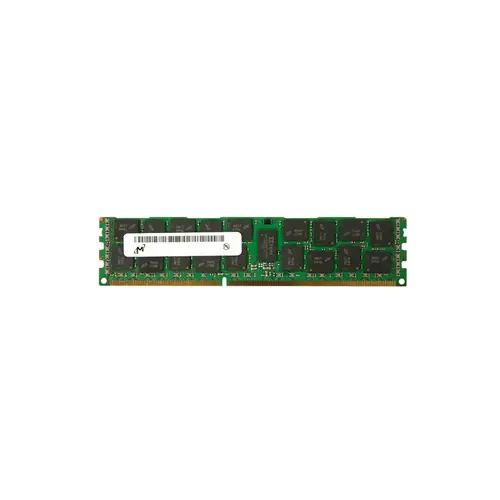
| Model | MT18KSF1G72PZ-1G6E2 |
|---|---|
| Product Type | Memory Module |
| Compliance Standards | RoHS |
| Memory Capacity | 8 GB |
| Memory Technology | DDR3 |
| Product Voltage | 1.35V |
| RAM Speed | 1600MHz |
| RAM Standard | DDR3-1600/PC3-12800 |
| Error Identifying | ECC |
| Signal Type | Registered |
| Column Access Strobe (CAS) | CL11 |
| Rank | Single Rank x4 |
| Quantity of Pins | 240-pin |
| RAM Genre | RDIMM |
Designed as an 8GB DDR3-1600 RDIMM with ECC and a registered signal type, this module ensures reliable data integrity for memory-intensive enterprise workloads such as virtualization and in-memory databases. Its single-rank x4 organization and CL11 latency deliver efficient command scheduling and low access latency, while 1.35V operation reduces thermal footprint in dense server deployments.
1. Integrated ECC corrects single-bit errors and detects multi-bit faults in real time, safeguarding data integrity for always-on transactional databases and critical financial applications.
2. Registered signal buffering stabilizes command and address paths, enabling dense server memory configurations while maintaining reliable communication under fully loaded channel conditions.
3. An eight-gigabyte capacity provides a balanced memory footprint for modest virtualization hosts, container orchestration nodes, and edge deployments where density-per-watt matters.
4. Sustained PC3-12800 throughput keeps latency-sensitive analytics queries and in-memory caches fed, preventing CPU pipeline stalls in data-intensive enterprise workloads.
5. Operating at a reduced low-voltage profile cuts per-module power consumption and exhaust heat, directly improving energy efficiency metrics in hyperscale and data center environments.
Built for demanding server environments, the Micron MT18KSF1G72PZ-1G6E2 Registered ECC DDR3 module directly addresses the critical pain points of IT infrastructure. Its Error Correcting Code (ECC) constantly scans and corrects single-bit memory errors caused by background radiation, preventing silent data corruption that could crash a virtualized cluster or corrupt financial transactions in an in-memory database like Redis. The Registered (RDIMM) architecture buffers command and address signals, allowing a server to remain rock-stable even when all 24 DIMM slots are populated, a non-negotiable requirement for dense VMware ESXi hosts maximizing VM density without sacrificing uptime. Operating at 1.35V, this low-voltage module significantly slashes power consumption and thermal output compared to standard 1.5V DDR3; in a full rack of servers running a real-time analytics farm, that reduction means lower electricity bills and less strain on cooling systems. Its single-rank x4 configuration with 1600MHz speed and CL11 timing delivers predictable, balanced bandwidth ideal for write-heavy database caching, where consistent low-latency access is more valuable than raw peak throughput. For your virtualized workloads and memory-hungry enterprise applications, this module translates directly to fewer unexplained system halts, higher consolidation ratios, and a cooler, more cost-effective data center.
General Virtualization
For a typical hypervisor hosting multiple VMs, populate at least six of these 8 GB RDIMMs across three channels per CPU to reach 48 GB, balancing cost and density. The low 1.35 V operation reduces power draw in always‑on hosts, and registered ECC ensures VM stability under memory pressure.
In-Memory Database
Deploy a fully populated configuration—12 or more modules per server—to maximize capacity for large dataset caching while maintaining single‑rank x4 performance for low latency. ECC is non‑negotiable for data integrity, and 1600 MHz speed strikes an optimal balance between bandwidth and thermal load in dense 24/7 deployments.
High-Performance Computing
Configure one DIMM per channel (typically 8 modules in dual‑socket systems) to achieve highest memory bandwidth with minimal rank contention. Job schedulers benefit from registered ECC resilience, and the 1.35 V profile helps contain power budgets in scaled‑out clusters running long‑duration parallel workloads.
Rigorously tested, server-compatible with Dell PowerEdge R720, HP ProLiant DL380p Gen8, and more.
Q: Can I mix this MT18KSF1G72PZ-1G6E2 with other memory modules of different brands or speeds?
A: Mixing is not recommended. This RDIMM requires matched ECC, rank, and CAS latency. Combining with dissimilar modules may cause instability or prevent the system from POSTing in enterprise servers.
Q: Is this memory compatible with my system?
A: It is compatible with servers supporting DDR3 ECC Registered DIMMs, such as platforms based on Intel Xeon E5-2600 v2 or AMD Opteron 6300 series. Always verify the system board’s qualified vendor list (QVL) before purchase.
Q: What is the recommended DIMM population order for optimal performance?
A: Refer to your server motherboard manual. Typically, populate identical DIMMs per channel starting with the first slot (often blue), ensuring balanced loading across all memory channels to maintain multi-channel ECC performance.
Q: Does this module support overclocking or XMP profiles?
A: No. This is a JEDEC-compliant server-grade RDIMM operating at standard DDR3-1600 timings. It does not support XMP profiles or overclocking, prioritizing stability and error correction for 24/7 operation.
Q: What warranty and typical failure rate can I expect?
A: This module includes a one-year warranty. Annualized failure rate (AFR) is typically under 0.5% in controlled environments, making it a reliable choice for enterprise deployments with proper cooling and stable power.