











 Secure payments
Standard refund policy
Trade Assurance
Secure payments
Standard refund policy
Trade Assurance
| Product Type | Memory Module |
|---|---|
| Memory Capacity | 8 GB |
| Memory Technology | DDR3 |
| Product Voltage | 1.5V |
| RAM Standard | DDR3-1600/PC3-12800 |
| Error Identifying | ECC |
| Signal Type | Unbuffered |
| Column Access Strobe (CAS) | CL11 |
| Rank | Dual Rank x8 |
| Quantity of Pins | 240-pin |
| RAM Genre | UDIMM |
This 8GB DDR3-1600 ECC unbuffered UDIMM, built with dual-rank x8 organization and a CAS latency of 11, is specifically engineered for entry-level servers and workstations where data integrity is critical, delivering reliable operation with single-bit error correction for virtualization hosts and memory-intensive financial or scientific applications. Its unbuffered signal type and standard 1.5V power profile ensure stable, low-latency performance in platforms that require ECC protection without the added complexity of registered memory.
1. ECC protection corrects single-bit errors in real time, preserving data integrity for financial transactions or database operations that cannot tolerate silent corruption.
2. Unbuffered signal type eliminates the delay of a register chip, delivering lower latency per access which benefits latency-sensitive micro-server applications.
3. 8 GB capacity per module supports meaningful memory density for light virtualization hosts, allowing smooth operation of multiple moderate VMs without immediate expansion.
4. DDR3-1600 bandwidth provides a 12.8 GB/s throughput ceiling, helping entry-level servers maintain responsive performance for concurrent file-sharing and web-hosting workloads.
5. Dual Rank x8 organization interleaves memory banks to maximize channel utilization, raising sustained throughput for memory-intensive tasks like in-memory caching.
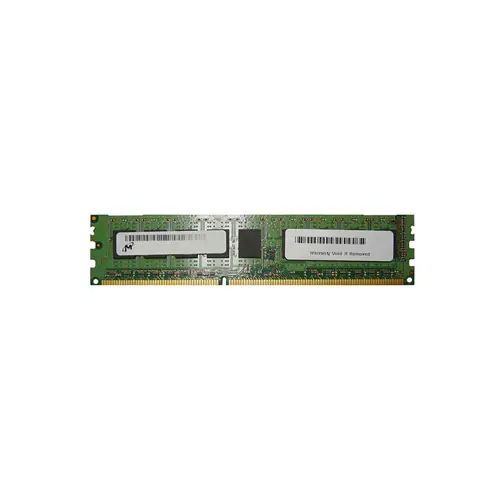
The Micron MT18JSF1G72AZ-1G6E1ZF 8GB DDR3-1600 ECC Unbuffered DIMM is ideal for entry-level servers and workstations that demand data integrity. Its ECC detects and corrects single-bit errors automatically, preventing silent data corruption in virtualized environments where multiple VMs share memory—a flipped bit during a database transaction could otherwise jeopardize financial records. The unbuffered design eliminates register latency, delivering quicker response for in-memory caching engines like Redis, which is crucial when millisecond delays impact user experience. Meanwhile, the dual-rank x8 organization interleaves memory banks, boosting bandwidth and allowing smooth multitasking under concurrent loads, such as running a file server and content management platform simultaneously. Standard 1.5V operation and DDR3-1600 CL11 timing ensure compatibility with a broad range of Xeon E3 systems, simplifying upgrades. This combination of error protection, low latency, and efficient bandwidth keeps your critical, always-on applications stable and responsive.
Capacity Planning Guidance for 8GB DDR3-1600 ECC Unbuffered DIMM
This module is an 8GB DDR3-1600 ECC Unbuffered DIMM. The combination of ECC and unbuffered design identifies it as server memory intended for entry-level single-socket servers or small business NAS platforms that require data integrity without registered buffering. Below are capacity planning recommendations for typical server workloads using this legacy DDR3 platform.
General Virtualization
In a single-socket virtualization host using a hypervisor like VMware ESXi or Proxmox, populate all four channels with identical 8GB modules for a balanced 32GB total. This provides enough capacity for 6-10 light to medium virtual machines while ECC guards against in-memory corruption, essential for stable multi-tenant operation. Avoid mixing unbuffered DIMMs of different ranks to maintain signal integrity.
In-Memory Database
For datasets that must reside entirely in RAM, such as Redis or Memcached, maximum density per channel is critical. Install four dual-rank 8GB DIMMs for 32GB with interleaved channels, which improves latency-sensitive transaction throughput. Plan for headroom of at least 20% over your working set size to allow replication and persistence overhead without swapping.
High-Performance Computing
HPC nodes with this memory type benefit from the ECC correction in long-running computational workloads where a single bit-flip would invalidate results. Fill all available DIMM slots with identical 8GB modules to maximize capacity within the board’s limit, typically up to 32GB on common LGA1155/LGA1150 platforms. Pair with a compatible Xeon E3 processor and ensure adequate cooling, as fully populated dual-rank DIMMs operate at higher temperatures.
Rigorously tested ECC server memory. Compatible with Dell PowerEdge T20, T110 II, R210 II, and HPE MicroServer Gen8.
Q: Can I mix this MT18JSF1G72AZ-1G6E1ZF with other memory modules of different brands or speeds?
A: Mixing different brands or speeds is strongly discouraged. ECC UDIMMs require identical specifications to maintain data integrity. Mismatched modules may lead to system instability, data errors, or failure to POST.
Q: Is this memory compatible with my Intel or AMD server platform?
A: This 8GB DDR3-1600 ECC unbuffered module fits servers based on Intel Xeon E3 v2/v3 or select AMD Opteron/A-Series platforms. Always confirm with your board's QVL for 8GB dual-rank ECC UDIMM support.
Q: What is the recommended DIMM population order for optimal performance?
A: Populate identical DIMMs in symmetric channels, typically starting with slots furthest from the CPU. Follow your server's manual for channel balancing to enable memory interleaving and maximize throughput on ECC platforms.
Q: Does this module support overclocking or XMP profiles?
A: No. This server-grade ECC module operates at fixed JEDEC DDR3-1600 CL11 timings. Overclocking and XMP are disabled to prioritize long-term data integrity and 24/7 mission-critical stability.
Q: What warranty and typical failure rate can I expect?
A: It includes a 1-year warranty. Industry annualized failure rates for quality ECC UDIMMs generally remain below 0.5%, offering excellent reliability for standard server and workstation workloads.