











 Secure payments
Standard refund policy
Trade Assurance
Secure payments
Standard refund policy
Trade Assurance
| Product Type | Memory Module |
|---|---|
| Compliance Standards | |
| Memory Capacity | 8 GB |
| Memory Technology | DDR3 |
| Product Voltage | 1.35V |
| RAM Speed | 1600MHz |
| RAM Standard | DDR3-1600/PC3-12800 |
| Error Identifying | ECC |
| Signal Type | Unbuffered |
| Column Access Strobe (CAS) | CL11 |
| Rank | Dual Rank x8 |
| Quantity of Pins | 240-pin |
| RAM Genre | UDIMM |
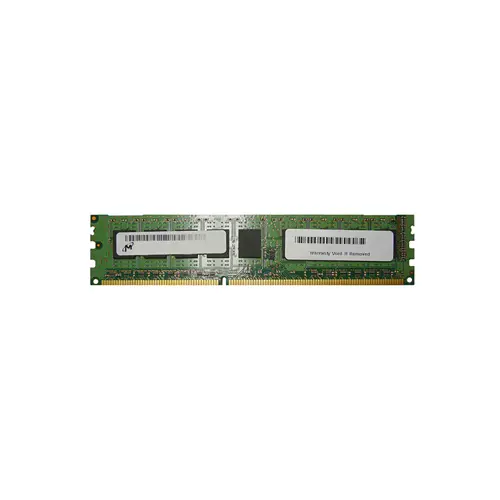
This is a server-grade memory module, purpose-built for entry-level servers and small-scale virtualization hosts where data integrity is critical. Its ECC capability corrects single-bit errors to prevent silent data corruption, while the dual-rank x8 configuration and low 1.35V voltage balance efficient memory interleaving with power savings for always-on deployments like NAS devices or lightweight in-memory databases.
1. ECC protection silently corrects single-bit memory errors in the background, preserving transactional integrity and eliminating the risk of silent data corruption in 24/7 server operations.
2. Dual Rank x8 organization maximizes memory bus utilization by interleaving access across ranks, delivering the consistent low-latency bandwidth virtualized workloads demand under heavy consolidation.
3. 1.35V low-voltage operation significantly reduces power draw and waste heat in dense rack deployments, directly trimming energy bills while maintaining rock-solid signal stability.
4. 1600MHz clock speed provides the sustained throughput legacy enterprise applications and database engines need, preventing I/O stalls during peak multi-client request surges.
5. UDIMM unbuffered architecture brings ECC reliability into cost-sensitive server builds, giving small business hosts and entry-level virtualization nodes a practical balance of data protection and affordability.
When you’re running a virtualization cluster or an in-memory database on a microserver or small business server, the last thing you need is a silent data corruption taking down your applications overnight. The MT18KSF1G72AZ-1G6E1ZE is an 8 GB DDR3 1600 unregistered ECC UDIMM built precisely for those scenarios where uptime and data integrity are non-negotiable. Its standout ECC engine actively detects and corrects single-bit memory errors, shielding your virtualized workloads from bit flips caused by background radiation — a critical safeguard in dense multi‑VM environments. The dual‑rank x8 organization keeps interleaving efficiency high, delivering noticeably smoother performance when Redis or Memcached saturates memory channels with high-velocity key‑value operations. With a 1.35 V operating voltage instead of the standard 1.5 V, thermal stress drops significantly, lowering cooling costs inside compact server chassis and extending the life of neighboring components. Because it is unregistered, this module minimizes memory latency compared to registered alternatives, which matters when every microsecond counts in database response times. Whether you are consolidating light‑duty virtualized nodes or upgrading an entry‑level storage appliance, this DIMM’s ECC protection, lean power draw, and bandwidth‑optimized dual‑rank layout give you enterprise‑grade reliability without the cost and complexity of registered memory, helping you maintain peak transactional throughput while defending the integrity of your data around the clock.
This 8GB DDR3L-1600 ECC unbuffered DIMM is a server-grade memory module. Its ECC protection and 1.35V low-voltage design make it ideal for always-on, energy-conscious data center environments. Below is capacity planning guidance for typical server workloads using this module.
General Virtualization
A virtualization host needs generous headroom for multiple VMs. Start with eight modules in a dual-socket server (64GB total) to support moderate consolidation, grouping them symmetrically for dual- or triple-channel interleaving. Scale to 16 modules (128GB) as VM density grows, always keeping identical DIMMs per channel to maintain stable ECC throughput.
In-Memory Database
In-memory platforms like Redis or SAP HANA demand maximum capacity and fault resilience. Populate all channels with two 8GB DIMMs per channel—a typical two-CPU, quad-channel server delivers 128GB using 16 modules. Distribute dual-rank DIMMs evenly across memory banks; this maximizes rank interleaving bandwidth while relying on full ECC coverage to guard critical data integrity.
High-Performance Computing (HPC)
HPC favors balanced bandwidth per core. Install one 8GB DIMM per memory channel (e.g., four modules for 32GB in a quad-channel box) to achieve the lowest latency and rated 1600MT/s speed. For memory-bound simulations, scale to two DIMMs per channel (eight modules, 64GB) while keeping per-channel rank counts identical to preserve uniform bandwidth and ECC scrub efficiency.
This server-grade UDIMM ECC has been rigorously validated and works with Dell PowerEdge T30/R210 II, HP MicroServer Gen8, and Lenovo ThinkServer TS140.
Q: Can I mix this MT18KSF1G72AZ-1G6E1ZE with other memory modules of different brands or speeds?
A: Mixing is not recommended for server environments. Different brands or speeds can cause stability issues and negate ECC protection. Always use identical modules to ensure reliable, validated performance and avoid potential data corruption.
Q: Is this memory compatible with my system?
A: This module is designed for servers/workstations using Intel Xeon E3 series or AMD Opteron platforms with DDR3 UDIMM slots. Verify your motherboard supports unbuffered ECC DDR3-1600 at 1.35V and consult the qualified vendor list.
Q: What is the recommended DIMM population order for optimal performance?
A: Populate identical modules in groups of two to enable dual-channel mode. Follow your server board’s manual for slot numbering; typically, start with slots 0 and 1 per channel to maximize memory bandwidth and ECC efficiency.
Q: Does this module support overclocking or XMP profiles?
A: No. This is an unbuffered ECC server module adhering to JEDEC DDR3-1600 standards. It does not support XMP or overclocking, as server memory prioritizes data integrity and stability over frequency manipulation.
Q: What warranty and typical failure rate can I expect?
A: This module includes a 1-year warranty. Unbuffered ECC UDIMMs like this Micron module exhibit very low failure rates, typically under 0.5% annually, when operated within specified voltage and temperature limits in server environments.