











 Secure payments
Standard refund policy
Trade Assurance
Secure payments
Standard refund policy
Trade Assurance
| Product Type | Memory Module |
|---|---|
| Compliance Standards | RoHS |
| Memory Capacity | 8 GB |
| Memory Technology | DDR3 |
| Product Voltage | 1.5V |
| RAM Speed | 1600MHz |
| RAM Standard | DDR3-1600/PC3-12800 |
| Error Identifying | ECC |
| Signal Type | Registered |
| Column Access Strobe (CAS) | CL11 |
| Rank | Single Rank x4 |
| Quantity of Pins | 240-pin |
| RAM Genre | RDIMM |
Designed for server-class platforms, this 8GB DDR3-1600 registered ECC module (RDIMM) ensures data integrity and system stability for virtualization and in-memory database workloads. Its single-rank x4 organization with CL11 latency and registered signal buffering optimizes memory bus loading, enabling higher density configurations without sacrificing reliable 1.5V operation.
1. ECC protection actively detects and corrects single-bit memory errors, preventing silent data corruption in mission-critical financial or database workloads.
2. Registered signal buffering stabilizes the command bus under heavy load, enabling densely populated server boards to scale memory capacity without compromising signal integrity.
3. Single Rank x4 organization uses narrower DRAM devices, allowing advanced server chipkill and data scrubbing features to isolate faults down to a single chip.
4. Sufficient module capacity supports a high number of virtual machines per physical host, improving consolidation ratios in private cloud deployments.
5. DDR3-1600 bandwidth provides ample throughput per channel, ensuring that memory-intensive enterprise applications like in-memory analytics run without bottlenecking the CPU.
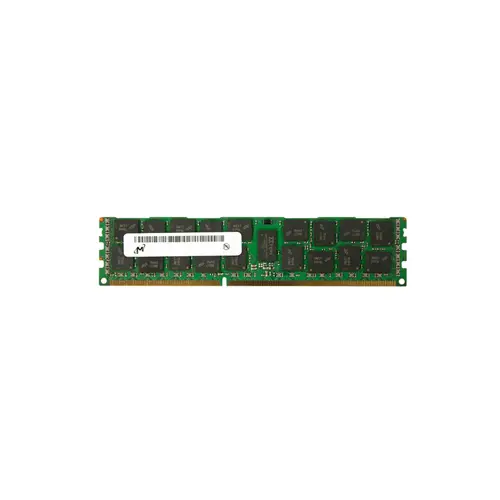
When deployed in a virtualized cluster running dozens of mission-critical VMs, the Micron MT18JSF1G72PZ-1G6E1FF 8GB DDR3-1600 RDIMM proves that server memory is never just about capacity. Its ECC engine actively corrects single-bit errors caused by background radiation, meaning a silent data corruption in a financial transaction or a customer database record is intercepted before it cascades into application failure. The registered signal buffer is equally vital: as you populate multiple DIMMs per channel to accommodate dense virtualization or in-memory databases like Redis, the register re-drives command and address signals, preserving electrical integrity so the system stays stable under heavy, concurrent access loads. Run a memory-hungry SAP HANA instance or a hypervisor hosting dozens of guests, and the 1600 MT/s bandwidth keeps latency-bound operations fluid, while the single-rank x4 organization optimizes command scheduling and reduces bank conflicts, delivering predictable performance in environments where every microsecond of memory access impacts user experience. For IT teams, this module translates directly into fewer unexplained crashes, validated data fidelity, and the confidence to scale memory-intensive workloads without compromising uptime.
General Virtualization
This 8GB DDR3-1600 Registered ECC DIMM is suited for small to mid‑sized virtualization hosts. To handle a dozen light VMs, populate six identical modules per CPU memory channel for a balanced 48GB configuration; enable memory mirroring or sparing only if high availability justifies halving usable capacity.
In-Memory Database
For in‑memory datasets approaching 128GB, install sixteen of these 8GB RDIMMs across all memory channels of a dual‑socket server, ensuring 1 DIMM per channel for maximum bandwidth. Prioritize low‑latency BIOS settings, but be aware that CL11 at 1600MHz may limit transactional throughput, making a larger single‑rank population preferable to mixing ranks.
High-Performance Computing (HPC)
In HPC clusters, density per node often matters more than per‑module capacity. Fully populate each memory channel with these 8GB ECC RDIMMs—typically twelve or sixteen modules per 2‑socket node—to deliver 96–128GB of bandwidth‑optimized memory. Match modules across all nodes to guarantee symmetric performance and stable MPI job execution, and monitor for thermal throttling under sustained load.
Rigorously tested server memory. Compatible with Dell PowerEdge R720, HP DL380p Gen8, Lenovo System x3650 M4.
Q: Can I mix this MT18JSF1G72PZ-1G6E1FF with other memory modules of different brands or speeds?
A: Mixing different brands or speeds is not recommended for an RDIMM server environment. The system will downclock to the slowest module, and mismatched rank or timing may cause stability issues or prevent POST.
Q: Is this memory compatible with my Intel Xeon E5 or AMD Opteron server platform?
A: This DDR3-1600 Registered ECC module is compatible with dual-processor platforms using Intel C602 or AMD SR56x0 chipsets. Verify that your server supports 1.5V 8GB RDIMMs and has a 240-pin slot.
Q: What is the recommended DIMM population order for optimal performance with this module?
A: Populate identical 8GB RDIMMs in sets matching the CPU memory channels, usually starting with slot A1 and B1 for two CPUs. Follow your server motherboard’s whitepaper for specific rank interleaving and balanced population to maintain triple-channel or quad-channel operation.
Q: Does this MT18JSF1G72PZ module support overclocking or XMP profiles?
A: No, this is a server-grade Registered ECC DIMM built to JEDEC specifications only. It does not support XMP or overclocking. The fixed CAS Latency 11 and 1600MHz speed are validated for 24/7 enterprise reliability, not for performance tuning.
Q: What warranty and typical failure rate can I expect with this memory?
A: This module is covered by a 1-year warranty. In server environments with proper cooling, the annualized failure rate for Micron RDIMMs is typically under 0.5%. We recommend running memory diagnostics upon installation.