











 Secure payments
Standard refund policy
Trade Assurance
Secure payments
Standard refund policy
Trade Assurance
| Product Type | Memory Module |
|---|---|
| Compliance Standards | |
| Memory Capacity | 8 GB |
| Memory Technology | DDR3 |
| Product Voltage | 1.35V |
| RAM Speed | 1600MHz |
| RAM Standard | DDR3-1600/PC3-12800 |
| Error Identifying | ECC |
| Signal Type | Registered |
| Column Access Strobe (CAS) | CL11 |
| Rank | Dual Rank x8 |
| Quantity of Pins | 240-pin |
| RAM Genre | RDIMM |
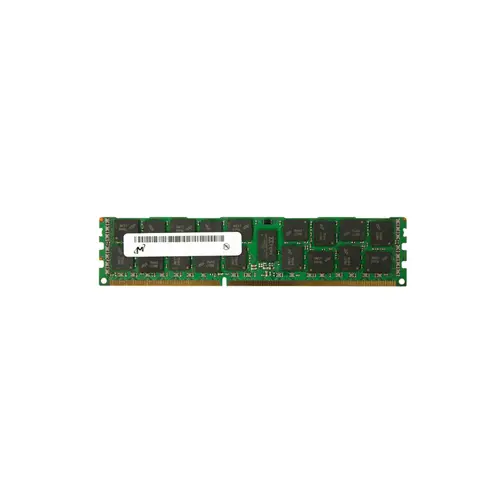
This 8GB DDR3-1600 RDIMM, with dual-rank x8 organization and registered ECC, is ideally suited for entry-level server platforms running memory-intensive workloads such as virtualized environments or small databases where data integrity is critical. Its 1.35V low-voltage operation reduces power consumption while the registered interface and ECC ensure stable signal integrity and single-bit error correction in 24/7 operation.
1. ECC error correction actively detects and fixes single-bit memory faults in real time, preserving transactional integrity across always-on enterprise applications.
2. Registered signal buffering stabilizes high-density memory channels, allowing servers to scale up memory capacity without compromising command signal integrity under heavy virtualization loads.
3. 1.35V low-voltage operation meaningfully cuts per-DIMM power consumption, reducing both energy costs and thermal strain in densely packed data-center racks.
4. Dual-rank x8 organization leverages rank interleaving to increase effective memory bandwidth, accelerating simultaneous read/write streams for multi-tenant hypervisor performance.
5. An eight-gigabyte capacity provides a cost-optimized building block that balances virtual machine density with affordable memory redundancy in mid-scale server deployments.
This 8GB DDR3L RDIMM (MT18KSF1G72PDZ-1G6N1) integrates four features that directly address real-world server pain points. First, its 1.35V power envelope reduces thermal load in high-density data centers, lowering your cooling overhead and improving long-term hardware reliability. Second, ECC error correction continuously guards against bit-flips caused by background radiation, preventing silent data corruption that would compromise a memory database or financial transaction log. Third, the registered buffer isolates the memory bus, allowing you to populate multiple DIMMs per channel so a virtualization platform can support dozens of VMs without signal degradation or boot failures. Finally, the dual-rank x8 design uses rank interleaving to boost sustained bandwidth; for in-memory databases such as Redis, concurrent reads and writes are overlapped across ranks, slashing latency and accelerating query throughput. Together, these attributes ensure data integrity, scalability, and energy efficiency for round-the-clock operations.
General Virtualization
Populate at least two 8 GB registered DIMMs per memory channel to balance capacity and bandwidth. A dual‑socket server with three channels per CPU benefits from twelve identical modules (96 GB total), leaving room for VM expansion while maintaining low‑power 1.35 V operation. Deploy modules in symmetric pairs to support memory mirroring or sparing if high availability is required.
In-Memory Database
Maximize capacity by filling all available DIMM slots with these dual‑rank 8 GB RDIMMs; a typical dual‑processor platform can accept up to sixteen modules for a 128 GB working set. Keep every channel identically loaded to avoid latency penalties, and leverage ECC to protect in‑memory data integrity. For latency‑sensitive workloads, consider limiting population to two DIMMs per channel to sustain DDR3‑1600 speed.
High Performance Computing
Install one 8 GB module per channel to achieve peak memory bandwidth on multi‑core nodes—eight modules in a dual‑socket, quad‑channel system yield 64 GB of well‑balanced capacity. The low 1.35 V supply and CL11 timing reduce power draw across large clusters, while registered signaling maintains signal integrity under heavy load. If bigger datasets are needed, scale by adding a second matched DIMM to each channel.
Rigorously tested server RAM, compatible with Dell PowerEdge R720/R620, HP ProLiant DL380p Gen8, Lenovo ThinkServer RD530, and similar systems.
Q: Can I mix this MT18KSF1G72PDZ-1G6N1 with other memory modules of different brands or speeds?
A: Mixing RDIMMs with different brands or speeds is not recommended. Mismatched modules can cause signal integrity issues and lead to POST failures or instability in server environments.
Q: Is this memory compatible with my system?
A: This DDR3-1600 ECC Registered DIMM is designed for Intel Xeon E5-2600 v2/v3 and select AMD Opteron platforms. Confirm your server motherboard supports 1.35V RDIMMs before purchasing.
Q: What is the recommended DIMM population order for optimal performance?
A: Refer to your server motherboard manual. Generally, populate identical DIMMs in matched channels starting with slots A1, B1, etc., to achieve balanced memory interleaving and peak throughput.
Q: Does this module support overclocking or XMP profiles?
A: No. This is an enterprise-grade RDIMM that strictly follows JEDEC standards. It does not support overclocking or XMP profiles, operating only at fixed timings for guaranteed reliability.
Q: What warranty and typical failure rate can I expect?
A: This Micron module includes a 1-year warranty. The annualized failure rate is very low, typical of enterprise-class memory, ensuring dependable operation under continuous 24/7 workloads.