











 Secure payments
Standard refund policy
Trade Assurance
Secure payments
Standard refund policy
Trade Assurance
| Product Type | Memory Module |
|---|---|
| Compliance Standards | RoHS |
| Memory Capacity | 8 GB |
| Memory Technology | DDR3 |
| Product Voltage | 1.5V |
| RAM Speed | 1066MHz |
| RAM Standard | DDR3-1066/PC3-8500 |
| Error Identifying | ECC |
| Signal Type | Registered |
| Column Access Strobe (CAS) | CL7 |
| Rank | Dual Rank x4 |
| Quantity of Pins | 240-pin |
| RAM Genre | RDIMM |
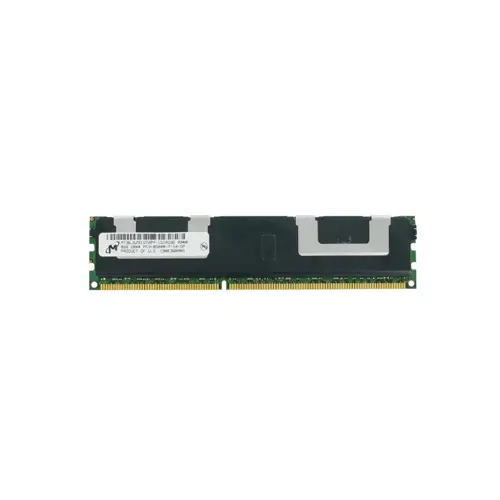
This RDIMM, with its Registered signal type and ECC error correction, is engineered specifically for server platforms where data integrity and stability under heavy loads are paramount, making it ideal for virtualization and in-memory database workloads. The combination of CL7 low latency and a Dual Rank x4 configuration optimizes command scheduling and interleaving, delivering consistent performance in multi-slot memory configurations.
1. ECC memory actively detects and corrects single-bit errors, preventing silent data corruption in mission-critical database and financial transaction servers.
2. Registered signal buffering stabilizes the command and address buses, allowing dense memory configurations essential for large-scale virtualization hosts without compromising signal integrity.
3. 8 GB capacity per module strikes a practical balance for moderate server virtualization density, supporting multiple lightweight VMs or containers without excessive power draw.
4. DDR3-1066 speed delivers dependable, power-efficient bandwidth for steady-state enterprise workloads where predictability trumps peak throughput.
5. Dual Rank x4 organization enables internal rank interleaving that saturates the memory channel more effectively, reducing latency variability under heavy concurrent VM access.
The MT36JSZS1G72PY-1G1A1DD is clearly a server-grade RDIMM, built for environments where failure is not an option. Its four defining characteristics directly address the real pain points of data center operators.
First, ECC error correction actively detects and corrects single-bit memory errors caused by background radiation or electrical noise. In a virtualized cluster running dozens of VMs on a single host, an uncorrected bit flip can silently corrupt a database transaction or crash a critical application overnight. ECC turns a hidden risk into a non-event, preserving data integrity around the clock.
Second, the Registered signal buffer isolates the memory controller from the electrical load of multiple modules. For an in-memory database like Redis or a heavily consolidated virtualization server, fully populating all DIMM slots with 8 GB sticks is common. Without registers, signal degradation would force you to reduce speed or capacity. Registered logic maintains stable 1066 MHz operation even under maximum load, ensuring predictable latency for every query.
Third, the Dual Rank x4 organization interleaves access across two internal ranks per module, boosting bandwidth efficiency. This directly translates into higher transaction throughput for a database engine scanning large tables. Finally, the tight CL7 latency minimizes the delay between a memory request and the delivery of critical data, which is vital when a financial trading system must react faster than a competing algorithm. Together, these features make this module a reliable workhorse for always-on enterprise infrastructure.
General Virtualization
For light to moderate virtualization hosts, populate at least six modules (48 GB total) to comfortably run 10–15 modest VMs. Because these are registered DIMMs, use identical 8 GB sticks in a balanced multi-channel configuration (e.g., three per memory channel on dual-socket systems) to maintain memory bandwidth and VM responsiveness. Increase to twelve modules (96 GB) when deploying heavier workloads or larger VM footprints, keeping spare slots for future growth.
In-Memory Database
In-memory databases demand capacity and low latency; start with twelve modules (96 GB) across all memory channels to hold substantial datasets and indexes while avoiding NUMA penalties. Deploy matched sets of these dual-rank x4 RDIMMs to fully utilize the memory bus, and plan for at least 192 GB across two nodes if high-availability clustering is required. Even with DDR3-1066 speed, maximizing channel population delivers the predictable latencies needed for real-time analytics.
High-Performance Computing (HPC)
For memory-bandwidth-sensitive HPC codes, fully populate every memory channel on each node with identical 8 GB RDIMMs—twelve or sixteen modules per dual-socket server—to achieve peak throughput. While 1066 MT/s is modest by modern standards, the balanced multi-channel configuration minimizes access contention and keeps all cores fed. Scale to 128–256 GB per node if you are running large-memory simulations, and always match the exact part number to preserve ECC and register consistency.
Rigorously tested server memory compatible with Dell PowerEdge R720, HP DL380p Gen8, and similar DDR3 RDIMMs.
Q: Can I mix this MT36JSZS1G72PY-1G1A1DD with other memory modules of different brands or speeds?
A: Mixing different brands or speeds is not recommended for registered ECC memory. Inconsistent ranks, timings, or voltage can cause POST failures, instability, or silent data corruption in server environments.
Q: Is this memory compatible with my system?
A: This RDIMM requires a server board supporting DDR3-1066 ECC Registered DIMMs, typically with Intel Xeon 5500/5600 or AMD Opteron 4100/6100 platforms. Always verify against your system's qualified vendor list.
Q: What is the recommended DIMM population order for optimal performance?
A: Populate identical DIMMs per channel following your server board manual. Generally, fill the first slot of each memory channel (often blue slots) with matched pairs to enable balanced interleaving and maximum throughput.
Q: Does this module support overclocking or XMP profiles?
A: No. This is an enterprise-class registered ECC module designed for 24/7 data integrity. It operates at fixed JEDEC standard latencies and does not support overclocking or XMP profiles.
Q: What warranty and typical failure rate can I expect?
A: This module is covered by a 1-year warranty. Enterprise-grade testing and rigorous binning result in an annualized failure rate well below 0.5%, ensuring high reliability in mission-critical deployments.