











 Secure payments
Standard refund policy
Trade Assurance
Secure payments
Standard refund policy
Trade Assurance
| Product Type | Memory Module |
|---|---|
| Compliance Standards | RoHS |
| Memory Capacity | 8 GB |
| Memory Technology | DDR3 |
| Product Voltage | 1.5V |
| RAM Speed | 1600MHz |
| RAM Standard | DDR3-1600/PC3-12800 |
| Error Identifying | ECC |
| Signal Type | Registered |
| Column Access Strobe (CAS) | CL11 |
| Rank | Single Rank x4 |
| Quantity of Pins | 240-pin |
| RAM Genre | RDIMM |
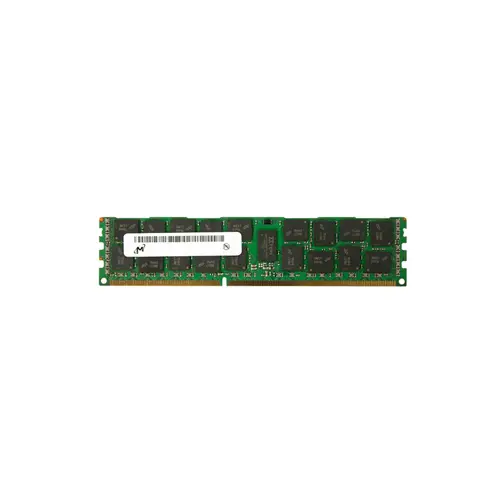
This 8 GB DDR3-1600 Registered ECC RDIMM module is a server-class memory solution purpose-built for virtualization platforms, in-memory databases, and data-critical workloads where operational integrity cannot be compromised. Its registered signal scheme stabilizes command and address buses under multi-DIMM loads, while the Single Rank x4 organization reduces electrical loading and ECC correction safeguards against single-bit errors, ensuring deterministic reliability in dense rack server deployments.
1. ECC protection silently detects and corrects single-bit errors, preventing silent data corruption in mission-critical databases and financial transactions.
2. Registered buffering stabilizes signal integrity across high-density memory configurations, enabling reliable operation under the heavy loads of 24/7 enterprise servers.
3. Eight gigabytes per module provide ample headroom for virtualized environments, allowing more VMs per physical host without costly memory bottlenecks.
4. Single-rank x4 organization maximizes memory bandwidth efficiency per channel, sustaining consistent throughput for latency-sensitive applications like in-memory caching.
5. 1600 MHz speed delivers solid bandwidth for DDR3-era workloads, balancing performance with proven platform compatibility in legacy server infrastructures.
As a server-class RDIMM, this Micron 8GB DDR3-1600 module is purpose-built to solve the critical challenges of enterprise data centers, where uptime and accuracy are non-negotiable. Its ECC technology continuously scans and corrects single-bit memory errors, preventing silent data corruption that could crash a virtualized host running dozens of VMs or produce inaccurate results in an in-memory database like SAP HANA. The registered signal buffer stabilizes the command and address buses, allowing you to populate all channels with multiple DIMMs without signal degradation—a direct enabler for scaling virtual machine density in VMware clusters or expanding large Redis caching layers. Complementing this, the single-rank x4 organization balances load and signal integrity while delivering strong bandwidth for sequential workloads. Together, these features transform raw specifications into real-world reliability: when a financial trading database performs millions of queries per hour, this memory ensures every transaction is processed faithfully, and when you run a 24/7 virtual desktop infrastructure, you avoid costly downtime caused by memory-induced system faults.
General Virtualization
For a typical virtualization host, populate a balanced number of modules per memory channel to maximize bandwidth while leaving room for future scaling. Using six or eight of these 8 GB registered DIMMs (48–64 GB total) in a dual-socket server provides ample capacity for 15–20 moderate VMs without overcommitting memory. Ensure identical part numbers across sockets to maintain symmetric NUMA performance.
In-Memory Database
In-memory databases demand both high capacity and data integrity, making ECC registered DIMMs essential. Aim for at least 128 GB by installing 16 of these 8 GB RDIMMs across all available slots in a single-socket or dual-socket server, prioritizing fully populating memory channels for maximum throughput. The single-rank x4 organization helps keep rank counts manageable, reducing electrical loading on the bus and maintaining 1600 MT/s speed under heavy write loads.
High-Performance Computing (HPC)
HPC clusters often prioritize memory bandwidth over sheer capacity for many scientific workloads. Install one DIMM per channel (one DPC) to run at the highest rated 1600 MHz speed without downgrading to a lower frequency, typically using 12 modules per dual-socket node for 96 GB. Registering and ECC functions are critical for long-running simulation integrity, and the 1.5 V standard voltage helps control total power in dense rack deployments.
Engineered and rigorously tested server memory. Compatible with Dell PowerEdge R720, HP ProLiant DL380p Gen8, Lenovo x3550 M4, and more.
Q: Can I mix this MT18JSF1G72PZ-1G6E1LI with other memory modules of different brands or speeds?
A: Mixing brands or speeds is not recommended for RDIMMs. Mismatched modules may cause signal integrity issues and instability, potentially preventing the server from posting.
Q: Is this memory compatible with my system?
A: This module is compatible with DDR3-based server platforms supporting Registered ECC, such as Intel Xeon E5-2600 v1/v2 or AMD Opteron 6300 series systems with 240-pin slots.
Q: What is the recommended DIMM population order for optimal performance?
A: Follow your motherboard's memory population guide. Typically, populate identical RDIMMs per channel, starting with slot A1 and B1 to maintain balanced memory interleaving and stability.
Q: Does this module support overclocking or XMP profiles?
A: No. This registered server memory adheres strictly to JEDEC DDR3-1600 specifications. It does not support overclocking or XMP profiles, prioritizing reliability and data integrity.
Q: What warranty and typical failure rate can I expect?
A: This product comes with a 1-year warranty. Operating under specified conditions, enterprise-class RDIMMs exhibit a very low AFR, typically below 0.5%, ensuring long-term reliability.