











 Secure payments
Standard refund policy
Trade Assurance
Secure payments
Standard refund policy
Trade Assurance
| Product Type | Memory Module |
|---|---|
| Compliance Standards | RoHS |
| Memory Capacity | 8 GB |
| Memory Technology | DDR3 |
| Product Voltage | 1.35V |
| RAM Speed | 1600MHz |
| RAM Standard | DDR3-1600/PC3-12800 |
| Error Identifying | ECC |
| Signal Type | Registered |
| Column Access Strobe (CAS) | CL11 |
| Rank | Dual Rank x4 |
| Quantity of Pins | 240-pin |
| RAM Genre | RDIMM |
Designed specifically for server-class platforms, this 8GB DDR3-1600 RDIMM with ECC and a registered signal type delivers exceptional data integrity for mission-critical workloads such as virtualization and in-memory databases. Its dual-rank x4 architecture and low 1.35V operating voltage improve signal stability and energy efficiency in dense server deployments, while the CL11 timing ensures reliable performance under sustained memory access.
1. ECC error correction silently detects and fixes single-bit memory faults, safeguarding transactional data integrity for mission-critical database workloads.
2. Registered signal buffering stabilizes electrical loading on the memory bus, enabling dense server board populations without risking data corruption.
3. Dual Rank x4 organization leverages bank interleaving to maximize sustained throughput, reducing latency bubbles during concurrent virtual machine memory access.
4. A balanced 8 GB capacity allows hypervisors to pack a practical number of lightweight instances, optimizing software licensing cost per gigabyte served.
5. The 1600 MT/s transfer rate supplies sufficient memory bandwidth to keep mid-range server CPUs fed, preventing bottlenecking during moderate multi-tenant processing.
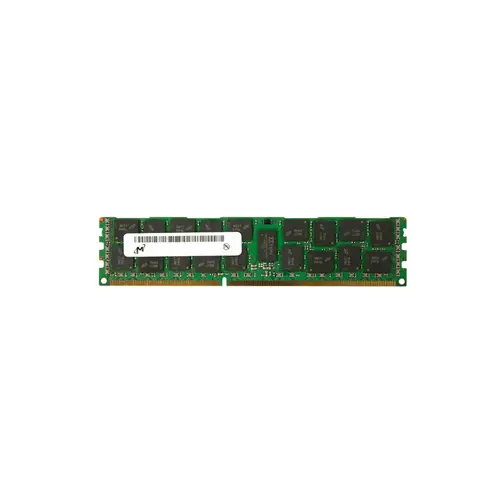
Designed for the rigors of server infrastructure, the Micron MT36KSF1G72PZ-1G6M2 is an 8GB DDR3-1600 Registered DIMM that turns specifications into crucial operational assurances. Its ECC technology is your frontline defense against silent data corruption, automatically detecting and correcting single-bit errors caused by background radiation. In a memory-resident database like Redis or SAP HANA, a single uncorrected bit flip can cascade into transactional inaccuracies or system crashes; ECC ensures every query result remains absolutely trustworthy, protecting revenue and reputation. The module’s Registered architecture, powered by an onboard buffer, stabilizes signal integrity when populating multiple DIMMs per channel. For a virtualization cluster running dozens of mixed-tenancy VMs on a single node, this means you can pack the server with RAM without sacrificing uptime or chasing sporadic memory faults, preserving SLA commitments. A Dual Rank x4 organization further elevates real-world throughput by interleaving access across internal banks, which directly accelerates the parallel data fetches that hypervisors and in-memory analytics demand. Finally, operating at a low 1.35V, it measurably reduces the thermal load and energy draw per socket—pain points that compound daily across a full rack of dense compute nodes, helping you contain cooling costs while sustaining 1600MHz bandwidth under unbroken enterprise workloads.
General Virtualization
For a virtualization host running multiple moderate VMs, start with at least six to eight 8GB RDIMMs (48–64GB) per socket to avoid ballooning and swapping under typical overcommit ratios. Populate identical modules symmetrically across all memory channels to maintain balanced NUMA access, and use the 1.35V low-voltage design to reduce power and cooling overhead in dense rack servers.
In-Memory Database
In-memory databases such as Redis or SAP HANA demand data integrity and sustained low latency, making ECC and registered buffering non-negotiable. Deploy a minimum of sixteen modules (128GB) per node, filling all available risers to hold the working set entirely in RAM; dual-rank x4 DIMMs are preferred here because they maximize rank interleaving and deliver higher sustained bandwidth under heavy read/write pressure.
High-Performance Computing
HPC clusters rely on the deterministic timing of registered ECC memory during long-running parallel simulations. Equip each compute node with eight to twelve modules (64–96GB) per processor, targeting roughly 1–2GB per physical core, so memory bandwidth stays aligned with floating-point throughput. Standardize on this single 8GB RDIMM part number across all nodes to simplify sparing and guarantee performance repeatability at scale.
Rigorously tested server memory, compatible with Dell PowerEdge R720, HP ProLiant DL380p Gen8, Lenovo ThinkServer RD430 and more.
Q: Can I mix this MT36KSF1G72PZ-1G6M2 with other memory modules of different brands or speeds?
A: Mixing registered ECC DDR3 modules is possible but strongly discouraged. Mismatched brands, speeds, or ranks often force all DIMMs to the lowest common speed and may cause system instability. Uniformity ensures reliable server operation.
Q: Is this memory compatible with my system?
A: This DDR3-1600 registered ECC RDIMM is designed for servers supporting 1.35V registered DDR3, such as Intel Xeon E5-2600 v1/v2 or AMD Opteron 6300 platforms. Please consult your motherboard's qualified vendor list to confirm compatibility.
Q: What is the recommended DIMM population order for optimal performance?
A: Install identical DIMMs starting from the slot farthest from the CPU per channel. Balance these dual-rank x4 RDIMMs symmetrically across all memory channels, following your server's specific population guidelines for best bandwidth and interleaving.
Q: Does this module support overclocking or XMP profiles?
A: No. This is a server-class registered ECC module operating strictly at JEDEC-standard DDR3-1600. It does not support XMP or overclocking; priority is given to data integrity and 24/7 operational stability.
Q: What warranty and typical failure rate can I expect?
A: This module carries a 1-year warranty. Enterprise RDIMMs like this Micron part typically achieve an annualized failure rate well below 0.5% under specified operating conditions, ensuring high long-term reliability.