











 Secure payments
Standard refund policy
Trade Assurance
Secure payments
Standard refund policy
Trade Assurance
| Product Type | Memory Module |
|---|---|
| Memory Capacity | 8 GB |
| Memory Technology | DDR4 |
| Product Voltage | 1.2V |
| RAM Speed | 2400MHz |
| RAM Standard | DDR4-2400/PC4-19200 |
| Error Identifying | ECC |
| Signal Type | Unbuffered |
| Column Access Strobe (CAS) | CL17 |
| Rank | Single Rank x8 |
| Quantity of Pins | 288-pin |
| RAM Genre | UDIMM |
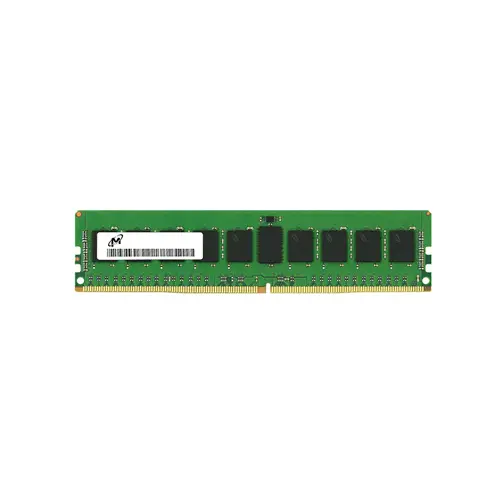
Designed for entry-level servers and workstations, this 8GB DDR4-2400 UDIMM with ECC is ideal for single-socket platforms running light virtualization, file serving, or memory-sensitive embedded applications. Its unbuffered architecture with single-rank x8 organization and CL17 latency delivers a balance of data integrity and low electrical load, ensuring stable error correction without sacrificing compatibility.
1. ECC protection detects and corrects single-bit errors in real time, preserving data integrity for mission-critical workloads and minimizing silent corruption in always-on server environments.
2. Unbuffered signal architecture eliminates the register latency penalty, delivering faster command-to-data access that benefits latency-sensitive enterprise applications like caching layers and in-memory databases.
3. DDR4-2400 speed class sustains solid memory throughput per channel, helping small-business servers handle multiple concurrent user requests or lightweight virtualized services without bandwidth bottlenecks.
4. Low operating voltage reduces the module’s thermal footprint and overall power draw, contributing to lower data center energy costs and greater rack-level power efficiency over continuous uptime.
5. Single rank organization enables efficient electrical loading on the memory bus, supporting stable operation at rated speed and simplifying qualification for entry-level server platforms where compatibility and straightforward upgrade paths matter.
The Micron MTA9ASF1G72AZ-2G3A1ZG is an 8GB DDR4-2400 UDIMM engineered for entry-level servers and workstations where data integrity and cost-efficiency must coexist. Its unbuffered ECC architecture directly addresses the critical pain point of silent data corruption. In a virtualized cluster running multiple lightweight containers or small business VMs, a single-bit error in DRAM caused by background radiation can cascade into hypervisor crashes or file system inconsistencies. This module’s ECC engine detects and corrects those errors in real time, preventing hours of troubleshooting and unplanned downtime.
The 1.2V low-power design and single-rank x8 organization become vital in dense microserver deployments. For an in-memory database like Redis handling high-frequency transactions, every watt of thermal waste erodes rack power budgets and forces lower CPU clock speeds due to cooling limits. By drawing less voltage and reducing the electrical load on the memory controller with just one rank, this DIMM minimizes heat output while delivering the full 19.2 GB/s of bandwidth and a tight CL17 latency. This ensures consistent response times under concurrent query loads without throttling—keeping your database responsive and your operating costs predictable.
This is a server-class DDR4-2400 ECC Unbuffered DIMM (UDIMM), designed for entry‑level servers and workstations that demand data integrity without registered buffering.
General Virtualization
To support multiple moderate VMs, populate channels evenly with at least four of these 8 GB modules for 32 GB total, enabling memory interleaving on quad‑channel platforms. For higher density, fill all available slots—six or eight modules—to reach 48 GB or 64 GB, securing headroom for hypervisor overhead and bursty workloads. ECC protection prevents bit‑flip errors that would compromise guest stability.
In‑Memory Database
Memory‑centric engines like Redis or SAP HANA require capacity and reliability. Maximize capacity by installing one module per channel across all memory channels—typically 8 to 16 modules in a single‑socket server—yielding 64 GB to 128 GB of fault‑resilient storage. The ECC UDIMM safeguards in‑flight transactional data, and the CL17 latency keeps read‑modify‑write operations responsive under heavy query pressure.
High Performance Computing (HPC)
Balance memory bandwidth by using an identical module in each channel, e.g., six or eight matched 8 GB sticks for a dual‑channel‑per‑socket setup. This guarantees symmetric access and peak GB/s for parallel solvers and simulations. The 2400 MT/s speed with single‑rank x8 organization minimizes rank‑switching overhead, while ECC eliminates silent data corruption during long‑running compute jobs, preserving result fidelity.
Tested for servers/workstations with ECC UDIMM, compatible with Dell PowerEdge T150, HPE ProLiant DL20 Gen10, and more.
Q: Can I mix this MTA9ASF1G72AZ-2G3A1ZG with other memory modules of different brands or speeds?
A: Mixing is not recommended. ECC UDIMMs require strict compatibility. Combining different brands, speeds, or ranks may cause instability, unbuffered ECC errors, or force the system to downclock to the slowest module’s JEDEC profile.
Q: Is this memory compatible with my server or workstation system?
A: It is compatible with platforms supporting DDR4 ECC UDIMMs, such as Intel Xeon E3-1200 v5/v6 or AMD Ryzen PRO with ECC-enabled chipsets. Verify your motherboard’s QVL for 288-pin UDIMM ECC support.
Q: What is the recommended DIMM population order for optimal performance?
A: Populate identical ECC UDIMMs per channel in matched slots, typically blue or black slots first. For dual-channel, install pairs in the same color slots as indicated in your server board manual to maintain interleaving and ECC functionality.
Q: Does this module support overclocking or XMP profiles?
A: No. As an enterprise ECC UDIMM, it adheres to JEDEC DDR4-2400 standards (PC4-19200). Overclocking and XMP are not supported; stability and data integrity are prioritized over performance tuning in server environments.
Q: What warranty and typical failure rate can I expect?
A: This Micron module includes a 1-year warranty. ECC UDIMMs have a very low annualized failure rate (AFR), typically under 0.5%, thanks to rigorous screening and error correction, ensuring high reliability for 24/7 operation.