











 Secure payments
Standard refund policy
Trade Assurance
Secure payments
Standard refund policy
Trade Assurance
| Product Type | Memory Module |
|---|---|
| Compliance Standards | RoHS |
| Memory Capacity | 4 GB |
| Memory Technology | DDR3 |
| RAM Speed | 1066 |
| RAM Standard | DDR3-1066/PC3-8500 |
| Error Identifying | Non-ECC |
| Signal Type | Unbuffered |
| Column Access Strobe (CAS) | CL7 |
| Rank | Dual Rank x8 |
| Quantity of Pins | 204-pin |
| RAM Genre | SoDIMM |
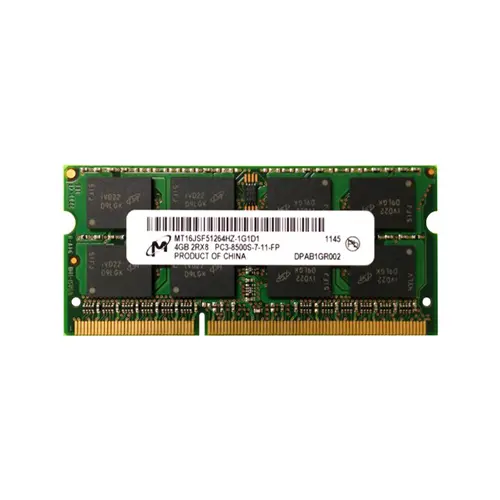
This is a standard DDR3-1066 Non-ECC Unbuffered SoDIMM designed for notebook upgrades and mobile workstations, offering a 4 GB capacity with a low-latency CL7 timing that improves system responsiveness in everyday multitasking and light productivity workloads. Its dual-rank x8 organization enhances memory access interleaving on compatible platforms, and the 204-pin form factor ensures a straightforward plug-and-play installation for older laptops requiring reliable, low-power memory expansion.
1. Designed specifically for ultra-compact notebooks, this SoDIMM form factor allows tool-free plug-and-play upgrades, minimizing downtime for road warriors.
2. With 4GB capacity, this module comfortably handles modern web browsing, office applications, and light multimedia tasks without disk thrashing, crucial for budget-conscious laptop users.
3. Balancing responsiveness with power efficiency, the 1066 MT/s data rate delivers smooth system performance while helping extend battery life during typical mobile usage.
4. The low CAS 7 latency reduces memory access delays, making everyday laptop tasks like tab switching and document opening feel noticeably snappier.
5. The industry-standard 204-pin interface guarantees seamless compatibility with DDR3 laptops, enabling a straightforward, worry-free memory upgrade.
Designed specifically for mobile platforms, this Micron 4GB DDR3-1066 SODIMM addresses the single most critical pain point for notebook users: extending the usable life of a portable system without compromising battery runtime or stability. The 204-pin small‑outline form factor ensures a precise mechanical fit in everything from ultra‑slim ultrabooks to aging mobile workstations, turning a memory upgrade into a straightforward, tool‑free procedure that even non‑technical users can perform in minutes.
In a real‑world mobile workstation scenario, where an engineer runs multiple CAD layers alongside simulation tools and a dozen browser tabs, the CL7 low‑latency timing and standard 1.5V operating voltage strike a careful balance. The tight CAS latency of 7 cycles translates directly into snappier application switching and reduced lag when scrubbing through large design files, while the mature DDR3 process node helps keep power draw modest—extending battery life during long client meetings or field work. For the owner of a thin‑and‑light laptop originally sold with only 2GB of soldered or single‑channel memory, plugging in this dual‑rank x8 module doubles capacity to a comfortable 4GB. That headroom virtually eliminates the constant paging to disk that makes lightweight notebooks feel painfully slow, cutting the time wasted on file saves and application loading. Because the module is non‑ECC and unbuffered, it aligns perfectly with the consumer chipset paths inside these notebooks, delivering full rated speed without compatibility surprises. Ultimately, this component gives a portable machine the responsive multitasking fitness it needs to handle today’s collaboration suites, cloud apps, and moderate content creation workloads, all while preserving the all‑day mobility that laptop users depend upon.
Capacity Planning Guide for Laptop DDR3 SoDIMM Memory
This module is a DDR3-1066 (PC3-8500) non-ECC unbuffered SoDIMM, clearly intended for laptops and mobile platforms. With a capacity of 4 GB per module, dual-rank x8 organization, and standard 1.5 V operation (typical of DDR3), it suits older notebooks requiring reliable, low-cost memory upgrades. When planning capacity, match the module’s speed and rank to the chipset’s limits to avoid POST failures.
Laptop Upgrade
For aging systems with only 2 GB or 4 GB soldered plus one open slot, adding a single 4 GB module doubles capacity to 8 GB. If both slots are accessible, replace the existing memory with a matched pair of these 4 GB sticks for dual-channel operation, ensuring smoother multitasking in Windows 10 or Linux. Always verify the maximum per-slot capacity (often 4–8 GB for DDR3 platforms) before purchasing.
Mobile Workstation
Professional workloads like CAD, large spreadsheets, or light virtualization require maximum addressable memory. Populate both slots with two 4 GB modules to reach the common 8 GB ceiling of many DDR3-era mobile workstations. While 16 GB kits are sometimes supported on quad-core Ivy Bridge or later, 4 GB DIMMs like this are the safe, stable choice for older mobile chipsets, avoiding compatibility issues with high-density 8 GB modules.
Ultrabook Power Saving
Ultrabooks and slim laptops prioritize battery runtime. Standard-voltage DDR3 (1.5 V) modules will work, but upgrading to low-voltage DDR3L (1.35 V) equivalents would yield better power efficiency. If retaining this 1.5 V module, ensure the system’s memory controller supports mixed voltages safely; otherwise, replace both slots with DDR3L versions. The dual-rank design slightly increases power draw versus single-rank, so for maximum battery life, single-rank modules might be preferred where available.
Rigorously tested, compatible with Dell Latitude, Lenovo ThinkPad, and HP EliteBook laptops.
Q: Can I mix this MT16JSF51264HZ-1G1D1 with other memory modules of different brands or speeds?
A: Mixing is possible but not recommended. Mismatched timings or ranks often force the memory controller to the lowest common speed, causing potential instability. Identical modules ensure reliable dual-channel operation.
Q: Is this memory compatible with my laptop system?
A: This DDR3-1066 204-pin SoDIMM fits notebooks with Intel 3rd/4th Gen Core or equivalent AMD platforms. Verify your model supports 4 GB dual-rank unbuffered non-ECC modules before purchasing.
Q: What is the recommended DIMM population order for optimal performance?
A: For dual-slot notebooks, install a matched pair to enable dual-channel mode. This dual-rank x8 module already provides good bandwidth alone, but pairing yields the best throughput. Refer to your laptop manual.
Q: Does this module support overclocking or XMP profiles?
A: No. This is a JEDEC-standard module without XMP support. It runs exclusively at the programmed 1066 MHz, CL7 timing for assured compatibility and stability in OEM laptop systems.
Q: What warranty and typical failure rate can I expect?
A: The module carries a 1-year warranty. The typical annualized failure rate is below 0.2% under normal use, consistent with Micron’s industrial-grade reliability for unbuffered SoDIMMs.