











 Secure payments
Standard refund policy
Trade Assurance
Secure payments
Standard refund policy
Trade Assurance
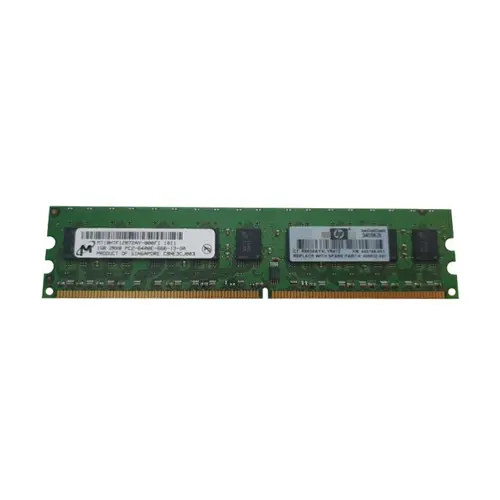
| Model | MT18HTF12872AY-800F1 |
|---|---|
| Product Type | Memory Module |
| Compliance Standards | RoHS |
| Memory Capacity | 1 GB |
| Memory Technology | DDR2 |
| Product Voltage | 1.8V |
| RAM Speed | 800MHz |
| RAM Standard | DDR2-800/PC2-6400 |
| Error Identifying | ECC |
| Signal Type | Unbuffered |
| Column Access Strobe (CAS) | CL6 |
| Rank | Dual Rank x8 |
| Quantity of Pins | 240-pin |
| RAM Genre | UDIMM |
This DDR2-800 unbuffered ECC UDIMM is targeted at legacy entry-level servers and workstations where data integrity is critical for always-on operations. Its dual-rank x8 organization combined with CAS 6 low latency enhances memory access efficiency and signal stability, making it ideal for aging platforms running lightweight virtualization or file-serving workloads that demand reliable error correction.
1. ECC protection catches and corrects single-bit errors at runtime, preserving data integrity for financial or database workloads where even a silent corruption is unacceptable.
2. Unbuffered architecture reduces access latency in low-density server nodes, making it a pragmatic fit for lightweight hosting tasks that do not demand registered memory overhead.
3. Dual Rank x8 organization interleaves operations across multiple banks, sustaining bandwidth under concurrent requests for smoother virtualization of modest legacy instances.
4. An 800 MHz clock sustains a 6.4 GB/s peak transfer rate, comfortably serving dedicated appliances like small-scale file shares or print servers without throughput bottlenecks.
5. CAS 6 latency tightens read response windows, improving deterministic performance in synchronous processing environments such as lightweight transaction monitors.
The MT18HTF12872AY-800F1 is a server-grade unbuffered ECC DDR2 module, purpose-built for entry-level servers and workstations where data integrity and stable multitasking are non-negotiable. In a small business virtualization host running several lightweight virtual machines, such as a domain controller and a web server, a single undetected memory bit flip can cascade into service outages or corrupted authentication databases. The ECC engine on this module actively corrects single-bit errors in real time, turning what could be a silent data corruption event into a routine, logged correction that keeps your services running uninterrupted. Translate that to an in-memory database like Redis used for session caching on a high-traffic e-commerce site: dual-rank x8 organization interleaves memory accesses across multiple banks, noticeably elevating bandwidth and reducing read/write latency during peak loads. The unbuffered design further cuts access latency compared to registered alternatives, which matters when every microsecond counts in a transaction-heavy application. Operating at a standard 1.8V and 800MHz with CL6 timings, this module delivers reliable, energy-conscious performance that extends the life of existing DDR2-based server platforms without sacrificing the data protection your critical workloads demand.
General Virtualization
For DDR2-era servers, cache this 1 GB ECC UDIMM primarily for lightweight hypervisor footprints. Configure at least four identical modules in dual-channel pairs to reach 4–8 GB, providing headroom for a few small VMs. For any production role, populate all available DIMM slots to maximize capacity, as the 1 GB per stick severely constrains modern guest memory allocation.
In-Memory Database
An all-in-memory dataset demands maximum capacity, so install the largest possible symmetrical set—often 8 modules (8 GB total) if the board supports it. This volume is only viable for tiny test or embedded databases, and you must balance one module per channel to retain dual-ranked bandwidth benefits. Given the limit, deploy this memory only where the working set stays under a few gigabytes.
High-Performance Computing (HPC)
Bandwidth-sensitive HPC workloads gain from balanced dual-channel configurations. Install pairs of these dual-rank x8 DIMMs to fill each channel identically, aiming for 4 modules (4 GB) or 8 modules (8 GB) where supported. Set identical CAS 6 and 800 MHz timings across all sticks to avoid imbalance, and leverage ECC to guard long-running simulations against single-bit errors.
Rigorously tested server memory. Compatible with Dell PowerEdge T105, HP ProLiant ML115 G5, and more.
Q: Can I mix this MT18HTF12872AY-800F1 with other memory modules of different brands or speeds?
A: Mixing different brands or speeds is not recommended in server environments. It may force all modules to run at the slowest common speed and can introduce instability. For reliable ECC operation, use identical modules.
Q: Is this memory compatible with my system?
A: This module is designed for servers supporting DDR2-800 ECC UDIMMs. It typically works with single-socket Intel Xeon 3000/5000 series or AMD Opteron platforms. Verify your motherboard specifically requires unbuffered ECC memory.
Q: What is the recommended DIMM population order for optimal performance?
A: Follow your server board’s manual. Generally, populate identical DIMMs in the slots furthest from the CPU first, filling channel 0 and then channel 1. Keeping balanced ranks per channel ensures optimal memory interleaving and ECC functionality.
Q: Does this module support overclocking or XMP profiles?
A: No. This is a standard JEDEC-compliant DDR2-800 ECC UDIMM. It does not support overclocking, XMP, or SPD programming for enthusiast timings, as server memory prioritizes data integrity and 24/7 stability over performance tuning.
Q: What warranty and typical failure rate can I expect?
A: This module carries a one-year warranty. It is built with high-quality components and an industry-typical AFR below 1% under rated conditions, ensuring dependable performance in servers operating within specified temperature and voltage ranges.