











 Secure payments
Standard refund policy
Trade Assurance
Secure payments
Standard refund policy
Trade Assurance
| Model | MT18HTF12872PY-667D2 |
|---|---|
| Product Type | Memory Module |
| Compliance Standards | RoHS |
| Memory Capacity | 1 GB |
| Memory Technology | DDR2 |
| Product Voltage | 1.8V |
| RAM Speed | 667MHz |
| RAM Standard | DDR2-667/PC2-5300 |
| Error Identifying | ECC |
| Signal Type | Registered |
| Column Access Strobe (CAS) | CL5 |
| Rank | Single Rank x4 |
| Quantity of Pins | 240-pin |
| RAM Genre | RDIMM |
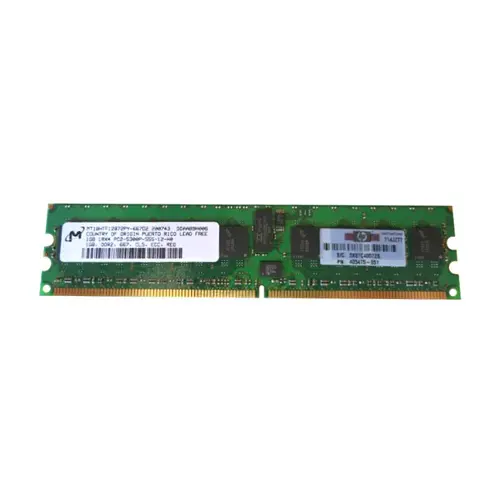
The MT18HTF12872PY-667D2 is a server-class DDR2-667 registered ECC DIMM, where the single-rank x4 organization minimizes bus loading and the registered signal type ensures robust multi-DIMM stability. It is ideally suited for legacy enterprise servers and workstations running memory-intensive workloads such as virtualization and in-memory databases, where ECC data integrity is critical.
1. ECC memory detects and corrects single-bit errors on the fly, delivering bulletproof data integrity for always-on enterprise servers where silent corruption can cascade into financial loss.
2. Registered DIMM architecture buffers command signals cleanly, allowing dense multi-module configurations in large-scale server racks without degrading command-bus stability.
3. Single Rank x4 organization uses narrower DRAM chips to tighten error coverage and slash access latency, directly sharpening hypervisor responsiveness under mixed workload virtualization.
4. A compact 1 GB tailored capacity suits dedicated network-appliance or edge-server roles, keeping memory overhead low while prioritizing nonstop reliability over raw density.
5. DDR2-667 transfer mode sustains consistent bandwidth that matches the steady I/O demands of legacy domain controllers and basic web services, preventing page-time lags.
The Micron MT18HTF12872PY-667D2 is a 1GB DDR2-667 Registered ECC DIMM, purpose-built for server platforms. Four defining characteristics make it indispensable in legacy enterprise environments. First, ECC protection is essential for memory-resident databases like Redis or caching layers; it corrects single-bit errors silently, preventing transactional corruption and unplanned downtime that can cost thousands per hour. Second, registered signal buffering ensures clean address and command paths, enabling you to populate multiple DIMMs per channel without signal degradation—critical for virtualization clusters that demand high memory capacity and flawless stability to prevent blue screens or data loss during live migration. Third, the DDR2-667 clock speed with a CAS latency of 5 delivers a responsive 5.3 GB/s bandwidth; in database-driven applications, that low latency means faster query processing and smooth VM responsiveness, directly improving end-user experience. Fourth, the 1.8V operating voltage reduces power consumption and heat output compared to older standards, lowering cooling demands in dense 2U server farms and extending the operational life of your infrastructure. Together, these traits let you extract reliable, cost-efficient service from aging hardware while safeguarding data integrity and minimizing business risk.
Memory Type Identification
This MT18HTF12872PY-667D2 is a server memory module — a 1 GB DDR2-667 Registered ECC DIMM. It is designed for stability-focused server platforms, not desktop or laptop use.
General Virtualization
Typical hypervisors rely on ample RAM to host multiple VMs, but a 1 GB DIMM imposes high module counts. Plan for a minimum of 16 identical modules (16 GB) to run light workloads; distribute them evenly across all memory channels (e.g., two modules per channel on an older dual-channel server board). Always populate in matched pairs to sustain the ECC and registered integrity that prevents data corruption under sustained multi-tenant operations.
In-Memory Database
In-memory databases demand large, contiguous addressable space, making sheer capacity critical. With these 1 GB sticks, target 64 GB or more by fully populating all DIMM slots — often 16 or 32 modules depending on the board. Enable memory mirroring or sparing only if performance is secondary; otherwise, use independent channel mode to maximize usable capacity. Registered ECC becomes vital here to detect and correct soft errors during constant data churn.
High-Performance Computing (HPC)
HPC clusters prize memory bandwidth as much as capacity. To optimize bandwidth, install modules in multiples that match the number of memory channels (e.g., 4 or 8 modules per node for dual‑channel systems) and avoid mixing ranks unevenly. Each node should run balanced, identical configurations so parallel jobs see uniform memory latency across the cluster. For compute‑intensive tasks, 8–16 GB per node (8–16 modules) offers a practical sweet spot, reserving remaining slots for future scaling while leveraging the registered architecture for long-running, error‑sensitive MPI workloads.
Rigorously tested, compatible with Dell PowerEdge 1950, HP DL360 G5, IBM x3650, and similar servers.
Q: Can I mix this MT18HTF12872PY-667D2 with other memory modules of different brands or speeds?
A: Mixing is strongly discouraged. ECC Registered modules must match speed, rank, and chip organization. Mismatched DIMMs can cause POST failures or silent data corruption in server environments.
Q: Is this DDR2-667 RDIMM compatible with dual-socket Intel 5000-series or AMD Opteron servers?
A: Yes, this 240-pin 1GB DDR2-667 ECC RDIMM works with most Intel 5000X/5100/5400 and AMD Opteron platforms. Always verify your board supports 667MHz registered memory and 1GB capacity.
Q: What is the recommended DIMM population order for optimal performance?
A: Install identical DIMMs in matched pairs per channel, starting with the lowest-numbered slots. Follow your server board's memory interleaving rules to maintain balanced memory channels and full ECC protection.
Q: Does this module support overclocking or XMP profiles?
A: No. This is a JEDEC-compliant DDR2 ECC RDIMM for servers. It does not include XMP or support overclocking. Reliability and data integrity require running at the specified 667MHz and 1.8V.
Q: What warranty and typical failure rate can I expect?
A: It includes a one-year warranty. The module undergoes rigorous testing for enterprise reliability. Typical annualized failure rate is extremely low, well under industry norms, ensuring stable long-term operation.