











 Secure payments
Standard refund policy
Trade Assurance
Secure payments
Standard refund policy
Trade Assurance
| Model | MT18HTF25672AZ-667H1 |
|---|---|
| Product Type | Memory Module |
| Compliance Standards | RoHS |
| Memory Capacity | 2 GB |
| Memory Technology | DDR2 |
| Product Voltage | 1.8V |
| RAM Speed | 667MHz |
| RAM Standard | DDR2-667/PC2-5300 |
| Error Identifying | ECC |
| Signal Type | Unbuffered |
| Column Access Strobe (CAS) | CL5 |
| Rank | Dual Rank x8 |
| Quantity of Pins | 240-pin |
| RAM Genre | UDIMM |
This 2GB DDR2-667 Unbuffered ECC module is best suited for legacy workstations or entry-level servers where data integrity is critical but registered memory overhead must be avoided, providing reliable error correction for file serving or light virtualization roles. Its dual-rank x8 configuration and CL5 latency optimize memory access parallelism while maintaining stable signal integrity on older platforms.
1. ECC error correction guards against single-bit memory faults in always-on servers, preserving service continuity for critical DNS and authentication workloads.
2. Dual Rank x8 organization maximizes channel utilization, enabling consistent throughput when a hypervisor consolidates multiple lightweight virtual appliances.
3. Unbuffered signal topology trims access latency, giving cost-sensitive microservers a responsiveness lift for low-latency caching and lightweight database queries.
4. CL5 column access latency keeps cache misses predictable, supporting real-time processing in industrial control or telecom monitoring roles where timing jitter is unacceptable.
5. PC2-5300 bandwidth delivers stable 5.3 GB/s throughput, comfortably handling concurrent file-sharing streams on a legacy small-office NAS appliance.
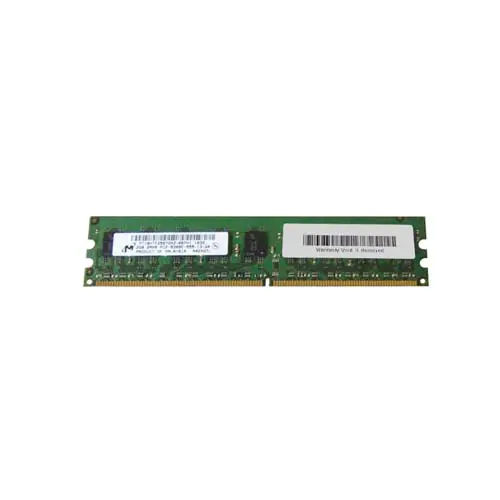
Meet the Micron MT18HTF25672AZ-667H1, a 2GB DDR2-667 ECC Unbuffered DIMM engineered for mission-critical servers. Its ECC actively corrects single-bit errors, preventing silent data corruption that could bring down a VMware host or compromise a transactional database. The Unbuffered architecture strips away register latency, offering your hypervisor immediate, low-overhead access—a decided advantage when multiple VMs simultaneously hammer memory. The module’s Dual Rank x8 design interleaves two rank sets, boosting bandwidth through concurrent row operations; for an in-memory store like Redis, this translates to higher query throughput without lag. A CAS 5 latency ensures minimal delay on each read, sharpening database response times. In environments where uptime and precision are non-negotiable—such as a virtualized ERP cluster or a real-time fraud detection system—these characteristics mean your data remains uncorrupted, your services stay responsive, and your aging server infrastructure continues earning its keep.
Capacity Planning for DDR2 ECC UDIMM (MT18HTF25672AZ-667H1)
This is a server-grade unbuffered ECC DDR2 module, commonly found in entry-level servers, small business NAS appliances, and legacy workstations. Its 2 GB capacity per DIMM limits modern scalability, so careful configuration is essential to maximize available resources within platform constraints.
General Virtualization
With hypervisors of that era (e.g., VMware ESX 3.x or early Hyper-V), memory is the first bottleneck. Populate all available DIMM slots with identical 2 GB modules to reach the board’s maximum—often 8–16 GB. This supports 6–10 light virtual machines. Avoid mixing non-ECC modules, as that disables error correction and undermines stability in multi-tenant environments.
In-Memory Database
Even for lightweight instances like Redis or Memcached on older Linux distributions, dataset size must fit entirely in RAM. Use the highest supported count of matched 2 GB ECC sticks to achieve 16–32 GB, providing a workable cache layer for small datasets. Dual-rank modules slightly improve throughput via rank interleaving, but capacity remains the primary concern.
High-Performance Computing
Clustered HPC nodes from the DDR2 generation often rely on memory bandwidth. Install modules in multiples that fill all memory channels (typically four identical DIMMs per node for dual-channel platforms). Uniform dual-rank x8 modules ensure consistent latencies across the cluster, which is critical for MPI job stability and repeatable benchmark results.
Rigorously tested server DDR2 ECC UDIMM; compatible with Dell PowerEdge R200, T105, HP ProLiant ML115 G5, and Lenovo TS100.
Q: Can I mix this MT18HTF25672AZ-667H1 with other memory modules of different brands or speeds?
A: Mixing modules is not recommended for server environments. ECC UDIMMs require identical ranks, speeds, and timings to maintain data integrity and avoid memory errors. Use matching MT18HTF25672AZ-667H1 sticks for reliable operation.
Q: Is this memory compatible with my Intel or AMD server platform?
A: This DDR2-667 ECC Unbuffered DIMM fits platforms with Intel 5000/5100 series or AMD Socket F chipsets. Verify your motherboard supports 2GB, 240-pin ECC UDIMMs and a 1.8V voltage specification before purchasing.
Q: What is the recommended DIMM population order for optimal performance?
A: Follow your server board's manual. Generally, populate identical modules in corresponding slots of each memory channel (e.g., DIMM_A1 and DIMM_B1 first) to enable dual-channel interleaving and maximize ECC throughput.
Q: Does this module support overclocking or XMP profiles?
A: No. This is a JEDEC-standard server UDIMM. It does not feature XMP profiles and is not designed for overclocking. Reliability and stability at rated DDR2-667 CL5 specifications take priority over speed tuning.
Q: What warranty and typical failure rate can I expect?
A: This Micron module includes a one-year warranty. Typical annualized failure rates are below 0.5% under specified operating conditions, backed by rigorous factory testing for mission-critical server applications.