











 Secure payments
Standard refund policy
Trade Assurance
Secure payments
Standard refund policy
Trade Assurance
| Model | MT18HTF25672FDZ-667H |
|---|---|
| Product Type | Memory Module |
| Compliance Standards | RoHS |
| Memory Capacity | 2 GB |
| Memory Technology | DDR2 |
| Product Voltage | 1.8V |
| RAM Speed | 667MHz |
| RAM Standard | DDR2-667/PC2-5300 |
| Error Identifying | ECC |
| Signal Type | Fully Buffered |
| Column Access Strobe (CAS) | CL5 |
| Rank | Dual Rank x4 |
| Quantity of Pins | 240-pin |
| RAM Genre | FB-DIMM |
This FB-DIMM is engineered for legacy server platforms, offering ECC and fully buffered signaling to ensure data integrity in memory-intensive workloads like virtualization and in-memory databases. Its dual-rank x4 organization and 240-pin FB-DIMM interface maximize channel bandwidth and reliability in older dual-processor servers that depend on serial point-to-point topologies.
1. ECC error correction automatically detects and corrects single-bit memory errors, ensuring data integrity for mission-critical financial transactions and preventing costly server downtime.
2. Fully Buffered architecture serializes data transfers to maintain signal integrity across high-density memory channels, enabling reliable operation in densely populated rack servers.
3. Dual Rank x4 organization leverages rank interleaving to amplify effective memory bandwidth, keeping latency low when hosting multiple virtual machines on a single physical host.
4. 2 GB capacity per module supplies sufficient headroom for concurrent enterprise applications and light virtualization, offering a practical balance between density and power consumption in scale-out deployments.
5. 667 MHz frequency sustaining 5.3 GB/s peak bandwidth eliminates memory bottlenecks during simultaneous user requests, ensuring responsive performance for database and web server workloads.
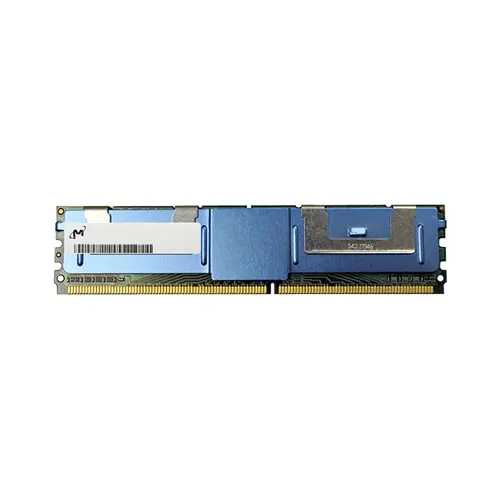
The Micron MT18HTF25672FDZ-667H is a server-class Fully Buffered DIMM engineered for mission-critical enterprise environments where data integrity and sheer capacity reign supreme. Its four defining characteristics directly address the pain points of IT architects managing virtualization clusters and in-memory databases. First, ECC protection actively corrects single-bit errors caused by cosmic radiation or electrical noise, silently preventing data corruption that would otherwise crash a hypervisor node or poison a transactional database. Second, the Fully Buffered architecture uses an Advanced Memory Buffer to decouple the DRAM from the memory bus, enabling the deployment of massive, stable memory populations without signal degradation; this is what makes consolidating dozens of virtual machines on a single physical host technically feasible. Third, the dual-rank organization leverages rank interleaving to boost effective bandwidth, so a Redis or Memcached instance can serve more requests per second while the CPU buffers the next data fetch in parallel. Finally, the 2 GB DDR2-667 specification supplies a proven, reliable clock speed and capacity point that keeps legacy enterprise platforms running enterprise Linux or VMware ESX productive, avoiding costly infrastructure teardowns. This module is not just a component; it is an assurance that your virtualized workloads and real-time analytics remain accurate, available, and performant around the clock.
The MT18HTF25672FDZ-667H is a 2 GB DDR2-667 Fully Buffered ECC DIMM, designed exclusively for server platforms with FB-DIMM memory controllers. For capacity planning, exploit its multi-channel architecture and reliability features in the following representative workload scenarios.
General Virtualization
Virtualized environments require ample capacity and rock-solid stability. Start by populating all memory channels evenly with matched pairs; eight modules (16 GB total) comfortably support a moderate number of lightweight VMs. For denser consolidation, install sixteen modules (32 GB) across four fully loaded channels. Always configure ECC mirroring or sparing if available, but prioritize balanced DIMM-per-channel ratios to sustain throughput under heavy hypervisor overhead.
In-Memory Database
In-memory databases depend on maximizing capacity while maintaining deterministic latency. Deploy the maximum number of modules your motherboard supports—often sixteen or more—to achieve 32 GB or higher. The native fully buffered architecture preserves signal integrity even with all slots occupied, reducing stalls. Disable memory scrubbing in firmware only after thorough testing, and configure rank interleaving to keep dual-rank x4 modules feeding data with minimal pipeline bubbles.
High-Performance Computing (HPC)
HPC clusters thrive on aggregate memory bandwidth and repeatable performance. Balance an identical number of DIMMs across every memory channel—typically two DIMMs per channel for a total of eight modules (16 GB)—to enable four-way channel interleaving. This arrangement doubles per-channel bandwidth and reduces hot-spots during massively parallel math libraries. Use optimized BIOS profiles that lock memory at 667 MHz and tighten secondary timings, ensuring all dual-rank modules operate in lockstep for predictable execution times.
Validated FB-DIMM server memory. Compatible with Dell PowerEdge 2950, HP ProLiant DL380 G5, and IBM System x3650.
Q: Can I mix this MT18HTF25672FDZ-667H with other memory modules of different brands or speeds?
A: Mixing FB-DIMMs of different brands or speeds is strongly discouraged. It can cause signal integrity issues and instability. For reliable server operation, use identical modules.
Q: Is this memory compatible with my system?
A: This 2GB DDR2-667 FB-DIMM is compatible with server boards using Intel 5000P/5000X chipsets or similar platforms that support fully buffered ECC memory. Verify your motherboard's FB-DIMM support before purchase.
Q: What is the recommended DIMM population order for optimal performance?
A: Populate dual-rank FB-DIMMs in matched pairs per branch, typically starting with the farthest slot from the CPU. Refer to your server’s technical manual for the exact memory channel and slot sequence.
Q: Does this module support overclocking or XMP profiles?
A: No. This server FB-DIMM adheres to strict JEDEC DDR2-667 standards (PC2-5300) and does not support overclocking or XMP profiles, ensuring maximum stability for mission-critical environments.
Q: What warranty and typical failure rate can I expect?
A: This Micron module carries a one-year warranty. Enterprise-class FB-DIMMs are built for high reliability, with an expected annualized failure rate well below 0.1% under specified operating conditions.