











 Secure payments
Standard refund policy
Trade Assurance
Secure payments
Standard refund policy
Trade Assurance
| Product Type | Memory Module |
|---|---|
| Memory Capacity | 8 GB |
| Memory Technology | DDR3 |
| Product Voltage | 1.5V |
| RAM Speed | 1866MHz |
| RAM Standard | DDR3-1866/PC3-14900 |
| Error Identifying | ECC |
| Signal Type | Unbuffered |
| Column Access Strobe (CAS) | CL13 |
| Rank | Dual Rank x8 |
| Quantity of Pins | 240-pin |
| RAM Genre | UDIMM |
This Unbuffered ECC DDR3-1866 UDIMM is tailored for entry-level servers and workstations where data integrity is critical, making it an ideal fit for light virtualization, file serving, and memory-sensitive embedded systems. Its dual-rank x8 organization boosts interleaving efficiency while the CL13 latency minimizes access delays, and the integrated ECC ensures single-bit error correction to sustain stability under 24/7 operation.
1. ECC detection and correction prevents silent data corruption, ensuring transactional integrity for critical enterprise databases and financial processing.
2. Unbuffered architecture eliminates register latency, delivering faster response times for single-socket application servers and virtualized workloads.
3. Dual-rank x8 organization maximizes bank-level parallelism, sustaining higher throughput under multi-threaded server tasks and memory-hungry VMs.
4. Eight-gigabyte capacity per module enables dense memory configurations in compact 1U servers, boosting virtual machine consolidation without sacrificing channel population.
5. The 1866 MT/s transfer rate accelerates large in-memory computations, cutting data retrieval delays for real-time analytics and caching layers.
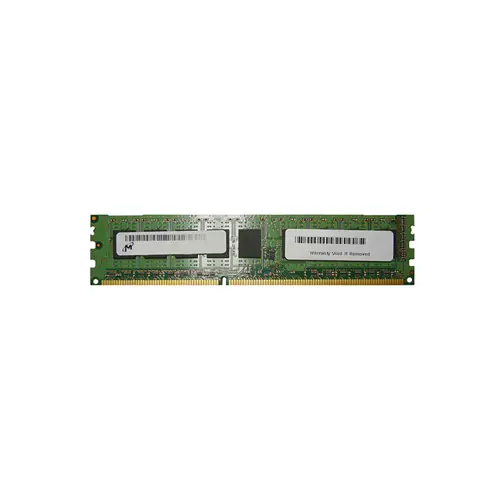
When you deploy a single-socket server or a compact virtualization host for a growing business, every component must balance reliability with responsive performance. The Micron MT18JSF1G72AZ-1G9E2ZE, an 8GB DDR3-1866 UDIMM with ECC, is engineered precisely for that intersection. Its ECC protection is not just a spec; in a 24/7 virtualized environment running multiple VMs, it actively detects and corrects single-bit memory errors caused by background radiation, preventing silent data corruption that could destabilize your hypervisor or slowly poison a critical database. The unbuffered design eliminates the extra clock cycle of registered modules, delivering lower latency that translates into faster in-memory database lookups in platforms like Redis or Microsoft SQL Server, where every nanosecond counts. Meanwhile, the dual-rank x8 organization feeds the memory controller with interleaved data bursts, sustaining high bandwidth when multiple virtual machines contend for resources. For a network-attached storage appliance or a lightweight workstation processing large design files, this combination of error vigilance, speed, and sustained throughput ensures that stability never comes at the cost of sluggish day-to-day performance.
General Virtualization
For a DDR3-era hypervisor, capacity is king. Deploying this 8 GB ECC UDIMM in a quad-channel population (four matching modules) yields 32 GB, which comfortably hosts 8–10 light VMs. Stick to identical dual-rank DIMMs per channel to preserve signal integrity and avoid memory speed downgrades.
In-Memory Database
In-memory workloads demand both reliability and the lowest possible latency. Populate all channels with identical 8 GB sticks to reach 64 GB or 128 GB, keeping the DIMMs tightly matched by rank and CAS latency (CL13). This configuration prevents memory bottlenecks during large dataset loads and ensures ECC scrubs single-bit errors without downtime.
High-Performance Computing
HPC nodes benefit from balanced memory bandwidth. Install six or eight of these dual-rank UDIMMs (48–64 GB total) to keep all memory channels active. The 1866 MT/s speed and ECC protect long-running simulations, while the unbuffered design avoids the extra latency of registered modules, crucial for latency-sensitive MPI jobs.
Thoroughly tested, compatible with Dell PowerEdge R210 II, HP ProLiant MicroServer Gen8, Lenovo ThinkServer TS140.
Q: Can I mix this MT18JSF1G72AZ-1G9E2ZE with other memory modules of different brands or speeds?
A: Mixing brands or speeds is not advised for ECC UDIMMs. Mismatched timings can cause instability or disable ECC. For server reliability, use identical Micron modules with the same part number.
Q: Is this memory compatible with my system?
A: It fits single‑socket servers/workstations supporting DDR3 ECC Unbuffered, like Intel Xeon E3/E5‑1xxx or select AMD AM3+/C32 platforms. Confirm your board supports 240‑pin UDIMM ECC and PC3‑14900 speeds.
Q: What is the recommended DIMM population order for optimal performance?
A: Follow the server board manual; typically populate identical pairs first (e.g., DIMM_A1 and DIMM_B1) for dual‑channel mode. Symmetric placement ensures ECC functionality and balanced memory interleaving.
Q: Does this module support overclocking or XMP profiles?
A: No. This JEDEC‑compliant ECC UDIMM is built for server stability. It does not support XMP or overclocking; it operates strictly at DDR3‑1866 CL13 for consistent 24/7 reliability.
Q: What warranty and typical failure rate can I expect?
A: A 1‑year warranty is provided. Typical AFR is very low (under 0.5%) due to Micron’s rigorous testing. The module delivers enterprise‑class reliability for continuous operation in server environments.