











 Secure payments
Standard refund policy
Trade Assurance
Secure payments
Standard refund policy
Trade Assurance
| Product Type | Memory Module |
|---|---|
| Compliance Standards | RoHS |
| Memory Capacity | 8 GB |
| Memory Technology | DDR3 |
| Product Voltage | 1.5V |
| RAM Speed | 1600MHz |
| RAM Standard | DDR3-1600/PC3-12800 |
| Error Identifying | ECC |
| Signal Type | Registered |
| Column Access Strobe (CAS) | CL11 |
| Rank | Dual Rank x8 |
| Quantity of Pins | 240-pin |
| RAM Genre | RDIMM |
This 8GB DDR3-1600 registered ECC RDIMM, with its dual-rank x8 organization and 1.5V operating voltage, is purpose‑built for server environments such as virtualization hosts and in‑memory databases where registered signaling and ECC together guarantee robust signal integrity and data reliability under sustained, heavy loads. The PC3‑12800 timing and CL11 latency further suit it to legacy Xeon‑based platforms that demand consistent, error‑free operation across multiple DIMMs per channel.
1. ECC memory actively detects and corrects single-bit errors, preserving financial transaction integrity in always-on database servers where even a single undetected bit flip could trigger catastrophic data corruption.
2. Registered clock drivers stabilize signal distribution across fully populated memory channels, enabling dense virtualization hosts to sustain 24/7 operation without degradation under constant memory access pressure.
3. Dual Rank x8 organization interleaves internal banks to overlap precharge and access cycles, delivering smoother throughput for hypervisors when multiple guest VMs contend for shared memory bandwidth.
4. 8 GB module capacity provides ample headroom for dedicated caching appliances or light container hosts, striking a practical balance between cost and operational density in scale-out server farms.
5. 1600 MHz frequency with 12.8 GB/s peak bandwidth accelerates in-memory analytics workloads, shrinking query response times for real-time business intelligence dashboards.
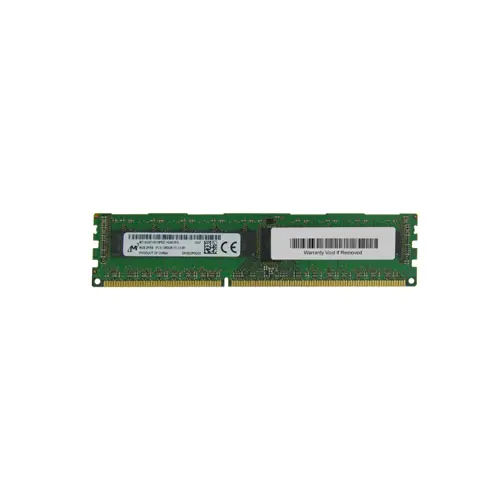
The MT18JSF1G72PDZ-1G6E1FG is a server RDIMM built around ECC, Registered buffering, Dual Rank x8, and 1600MT/s speed. In virtualized clusters, a bit-flip from background radiation can corrupt VM memory; the ECC engine catches and corrects it instantly, keeping hypervisors and financial databases safe. Registered logic then stabilizes high-density deployments. It allows you to populate all 24 DIMM slots in a 2U server without signal degradation, delivering the huge capacity needed for dense consolidation or SAP HANA. The Dual Rank x8 design leverages interleaving to overlap operations. When your Redis cache processes thousands of requests per second, the controller switches between ranks to reduce latency and boost throughput. The 1600MT/s interface supplies 12.8 GB/s bandwidth, preventing bottlenecks during real-time analytics. With a standard 1.5V operating voltage and 8GB capacity per module, it fits existing DDR3 server platforms seamlessly. This translates to uncompromising data integrity and workload agility.
General Virtualization
For a typical hypervisor host, deploy a minimum of four 8 GB RDIMMs (32 GB total) evenly across memory channels to balance virtual machine density and memory interleaving. Scale to eight modules (64 GB) or more when running heavier workloads like mixed database and application VMs, leveraging ECC reliability to protect multi-tenant environments.
In-Memory Database
In-memory databases demand both capacity and low latency. Start with eight 8 GB RDIMMs (64 GB) fully populating dual-socket memory channels for maximum bandwidth. For larger datasets, deploy multiple identical nodes and fill all available DIMM slots with registered DIMMs, ensuring error correction protects in-flight data integrity during real-time analytics.
High-Performance Computing
HPC clusters benefit from balanced DIMM configurations that maximize memory bandwidth per compute node. Install at least one 8 GB RDIMM per channel (often 8 modules for 64 GB) to enable effective channel interleaving and reduce contention. The registered, ECC design allows large per-node memory footprints without compromising signal integrity during tightly coupled MPI jobs.
This server memory is rigorously tested, compatible with Dell PowerEdge R720/R730, HP DL380p Gen8, and more.
Q: Can I mix this MT18JSF1G72PDZ-1G6E1FG with other memory modules of different brands or speeds?
A: Mixing Registered ECC modules is not recommended, as differing brands, speeds, or ranks may cause signal integrity issues and system instability. For server environments, uniform population is critical.
Q: Is this memory compatible with my Intel Xeon E5-based server?
A: This 8GB DDR3-1600 Registered ECC DIMM is compatible with Intel Xeon E5-2600/2400 v1/v2 and equivalent AMD Opteron platforms using C602/C604 chipsets. Verify your board’s memory QVL list for confirmation.
Q: What is the recommended DIMM population order for optimal performance?
A: Populate identical DIMMs per memory channel according to your server manual. For dual-rank x8 RDIMMs, start with slot 1 in each channel, filling balanced configurations to achieve full memory bandwidth with minimal latency.
Q: Does this module support overclocking or XMP profiles?
A: No. This is a JEDEC-compliant Registered ECC server module. It does not support overclocking or XMP profiles. It operates at fixed 1600MHz with CL11 timings to ensure data integrity in mission-critical deployments.
Q: What warranty and typical failure rate can I expect?
A: This module includes a 1-year warranty. Designed with meticulous error correction and RoHS compliance, it exhibits an extremely low annualized failure rate suitable for 24/7 enterprise operation.