











 Secure payments
Standard refund policy
Trade Assurance
Secure payments
Standard refund policy
Trade Assurance
| Model | MT18JSF25672AZ-1G1F1 |
|---|---|
| Product Type | Memory Module |
| Compliance Standards | RoHS |
| Memory Capacity | 2 GB |
| Memory Technology | DDR3 |
| Product Voltage | 1.5V |
| RAM Speed | 1066MHz |
| RAM Standard | DDR3-1066/PC3-8500 |
| Error Identifying | ECC |
| Signal Type | Unbuffered |
| Column Access Strobe (CAS) | CL7 |
| Rank | Dual Rank x8 |
| Quantity of Pins | 240-pin |
| RAM Genre | UDIMM |
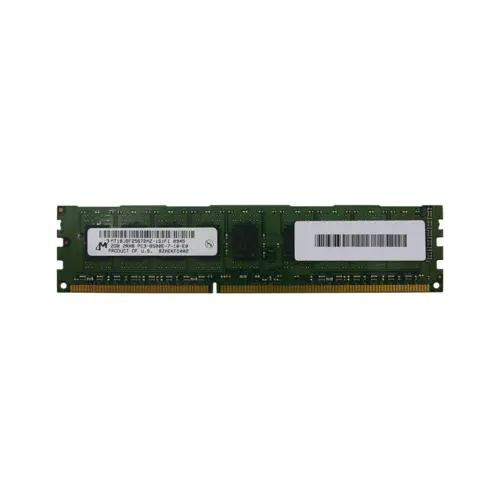
The MT18JSF25672AZ-1G1F1 is a 2GB DDR3-1066 ECC UDIMM built for entry-level servers and workstations where uncompromising data integrity is essential for light virtualization or memory-intensive database roles. Its dual-rank x8 configuration interleaves accesses to boost memory bandwidth, while the CL7 latency and unbuffered architecture ensure stable, low-overhead error correction in platforms that prioritize reliability.
1. ECC error correction detects and corrects single-bit memory faults, preserving data integrity in always-on micro-servers and NAS appliances that safeguard critical business records.
2. Unbuffered UDIMM architecture cuts signal latency versus registered alternatives, sharpening response times for lightweight DNS, DHCP, and small-scale virtualization hosts.
3. Dual-rank x8 interleaving organizes banks to keep the memory channel steadily fed, sustaining smooth performance for multi-threaded backup jobs and containerized applications.
4. CL7 column access latency accelerates random read/write operations, reducing query lag in low-transaction database and email serving tasks.
5. Purpose-built 2GB density fits headless embedded server and network gateway platforms where minimal power draw and stable behavior outweigh sheer memory capacity.
Designed for entry-level servers and workstations, the MT18JSF25672AZ-1G1F1 is an unbuffered DDR3 ECC UDIMM engineered to solve critical stability and performance pain points that impact your bottom line. Its ECC capability is non-negotiable in any hosted environment: in a virtualized cluster running multiple tenants, a single undetected bit-flip in memory can corrupt hypervisor state or silently alter financial data in a transactional database, leading to costly downtime or compliance failures. The module’s dual-rank x8 organization directly accelerates memory-intensive applications like an in-memory database or Redis cache, using rank interleaving to overlap read/write cycles and boost effective bandwidth without raising clock speeds. This low CAS latency of CL7, coupled with the unbuffered architecture, minimizes signal travel time, so each access completes measurably faster—a decisive advantage when microsecond response times directly define user experience in real-time analytics. Operating at a reliable 1.5V, it maintains thermal headroom inside dense 1U rack nodes, preventing throttling during sustained workloads. With compliance to RoHS standards, you deploy a proven, stable memory foundation that keeps your database queries consistent and your services online.
General Virtualization
For lightweight hypervisors hosting multiple small VMs, populate all memory channels with identical 2 GB UDIMMs to maximize available capacity while maintaining balanced interleaving. Aim for a minimum of 8 modules (16 GB) to support a modest cluster of virtual machines, ensuring each VM receives dedicated ECC protection against in-memory errors. Avoid mixing capacities or speeds to preserve stability in multi-tenant workloads.
In-Memory Database
In-memory databases demand both capacity and data integrity; deploy six to eight of these 2 GB ECC UDIMMs (12–16 GB) across all memory channels to reduce latency through symmetrical channel population. Supplement the configuration with SSD-backed swap only for cold data, as active datasets should reside entirely in DRAM. Note that for modern workloads this capacity is limited, so prioritize only small-scale caching or development instances.
High Performance Computing (HPC)
For entry-level HPC nodes processing moderate datasets, install the modules in a balanced multi-channel configuration—typically six or twelve DIMMs on dual-socket platforms—to sustain bandwidth under continuous load. The ECC functionality is critical for long-running simulations where bit flips could corrupt results. Validate that total installed memory aligns with the problem size per core, and consider replacing these low-density sticks with higher-capacity RDIMMs if scaling beyond 32 GB is required.
Server memory, rigorously tested. Compatible with Dell PowerEdge R320, R420, HP ProLiant DL320e Gen8, Lenovo ThinkServer TS140.
Q: Can I mix this MT18JSF25672AZ-1G1F1 with other memory modules of different brands or speeds?
A: Mixing ECC UDIMMs from different vendors or speeds is not recommended. The system will operate at the lowest common speed, potentially causing instability and undermining error correction capabilities.
Q: Is this memory compatible with my Intel or AMD server platform?
A: This DDR3-1066 ECC Unbuffered DIMM is compatible with Intel Xeon E3-1200 series (e.g., C202/C204 chipsets) and select AMD Opteron 4000 series platforms that support 2GB UDIMMs and ECC functionality.
Q: What is the recommended DIMM population order for optimal performance?
A: Consult your server motherboard manual. Generally, populate identical DIMMs starting with the slot farthest from the CPU, filling blue slots first for channel balancing and optimal ECC memory interleaving.
Q: Does this module support overclocking or XMP profiles?
A: No. As a server-grade ECC UDIMM running at JEDEC standard DDR3-1066 with CL7, it is designed for data integrity and stability. Overclocking and XMP are not supported.
Q: What warranty and typical failure rate can I expect?
A: This module is covered by a 1-year warranty. Enterprise-class ECC UDIMMs exhibit an extremely low annualized failure rate, typically below 0.5%, when operated within specified voltage and thermal limits.