











 Secure payments
Standard refund policy
Trade Assurance
Secure payments
Standard refund policy
Trade Assurance
| Product Type | Memory Module |
|---|---|
| Compliance Standards | RoHS |
| Memory Capacity | 2 GB |
| Memory Technology | DDR3 |
| Product Voltage | 1.5V |
| RAM Speed | 1333MHz |
| RAM Standard | DDR3-1333/PC3-10600 |
| Error Identifying | ECC |
| Signal Type | Unbuffered |
| Column Access Strobe (CAS) | CL9 |
| Rank | Dual Rank x8 |
| Quantity of Pins | 240-pin |
| RAM Genre | UDIMM |
This is an unbuffered ECC DDR3 memory module primarily designed for entry-level servers and single-socket workstations where data integrity is critical. Its dual-rank x8 organization and CL9 latency ensure stable 1333 MHz operation with enhanced error correction, making it well-suited for file servers, light virtualization, and mission-critical small business applications that require reliable 24/7 uptime.
1. ECC protection continuously corrects single-bit memory errors, preventing silent data corruption in always-on entry-level servers hosting critical but lightweight network services.
2. Unbuffered signal type reduces access latency for the CPU, making this module a cost-efficient fit for small business servers where every millisecond of response time matters.
3. Dual Rank x8 organization interleaves access across two internal ranks, boosting sustained bandwidth to keep basic virtualization or file-serving workloads running smoothly under moderate concurrency.
4. 1333MHz operating speed delivers a stable and predictable 10.6 GB/s throughput, well-matched to energy-efficient single-socket servers that prioritize reliability over peak performance.
5. 2 GB capacity suits dedicated appliance-like roles such as DNS, DHCP, or firewall micro-services, where a minimal always-on footprint trumps the need for large memory pools.
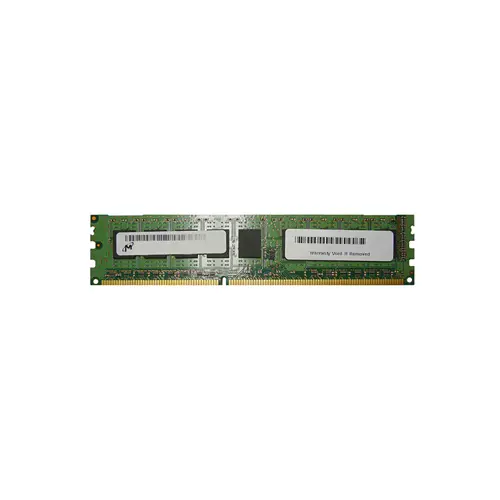
The Micron MT18JSF25672AZ-1G4G1 is a server-grade DDR3 UDIMM engineered for workstations and entry-level servers where data integrity and consistent throughput are non-negotiable. Its built-in ECC technology actively corrects single-bit memory errors in real time, shielding your virtualized cluster from silent data corruption that could crash hypervisors or poison guest machines. In a virtualized environment with multiple VMs contending for resources, that protection means fewer unexplained outages and reduced risk of database index inconsistencies. The dual-rank x8 organization further boosts interleaving efficiency, elevating sustained bandwidth during memory-intensive workloads like an in-memory Redis cache or a heavily queried SQL transaction log. Paired with 1333 MHz CL9 timing, the module delivers predictable, low-latency responses under continuous load, accelerating query execution without sacrificing stability. Unlike registered memory, this unbuffered ECC design speaks directly to the memory controller, trimming access delays in smaller-scale server builds. For administrators running ZFS storage pools or lightweight hyper-converged nodes, choosing this module means backing every computation with verified accuracy and consistent, reliable speed.
General Virtualization
For a hypervisor hosting moderate virtual machines, quantity matters more than single-module capacity. Using this 2 GB ECC UDIMM, populate up to six or eight identical modules across the server’s channels to achieve 12–16 GB of fault-tolerant memory, sufficient for lightweight guest workloads. Always install modules in symmetrical channel pairs to maintain balanced interleaving and maximize throughput under consolidation stress.
In-Memory Database
In-memory databases like Redis or Memcached thrive on low latency and data integrity, making ECC indispensable. Even with this modest 2 GB UDIMM, you can build a dedicated 16 GB cache tier by filling all eight DIMM slots of a single-socket board. Keep a few spare modules on-site—ECC scrubbing will flag correctable errors early, and rapid replacement preserves uptime for latency-critical queries.
High-Performance Computing (HPC)
HPC clusters often prioritize a large number of low-cost nodes over massive per-node capacity. Deploy these modules in bulk across fanless edge or render nodes, each populated with four to six 2 GB sticks (8–12 GB total). Dual rank x8 construction delivers decent bandwidth at 1333 MT/s, and unbuffered ECC protects long-running simulation tasks from transient memory faults without the premium of registered memory.
Rigorously tested, this ECC UDIMM server memory is compatible with Dell R210 II, HP ML310e Gen8, Lenovo TS140, and more.
Q: Can I mix this MT18JSF25672AZ-1G4G1 with other memory modules of different brands or speeds?
A: We strongly advise against mixing DIMMs with different speeds or brands in a server. Mismatched modules can cause system instability and ECC errors, negating data integrity benefits. Use identical part numbers for guaranteed compatibility and reliable operation.
Q: Is this memory compatible with my Intel Xeon E3 or AMD Opteron server platform?
A: This 2GB DDR3-1333 ECC Unbuffered DIMM is compatible with platforms supporting registered or unbuffered ECC DDR3. Verify your server board's Qualified Vendor List (QVL) for Intel Xeon E3-12xx or AMD 4xxx-series CPUs. It is not compatible with registered DIMM only systems.
Q: What is the recommended DIMM population order for optimal performance on my dual-socket server board?
A: Populate identical ECC UDIMMs in matched pairs per channel to enable symmetric memory interleaving. Typically start with slot 1A and 1B. Refer to your server's manual for the exact sequence to avoid performance degradation and uncorrected memory errors.
Q: Does this ECC Unbuffered DIMM support overclocking or XMP profiles?
A: No. This is a server-grade JEDEC standard DDR3-1333 module with CL9 latency. ECC memory is designed for stability and data integrity, not overclocking. It adheres strictly to standard SPD profiles without XMP support.
Q: What warranty and typical failure rate can I expect for this Micron MT18JSF25672AZ module?
A: It is covered by a 1-year warranty. Enterprise-class DDR3 ECC UDIMMs from Micron typically exhibit an Annualized Failure Rate (AFR) below 0.5% under normal operating conditions, ensuring high reliability for critical workloads.