











 Secure payments
Standard refund policy
Trade Assurance
Secure payments
Standard refund policy
Trade Assurance
| Product Type | Memory Module |
|---|---|
| Memory Capacity | 2 GB |
| Memory Technology | DDR3 |
| Product Voltage | 1.5V |
| RAM Standard | DDR3-1333/PC3-10600 |
| Error Identifying | ECC |
| Signal Type | Registered |
| Column Access Strobe (CAS) | CL9 |
| Rank | Dual Rank |
| Quantity of Pins | 240-pin |
| RAM Genre | RDIMM |
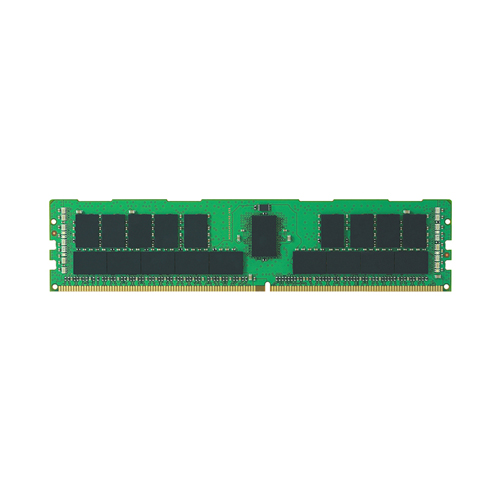
This 2 GB DDR3-1333 RDIMM with ECC and registered signal type is architected for entry-level servers and small-scale virtualization hosts where data integrity takes priority over capacity. Its dual-rank configuration enhances memory bandwidth via rank interleaving, while the registered interface stabilizes command and address signals across multiple DIMMs in rack-dense platforms.
1. ECC protection detects and corrects single-bit memory errors in real time, preserving data integrity for mission-critical enterprise workloads where even silent corruption is unacceptable.
2. Registered signaling stabilizes command and address lines under heavy multi-DIMM configurations, allowing servers to scale up memory channels without compromising signal quality.
3. Dual Rank organization leverages rank interleaving to boost effective bandwidth utilization, accelerating concurrent access patterns typical in virtualized and database environments.
4. DDR3-1333 operation supplies up to PC3-10600 peak bandwidth, sustaining steady throughput for moderate transactional processing and mid-density virtualization hosts.
5. Compact capacity fits dedicated microservices, network appliance roles, or boot-level provisioning precisely, avoiding stranded resources while keeping power per slot low.
The Micron MT18JSF25672PDY-1G4D is a DDR3-1333 Registered ECC DIMM built for the relentless demands of server environments. In a virtualization cluster hosting dozens of VMs per node, every bit matters. Its Error Correcting Code (ECC) transparently detects and fixes single-bit memory errors, preventing silent data corruption that could crash hypervisors or subtly alter guest application data. The Registered (buffered) signaling stabilizes electrical loads when populating multiple DIMMs per channel, enabling the high-density memory configurations essential for scaling virtual machines without sacrificing uptime. Dual Rank organization interleaves accesses across two internal banks of DRAM, boosting effective bandwidth under the chaotic, simultaneous I/O requests of a hypervisor. In an in-memory database like Redis, that same ECC guards against in-flight corruption of frequently updated key-value stores, preserving transactional integrity. The Registered nature allows dense memory pools to hold massive datasets entirely in RAM, cutting latency, while Dual Rank and 1333 MT/s throughput accelerate the high concurrency of real-time analytics queries, directly translating into faster, more reliable business insights.
General Virtualization
For basic virtualization hosts using these 2 GB RDIMMs, populate at least one module per memory channel to maintain balanced memory interleaving and consistent latency. Aim for symmetric configurations across both sockets in dual-processor systems—for instance, eight identical modules per CPU to provide 16 GB per socket, which can support a modest number of lightweight VMs. Always install modules in matched sets to preserve ECC error correction and ensure the hypervisor remains stable under memory pressure.
In-Memory Database
In-memory databases demand absolute capacity and data integrity, so fully populate every available DIMM slot with these registered ECC modules to maximize total memory within the platform’s limits. Even with 2 GB sticks, a 24-slot server delivers only 48 GB, making it suitable for small caching layers or development datasets rather than production-scale analytics. Leverage the dual-rank design for slightly better bandwidth, and always set the memory mode to fully mirrored or lockstep if the application requires fault resilience.
High-Performance Computing
For HPC workloads, bandwidth is critical; install at least one module per channel across all memory controllers to enable full channel interleaving. While 2 GB capacity per node is extremely low by modern standards, a farm of such nodes can still serve embarrassingly parallel tasks that require little memory per core. Fill all channels symmetrically with identical dual-rank RDIMMs to avoid performance throttling, and consider population rules that keep each channel’s load consistent for maximum floating-point throughput.
Rigorously tested, compatible with Dell PowerEdge R710, HP ProLiant DL380 G7, IBM System x3650 M3.
Q: Can I mix this MT18JSF25672PDY-1G4D with other memory modules of different brands or speeds?
A: Mixing is discouraged. Using modules with identical ECC Registered specifications, timings, and voltage ensures signal integrity and prevents system instability. Variation can cause POST failures.
Q: Is this memory compatible with my Intel or AMD server platform?
A: It is compatible with platforms supporting DDR3-1333 ECC Registered DIMMs, such as Intel Xeon 5500/5600 series or AMD Opteron 4100/6100 series chipsets. Verify your board's qualified vendor list.
Q: What is the recommended DIMM population order for optimal performance?
A: Populate identical DIMMs per channel, starting with the slot farthest from the CPU. Balance capacity across channels and follow your server's population rules for dual-rank RDIMMs to maintain throughput.
Q: Does this module support overclocking or XMP profiles?
A: No. This is a JEDEC-compliant server memory module designed for stability. It does not support overclocking or XMP profiles; it runs strictly at its rated DDR3-1333 CL9 specification.
Q: What warranty and typical failure rate can I expect?
A: This module includes a one-year warranty. As an enterprise-grade RDIMM with ECC, it offers a very low annualized failure rate under normal server operating conditions.