











 Secure payments
Standard refund policy
Trade Assurance
Secure payments
Standard refund policy
Trade Assurance
| Model | MT18JSF51272-1G1D |
|---|---|
| Product Type | Memory Module |
| Compliance Standards | RoHS |
| Memory Capacity | 4 GB |
| Memory Technology | DDR3 |
| Product Voltage | 1.5V |
| RAM Speed | 1066MHz |
| RAM Standard | DDR3-1066/PC3-8500 |
| Error Identifying | ECC |
| Signal Type | Registered |
| Column Access Strobe (CAS) | CL7 |
| Rank | Dual Rank x8 |
| Quantity of Pins | 240-pin |
| RAM Genre | RDIMM |
This Micron RDIMM is engineered for server platforms requiring data integrity and uptime, such as virtualization hosts and in-memory databases, where its registered signal path and ECC ensure stable operation under heavy load. The dual-rank x8 configuration combined with CL7 latency delivers balanced throughput and low access times for DDR3-1066 infrastructures that prioritize reliability over raw speed.
1. ECC error correction continuously guards against single-bit memory faults, delivering the data integrity that financial trading systems and virtualization hosts demand for non-disruptive operation.
2. Registered buffering amplifies signal strength across densely populated DIMM slots, enabling stable scaling of memory capacity in large-footprint data-center servers.
3. Dual Rank x8 layout keeps memory channels fully utilized, sustaining consistent throughput when multiple virtual machines compete for shared resources.
4. A tightly tuned CAS latency shortens the data retrieval window, sharpening response times for caching layers and real-time in-memory databases.
5. Standard-density capacity provides a cost-optimized foundation for dedicated application servers, balancing workload headroom with tight power budgets.
When you are running a virtualized cluster hosting dozens of mission-critical VMs, a single undetected bit-flip in memory can cascade into data corruption across your entire environment. The Micron MT18JSF51272-1G1D is a 4GB DDR3-1066 RDIMM purpose-built for server workloads, and its four defining characteristics translate directly into operational resilience. First, ECC error correction continuously detects and corrects single-bit errors, which is non-negotiable for in-memory databases like Redis or SAP HANA where every calculation must be exact. Second, the Registered signal architecture buffers command and address signals, allowing the memory controller to drive larger capacities stably—this means you can populate all 24 DIMM slots on a dual-socket server without signal degradation, a vital requirement for dense virtualization hosts. Third, its Dual Rank x8 organization interleaves access across two internal ranks, boosting bandwidth and concurrency: hypervisors smoothly schedule simultaneous I/O from multiple VMs without memory bottlenecks. Finally, the CL7 low latency combined with 1066MHz speed delivers the snappy response that transactional databases and real-time analytics demand. For the IT manager, this module isn’t just a spec—it’s insurance against silent data corruption, a foundation for seamless scalability, and a measurable improvement in workload throughput.
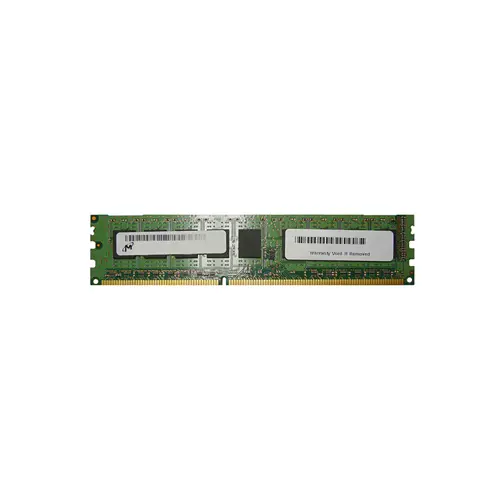
The module MT18JSF51272-1G1D is a 4GB DDR3-1066 Registered ECC DIMM (RDIMM) with 240 pins and 1.5V signaling, clearly identifying it as server-class memory for reliable, multi-socket platforms. Capacity planning must align with workload demands.
General Virtualization
For moderate VM density on a dual-socket server, install 12 identical modules (48GB total) by populating two DIMMs per channel across six memory channels. This balanced configuration maintains interleaving and ECC protection while delivering sufficient capacity for over 20 light VMs. For budget-sensitive hosts, use 6 modules (24GB) with one per channel, reserving slots for future scaling.
In-Memory Database
In-memory databases like Redis or SAP HANA require maximum capacity within reliability constraints. Fully populate all available DIMM slots—often 12 to 18 per server—to reach 48GB to 72GB using these 4GB RDIMMs. Enable memory mirroring or sparing modes to protect against uncorrectable errors, sacrificing some usable RAM. Note that this density suits small-scale or legacy in-memory instances; modern deployments may quickly outgrow the capacity.
High-Performance Computing
HPC clusters depend on bandwidth and uniformity. Install one 4GB RDIMM per memory channel (typically six or eight modules per node) to achieve a balanced, low-latency configuration without rank-switching penalties. This yields 24GB to 32GB per node, sufficient for many parallel MPI workloads. For larger memory footprints, scale across more nodes rather than mixing capacities, preserving uniform channel population and error correction.
Rigorously tested, compatible with Dell PowerEdge R720, HPE ProLiant DL380p Gen8, Cisco UCS C220 M3.
Q: Can I mix this MT18JSF51272-1G1D with other memory modules of different brands or speeds?
A: Mixing is not recommended in servers. Different ranks, speeds, or vendors may cause instability or force all modules to the lowest common speed, compromising validated reliability.
Q: Is this memory compatible with my Intel or AMD server platform?
A: It fits server boards supporting DDR3 Registered ECC RDIMMs, such as Intel 5500/5520 or AMD SR56x0 chipsets. Please verify your board's memory QVL for 4GB dual-rank x8 PC3-8500 modules.
Q: What is the recommended DIMM population order for optimal performance?
A: For optimal performance, populate identical DIMMs per channel following your server board's manual—typically starting with the blue slots for channel 1. Balanced interleaving requires matching ranks across channels.
Q: Does this module support overclocking or XMP profiles?
A: No. This is an enterprise-grade Registered ECC module conforming to JEDEC DDR3-1066 specifications. It does not support overclocking, XMP, or any deviation from standard 1.5V timings.
Q: What warranty and typical failure rate can I expect?
A: This module includes a 1-year warranty. As a Micron-based RDIMM built for server-grade workloads, it delivers very low annualized failure rates under proper thermal conditions.