











 Secure payments
Standard refund policy
Trade Assurance
Secure payments
Standard refund policy
Trade Assurance
| Product Type | Memory Module |
|---|---|
| Compliance Standards | RoHS |
| Memory Capacity | 4 GB |
| Memory Technology | DDR3 |
| Product Voltage | 1.5V |
| RAM Speed | 1333MHz |
| RAM Standard | DDR3-1333/PC3-10600 |
| Error Identifying | ECC |
| Signal Type | Unbuffered |
| Column Access Strobe (CAS) | CL9 |
| Rank | Dual Rank x8 |
| Quantity of Pins | 240-pin |
| RAM Genre | UDIMM |
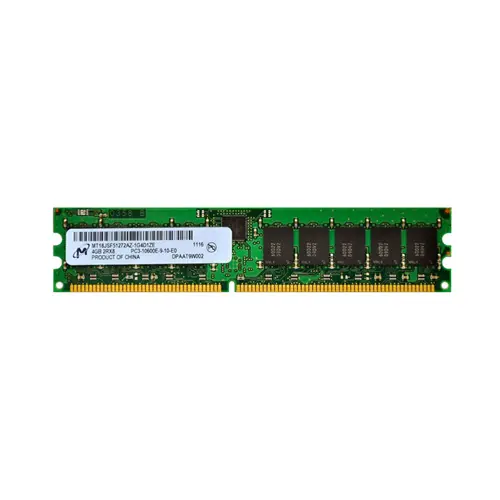
Designed as an ECC Unbuffered DIMM, this 4GB DDR3-1333 module is tailored for entry-level servers or single-socket workstations where data integrity is critical. Its dual-rank x8 organization with CL9 latency boosts memory bandwidth efficiency, while built-in ECC error correction safeguards against in-memory bit errors during sustained operation.
1. Error correction code actively scrubs single-bit errors, preserving data integrity in always-on microserver environments where undetected corruption during financial record-keeping is simply unacceptable.
2. Unbuffered signal topology cuts register latency, delivering snappier memory response for cost-sensitive entry-level servers that rely on quick database reads and light virtualization.
3. A 4 gigabyte footprint targets dedicated appliance roles like DNS, firewall, or lightweight hypervisors, keeping power consumption modest while running stable, single-purpose workloads.
4. 1333 megatransfers per second throughput aligns with mainstream server processors of its era, providing sufficient bandwidth for web hosting and file services without saturation.
5. Dual Rank x8 organization leverages rank interleaving to elevate effective bandwidth, smoothing performance under concurrent access patterns typical of multi-user NAS or backup scheduling.
Judging by its UDIMM form factor, 240-pin interface, and integrated ECC, the Micron MT18JSF51272AZ-1G4D1ZE is unequivocally a server memory module built for entry-level servers and workstations. In these environments, where every transaction matters, four defining characteristics of this 4GB DDR3-1333 stick translate directly into operational resilience.
The ECC error correction is your first line of defense against silent data corruption. In a hypervisor hosting multiple lightweight virtual machines, a single undetected bit flip can crash an entire guest instance or quietly corrupt application data. ECC detects and corrects these errors on the fly, preserving uptime for critical services. The unbuffered architecture then eliminates the additional clock cycle of registered memory, delivering lower latency that accelerates small-block I/O for a busy database server running Redis or an in-memory caching tier. Its dual rank x8 organization steps in where bandwidth counts, leveraging rank interleaving so that while one rank is refreshing, the other can respond to read requests, keeping query throughput high during concurrent workloads without stalling. Finally, the standard 1.5V operating voltage ensures thermal compliance in dense chassis and reduces long-term energy costs for 24/7 operations. Together, these characteristics mean you are deploying affordable, integrity-hardened memory that keeps small-scale virtualized clusters and file servers running accurately, responsively, and cost-effectively around the clock.
General Virtualization
For a single-socket virtualization host, install four of these 4 GB ECC UDIMMs to reach 16 GB of capacity, which comfortably runs several lightweight virtual machines. Populating all memory channels—typically dual- or triple-channel on Xeon E3 or similar platforms—unlocks interleaved bandwidth while the ECC engine guards against hypervisor‑level data errors. This balanced configuration gives small‑business or home‑lab deployments stable, cost‑effective consolidation.
In-Memory Database
In‑memory workloads such as Redis or Memcached require absolute data integrity and low latency, making dense, symmetric population critical. Install six or eight identical dual‑rank 4 GB modules for 24 GB to 32 GB total, filling every channel uniformly to maintain cache‑line‑friendly access and minimal skew. ECC eliminates silent corruption on hot datasets, so your real‑time analytics or financial caches run reliably around the clock.
High-Performance Computing (HPC)
Maximize memory bandwidth by loading all DDR3 channels evenly—for example, eight 4 GB DIMMs in a quad‑channel node deliver 32 GB at peak throughput. Uniform, dual‑rank UDIMMs sustain high‑speed parallel reads/writes, preventing channel imbalance that starves numerical solvers or simulation kernels. The unbuffered ECC construction merges strong error protection with fast signal integrity, making it ideal for CFD, molecular dynamics, and other throughput‑sensitive scientific workloads.
Rigorously tested server UDIMM, compatible with Dell R210 II, HP MicroServer Gen8.
Q: Can I mix this MT18JSF51272AZ-1G4D1ZE with other memory modules of different brands or speeds?
A: Mixing modules is not recommended for server environments. ECC and registered/unbuffered attributes must match exactly; otherwise, the system may default to non-ECC mode or fail POST, compromising data integrity.
Q: Is this memory compatible with my system? Which Intel or AMD platforms support this ECC UDIMM?
A: This DDR3-1333 ECC UDIMM is validated for Intel Xeon E3-1200 series, select Core i3, and AMD AM3+ FX platforms with ECC support. Always verify your server board's QVL for unbuffered ECC compatibility.
Q: What is the recommended DIMM population order for optimal performance with this dual-rank module?
A: Populate identical dual-rank DIMMs in matched channels first. For dual-socket servers, balance memory across both CPUs. Refer to the system manual for specific slot numbering, typically filling blue slots first for interleaving.
Q: Does this module support overclocking or XMP profiles?
A: No. This is a JEDEC-compliant server-grade ECC UDIMM running at standard 1333MHz with CL9 timings. Overclocking or XMP is not supported as stability and data reliability take precedence over speed in server environments.
Q: What warranty and typical failure rate can I expect for this memory?
A: A 1-year warranty is provided. ECC UDIMMs exhibit an extremely low annualized failure rate (AFR) typically below 0.5%, as they undergo rigorous screening and are designed for 24/7 mission-critical operation.