











 Secure payments
Standard refund policy
Trade Assurance
Secure payments
Standard refund policy
Trade Assurance
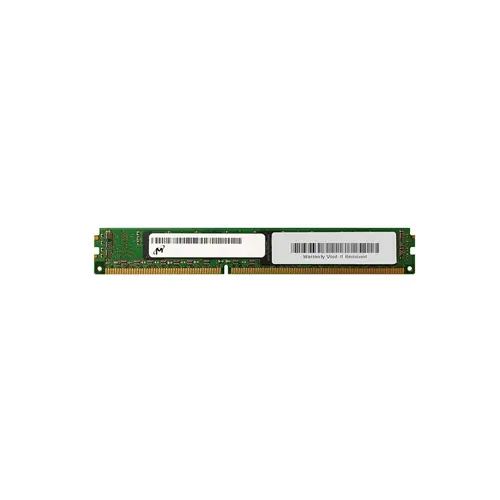
| Model | MT18KDF1G72AZ-1G4E1 |
|---|---|
| Product Type | Memory Module |
| Compliance Standards | RoHS |
| Memory Capacity | 8 GB |
| Memory Technology | DDR3 |
| Product Voltage | 1.35V |
| RAM Speed | 1333MHz |
| RAM Standard | DDR3-1333/PC3-10600 |
| Error Identifying | ECC |
| Signal Type | Unbuffered |
| Column Access Strobe (CAS) | CL9 |
| Rank | Dual Rank x8 |
| Quantity of Pins | 240-pin |
| RAM Genre | UDIMM |
This DDR3L-1333 ECC UDIMM is designed for entry-level servers, micro-virtualization hosts, and network-attached storage platforms where data integrity is critical. Its dual-rank x8 configuration enhances memory bandwidth through interleaving, while unbuffered signaling and CL9 latency deliver responsive operation and robust single-bit error correction at an energy-efficient 1.35V.
1. ECC protection detects and corrects single-bit errors in real time, preserving data integrity during continuous operation of critical entry-level server applications like file sharing or light virtualization.
2. Unbuffered signal topology eliminates the register buffer delay, delivering lower latency that improves responsiveness for latency-sensitive workloads on a microserver or small business server.
3. Ultra-low 1.35V supply dramatically cuts power draw and waste heat generation, enabling denser deployments in fanless small-office servers while reducing long-term energy costs.
4. Eight gigabytes of capacity per module provide ample headroom to run several concurrent containers or lightweight virtual machines on a single socket, simplifying consolidation for departmental workloads.
5. Dual rank x8 organization leverages bank interleaving to keep the memory channel busy, sustaining higher effective throughput when handling multiple simultaneous client requests in a workgroup collaboration server.
When every computation demands unwavering accuracy, the Micron MT18KDF1G72AZ-1G4E1 8GB DDR3 UDIMM becomes the silent guardian of your data. Engineered with ECC error correction, this module actively detects and corrects single-bit memory errors, a non-negotiable safeguard for virtualized clusters where a cosmic ray-induced bit flip can silently corrupt a hypervisor’s memory space and bring down dozens of guest machines. In an in-memory database like Redis or Memcached, that same ECC armor ensures transactional consistency, preventing the slow data degradation that unbuffered non-ECC memory would simply ignore until application logic fails. The dual-rank x8 design delivers superior bandwidth by interleaving access across two internal ranks, accelerating simultaneous read and write operations when your analytics container is hammering the dataset. Underneath that throughput lies a deliberate 1.35V low-voltage operation: in a 24/7 rack, the cumulative power saving versus standard 1.5V DDR3 becomes a measurable drop in both electricity draw and cooling overhead, directly lowering your total cost of ownership without sacrificing the CL9 latency that keeps response times crisp. When data is your most valuable asset, this memory means you never have to choose between reliability and performance.
General Virtualization
Deploy this 8 GB DDR3-1333 ECC UDIMM in identical pairs or sets of four to populate all available memory channels on your server board. For a typical virtualization host running 10–15 light VMs, install four modules (32 GB total) to balance capacity and memory bandwidth. Always use matched DIMMs to maintain error correction coherency, and leave a few slots free if future growth is anticipated.
In-Memory Database
Memory-resident workloads demand both capacity and reliability. Fill all DIMM slots with these 8 GB modules to reach the board’s maximum supported RAM—commonly 48–64 GB on single-socket servers. ECC is critical here to prevent silent data corruption during in-memory transactions. If your database size outgrows the board’s limit, consider upgrading to higher-capacity modules while retaining ECC unbuffered characteristic for chipset compatibility.
High-Performance Computing
Bandwidth-sensitive HPC jobs benefit from balanced memory channel populations. Install six or eight modules across the memory channels to achieve peak theoretical throughput; symmetrical loading prevents performance penalties. The 1.35 V low-voltage design helps control thermals in dense compute nodes. Pair the configuration with a processor that supports dual-rank x8 DIMMs at 1333 MHz to avoid downclocking under full load, ensuring predictable, sustained floating-point performance.
Server memory rigorously tested for Dell PowerEdge R320, T320, R420, HP ProLiant MicroServer Gen8.
Q: Can I mix this MT18KDF1G72AZ-1G4E1 with other memory modules of different brands or speeds?
A: Mixing is not recommended for server environments. Even identical specs from different brands can cause subtle timing mismatches, risking system instability and data corruption under ECC operation.
Q: Is this memory compatible with my Intel or AMD server platform?
A: It fits platforms supporting DDR3-1333 ECC Unbuffered DIMMs, such as Intel Xeon E3-1200 v2 series or AMD Opteron 3300 series. Verify your board supports 1.35V UDIMMs, not RDIMMs.
Q: What is the recommended DIMM population order for optimal performance?
A: Populate channels sequentially: first fill blue slots (channel A), then black slots (channel B). Consult your motherboard manual for exact slot numbering to maintain balanced memory interleaving and full ECC throughput.
Q: Does this module support overclocking or XMP profiles?
A: No. As ECC UDIMM server memory, it adheres to strict JEDEC standards for reliability. It does not support XMP or overclocking, as data integrity takes priority over speed.
Q: What warranty and typical failure rate can I expect?
A: This module includes a one-year warranty. Typical annualized failure rate (AFR) is below 0.5% under server operating conditions, reflecting Micron's rigorous component screening and testing procedures.