











 Secure payments
Standard refund policy
Trade Assurance
Secure payments
Standard refund policy
Trade Assurance
| Model | MT18KDF1G72AZ-1G6P1 |
|---|---|
| Product Type | Memory Module |
| Compliance Standards | RoHS |
| Memory Capacity | 8 GB |
| Memory Technology | DDR3 |
| Product Voltage | 1.35V |
| RAM Speed | 1600MHz |
| RAM Standard | DDR3-1600/PC3-12800 |
| Error Identifying | ECC |
| Signal Type | Unbuffered |
| Column Access Strobe (CAS) | CL11 |
| Rank | Dual Rank x8 |
| Quantity of Pins | 240-pin |
| RAM Genre | UDIMM |
This low-voltage 1.35V DDR3-1600 UDIMM with ECC is ideally suited for single-socket workstations and entry-level server platforms running memory-intensive, data-critical workloads such as financial modeling or content creation. Its dual-rank x8 organization enhances interleaving efficiency while unbuffered signaling minimizes latency, and the integrated ECC engine silently corrects single-bit errors to safeguard data integrity without compromising CL11 responsiveness.
1. On-the-fly error correction protects data integrity at every clock cycle, essential for always-on services where even a single bit flip can corrupt financial records or customer databases.
2. Low-voltage operation slashes power consumption and heat output per DIMM, directly improving energy efficiency and reducing cooling costs in densely packed rack deployments.
3. Dual Rank x8 organization interleaves memory accesses across internal banks, keeping the memory channel fully utilized and smoothing out latency spikes during concurrent virtual machine I/O.
4. Ample capacity provides headroom to consolidate multiple lightweight containerized applications or run a memory caching layer, maximizing workload density without immediate node expansion.
5. Sufficient signal rate delivers responsive data fetches for real-time monitoring dashboards and user-facing portals, preventing queuing delays under moderate concurrent user loads.
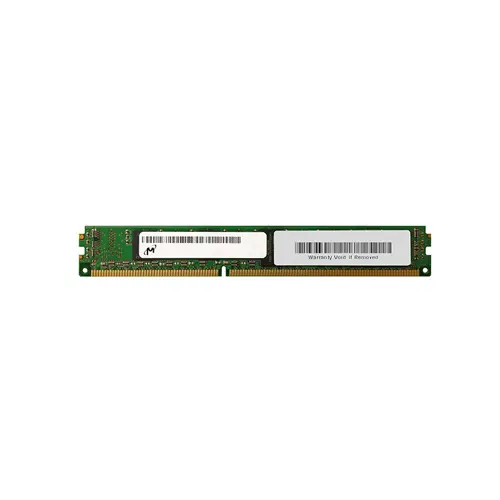
The Micron MT18KDF1G72AZ-1G6P1 is an 8 GB DDR3 UDIMM engineered for entry-level servers and workstations, where balancing data integrity, energy cost, and consistent performance is a daily operational challenge. Its ECC technology directly confronts the silent data corruption caused by single-bit errors. In a virtualization cluster running multiple lightweight VMs or containers, an unchecked bit flip in memory can destabilize an entire host, forcing a cascading failover that disrupts services. ECC catches and corrects these errors on the fly, preserving uptime in a hyperconverged setup without the premium of registered DIMMs. The module’s 1.35 V low-voltage operation translates into tangible savings and thermal headroom. For a dense microserver farm or a 24/7 in-memory database appliance, the reduced power draw per DIMM accumulates into significantly lower cooling and electricity bills, while also extending the service life of embedded power stages. A true 1600 MHz clock speed combined with a dual-rank x8 organization then ensures that the memory controller can interleave accesses across two internal ranks, effectively hiding precharge latency. This is crucial when Redis or Memcached must sustain hundreds of thousands of small-object queries per second; a single-rank module would stall more frequently, but dual-rank interleaving smooths out the request pipeline and raises the ceiling of predictable throughput. Even with an unremarkable CAS latency of 11 cycles, the steadied rank interleaving and pure unbuffered signaling keep Java heap operations in a mid-tier application server lean and responsive. Together, these four characteristics—error correction, low voltage, dual-rank bandwidth, and unbuffered simplicity—form a cost-optimized reliability layer that keeps critical always-on services running predictably without inflating the platform budget.
Server Memory Capacity Planning
This ECC UDIMM is intended for server-class machines. Capacity planning for typical workloads is outlined below.
General Virtualization
Populate memory channels evenly to gain ECC protection and channel interleaving. Use a baseline of 4 x 8GB (32GB) for light VMs, scaling to 8 x 8GB (64GB) for moderate consolidation. Always deploy identical modules to maintain data integrity and ease expansion.
In-Memory Database
Maximize capacity by filling all DIMM slots; an 8-slot node yields 64GB suited for small Redis or Memcached deployments. The 1.35V low-voltage rating helps control thermals in compact chassis, improving long-term reliability.
High Performance Computing
For bandwidth-centric HPC, install one module per channel to unlock full bus width. A dual-socket node with 8x8GB (64GB) provides ~51.2 GB/s peak, enough for mid-range CFD or weather models. The dual-rank x8 design reduces contention and boosts sustained throughput.
Rigorously tested server DDR3 ECC UDIMM, validated for Dell PowerEdge R320/R420/R520 and HP ProLiant DL360e Gen8.
Q: Can I mix this MT18KDF1G72AZ-1G6P1 with other memory modules of different brands or speeds?
A: Mixing is not recommended. For server stability, use identical ECC UDIMMs. Unmatched speeds or non-ECC modules will force the entire memory array to run at the lowest common specification, potentially causing errors.
Q: Is this memory compatible with my system?
A: This DDR3-1600 ECC UDIMM suits servers and workstations with 240-pin slots and Intel Xeon E3/E5 or AMD Opteron platforms. Please confirm your motherboard supports 1.35 V unbuffered ECC memory.
Q: What is the recommended DIMM population order for optimal performance?
A: Populate identical DIMMs per memory channel according to the server motherboard manual. Typically, install dual-rank modules starting from the farthest slot from the CPU in each channel for optimal signal integrity and bandwidth.
Q: Does this module support overclocking or XMP profiles?
A: No. This is a server-grade ECC UDIMM compliant with JEDEC DDR3-1600 specifications. It does not support XMP or overclocking, as stability and data integrity are prioritized over speed adjustments.
Q: What warranty and typical failure rate can I expect?
A: This module comes with a one-year warranty. The typical annualized failure rate (AFR) for such enterprise memory is well below 0.5% under normal operating conditions, reflecting high reliability.