











 Secure payments
Standard refund policy
Trade Assurance
Secure payments
Standard refund policy
Trade Assurance
| Model | MT18KDF1G72PZ-1G6 |
|---|---|
| Product Type | Memory Module |
| Compliance Standards | RoHS |
| Memory Capacity | 8 GB |
| Memory Technology | DDR3 |
| Product Voltage | 1.35V |
| RAM Speed | 1600MHz |
| RAM Standard | DDR3-1600/PC3-12800 |
| Error Identifying | ECC |
| Signal Type | Registered |
| Column Access Strobe (CAS) | CL11 |
| Rank | Single Rank x4 |
| Quantity of Pins | 240-pin |
| RAM Genre | VLP RDIMM |
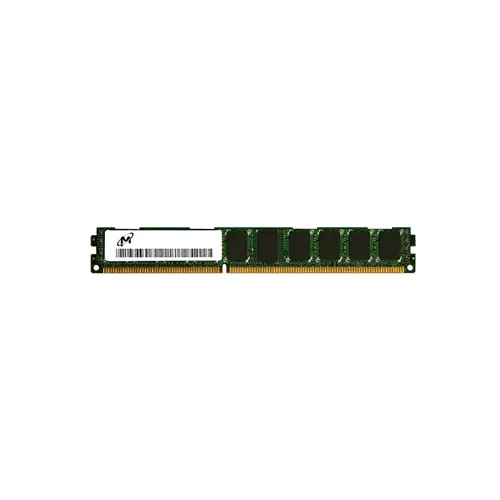
The MT18KDF1G72PZ-1G6 is a server-grade DDR3 VLP RDIMM optimized for dense virtualization and memory-intensive database workloads where low-profile form factor and power efficiency are critical. Its registered ECC architecture with 1.35V low-voltage operation and single-rank x4 configuration ensures robust signal integrity and data reliability while enabling higher memory population density in 1U and blade servers.
1. ECC memory quietly detects and corrects single-bit errors in the background, ensuring transactional integrity and crash resilience for virtualized databases and financial services.
2. Registered buffering re-drives address and command signals cleanly, allowing fully populated memory channels without signal degradation, which is essential for scaling up in-memory workloads.
3. The very low profile form factor reduces airflow obstruction inside dense 1U and blade enclosures, sustaining lower operating temperatures and higher compute density per rack.
4. Operating at reduced voltage cuts overall server farm power consumption and thermal stress, directly shrinking cooling overhead and improving long-term hardware reliability.
5. The sustained transfer rate keeps data flowing smoothly to each CPU core under heavy consolidation, preventing memory bandwidth starvation when hosting dozens of virtual machines.
The MT18KDF1G72PZ-1G6 is unmistakably a server-grade memory module, a VLP Registered ECC DDR3 DIMM built for enterprise environments where failure is not an option. Its four defining characteristics directly address the toughest pain points in data centers and high-density compute platforms.
First, ECC error correction continuously detects and corrects single-bit memory errors—left unchecked, these silent bit flips can corrupt financial transactions or destabilize a week-long simulation run. Second, the registered signal buffer enables the server to support fully populated memory channels across multiple DIMMs without signal degradation; in a virtualization cluster running dozens of VMs, this means you can safely scale to 384 GB or more per node and keep every guest responsive under heavy consolidation. Third, the 1.35V low-voltage operation cuts power draw at the module level, which across a rack of 40 nodes translates into measurable savings in cooling and electricity, while lowering thermal stress on nearby NVMe drives and processors. Finally, the very low profile form factor fits seamlessly into blade servers and 1U chassis where standard-height DIMMs would physically conflict with airflow paths or adjacent components—solving a major logistical barrier in dense deployments. Whether you are turbocharging an in-memory database like Redis or building a fault-tolerant hypervisor farm, this memory delivers the reliability, density, and efficiency your infrastructure depends on.
General Virtualization
For virtualized workloads, deploy modules in matched sets to populate all memory channels per CPU, ensuring optimal memory bandwidth. Using this 8 GB registered DIMM, a typical dual‑socket server would start with six or eight identical modules for a balanced 48 GB or 64 GB configuration, leaving room for future growth. Stick to identical part numbers to guarantee ECC integrity and avoid NUMA imbalances.
In‑Memory Database
In‑memory databases demand both capacity and reliability, so plan for the maximum DIMM slots supported by the platform. Populate with this single‑rank x4 RDIMM in multiples of eight or twelve to reach 128 GB or higher, keeping latency low through matched CAS timings. The 1.35 V operation helps curb thermal load when the server runs sustained, data‑heavy queries.
High‑Performance Computing
HPC clusters benefit from moderate capacity per node paired with high memory speed, making this DDR3‑1600 RDIMM a cost‑effective choice for dense compute blades. Configure six or eight identical 8 GB modules per node to sustain dual‑channel or triple‑channel throughput without throttling. The registered interface stabilises the command bus under the intense, parallel access patterns typical of scientific simulations.
Rigorously tested for compatibility with Dell PowerEdge R720, HP ProLiant DL380p Gen8, IBM System x3650 M4, and Lenovo ThinkServer RD430.
Q: Can I mix this MT18KDF1G72PZ-1G6 with other memory modules of different brands or speeds?
A: Mixing this Registered ECC DIMM with different brands or speeds is strongly discouraged. Variations in rank, timings, or voltage can cause signal integrity issues and system instability on server platforms.
Q: Is this memory compatible with my system?
A: This 240-pin DDR3-1600 RDIMM suits Intel Xeon E5/E3 v2/v3 or AMD Opteron servers that support 1.35V registered ECC memory. Always cross-check your motherboard’s qualified vendor list for compatibility.
Q: What is the recommended DIMM population order for optimal performance?
A: Populate identical DIMMs per channel, starting with the slots color-coded blue, then black. Balance capacity evenly across CPU sockets in dual-processor systems. Consult your server manual for exact slot numbering.
Q: Does this module support overclocking or XMP profiles?
A: No, this server RDIMM strictly follows JEDEC standards. It does not support overclocking or XMP profiles, ensuring fixed 1600MHz CL11 operation for maximum data integrity and 24/7 reliability.
Q: What warranty and typical failure rate can I expect?
A: The module includes a 1-year warranty. Enterprise-grade registered ECC memory has a very low annualized failure rate, typically under 0.5% under specified conditions, ensuring stable long-term operation.