











 Secure payments
Standard refund policy
Trade Assurance
Secure payments
Standard refund policy
Trade Assurance
| Product Type | Memory Module |
|---|---|
| Compliance Standards | RoHS |
| Memory Capacity | 4 GB |
| Memory Technology | DDR3 |
| Product Voltage | 1.35V |
| RAM Speed | 1333MHz |
| RAM Standard | DDR3-1333/PC3-10600 |
| Error Identifying | ECC |
| Signal Type | Registered |
| Column Access Strobe (CAS) | CL9 |
| Rank | Single Rank x4 |
| Quantity of Pins | 240-pin |
| RAM Genre | VLP RDIMM |
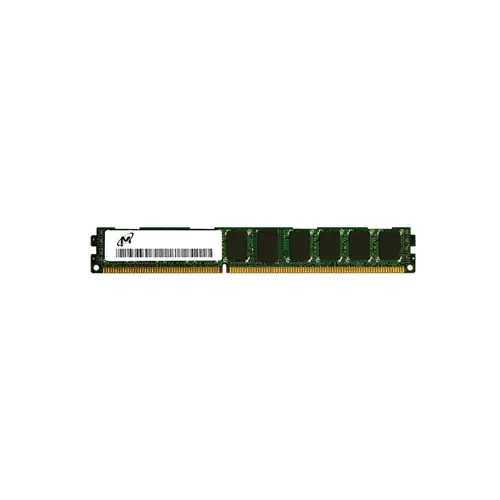
This 4GB DDR3L-1333 VLP RDIMM is a server-grade memory module purpose-built for virtualization hosts and in-memory databases that demand uncompromising data integrity. Its single-rank x4 ECC registered architecture, combined with a low 1.35V operating voltage and CL9 latency, ensures robust signal stability and energy efficiency in space-constrained rack and blade server deployments.
1. ECC memory actively detects and corrects single-bit data errors, preventing silent corruption in transactional databases and massively reducing unplanned server downtime.
2. Registered signal buffering minimizes electrical loading on the memory controller, enabling fully populated multi-socket servers to maintain stable, high-capacity configurations under constant virtualization workloads.
3. VLP RDIMM form factor lowers module height for dense blade and microserver deployments, improving airflow and thermal headroom so cooling costs stay predictable in high-density racks.
4. 1.35V low-voltage DDR3L operation cuts DRAM power draw significantly, directly lowering total cost of ownership through reduced energy and cooling overhead in always-on data centers.
5. Single Rank x4 organization balances bandwidth and command bus efficiency, ensuring consistent memory latency for latency-sensitive financial computing jobs when multiple modules are installed per channel.
The Micron MT18KDF51272PZ-1G4M1 is a 4GB DDR3-1333 VLP RDIMM engineered for server workloads. ECC corrects single-bit errors, preventing silent data corruption that could crash virtual machines or corrupt transactional databases. The registered buffer decouples the memory controller from the DRAM chips, enabling stable operation when all slots are fully populated—vital for scaling VMware clusters or large-memory databases like Redis. Its single-rank x4 construction reduces electrical loading, boosting command rate and sustained bandwidth for latency-sensitive in-memory analytics. Operating at a low 1.35V dramatically reduces power draw and cooling overhead across dense rack deployments, while the Very Low Profile design maximizes airflow in 1U servers, keeping thermals in check and extending module lifespan. In combination, these features ensure your virtualized infrastructure and real-time data engines run with uncompromising stability and efficiency.
General Virtualization
For virtualized hosts, balance capacity and bandwidth by installing these 4 GB registered ECC DIMMs identically across every memory channel. A dual‑socket server with triple‑channel architecture performs well with six modules (24 GB) or twelve modules (48 GB), keeping symmetrical access. This approach sustains 1333 MT/s and reliably supports a dozen light to medium VMs while the 1.35 V low‑voltage operation trims power and cooling costs.
In‑Memory Database
Maximise footprint and minimise latency for database caching. Populate all available DIMM slots with these 4 GB VLP RDIMMs; a dual‑processor platform with 12 slots per socket yields 96 GB of fully buffered ECC memory. The very‑low‑profile design eases airflow in dense 1U/2U chassis, and the single‑rank x4 organisation with CL9 latency helps maintain consistent response times under heavy in‑memory load.
High‑Performance Computing
Memory‑bandwidth‑sensitive HPC jobs demand perfectly balanced channel populations. Install one or two DIMMs per channel to leverage the full width of the processor’s memory controller. On a quad‑channel node, eight modules (32 GB) or sixteen modules (64 GB) form a uniform array that preserves 1333 MHz effective speed and registered ECC integrity for long‑running simulations where data accuracy is critical.
Rigorously tested server memory – compatible with Dell PowerEdge R720, R620, HP DL380p Gen8, and more.
Q: Can I mix this MT18KDF51272PZ-1G4M1 with other memory modules of different brands or speeds?
A: Mixing is strongly discouraged. This RDIMM requires registered DDR3-1333 timings. Combining with different speeds, ranks, or unbuffered modules will cause instability and may prevent boot. Use identical modules for guaranteed server uptime.
Q: Is this memory compatible with my system?
A: Compatible with Intel Xeon E5-2600 v1/v2 and AMD Opteron 6300/6200 platforms using DDR3 Registered ECC memory. Verify your server board supports 1.35V VLP RDIMMs and has 240-pin slots; check the qualified vendor list for precise certification.
Q: What is the recommended DIMM population order for optimal performance?
A: Install identical modules in matching pairs, one set per memory channel, typically populating the farthest slot from the CPU first. Consult your server manual for balancing across NUMA nodes, maximizing interleaved memory bandwidth and maintaining ECC correction performance.
Q: Does this module support overclocking or XMP profiles?
A: No. As a Registered ECC server module, it adheres strictly to JEDEC DDR3-1333 standards at CL9. It does not contain XMP profiles and is not intended for overclocking; stability and data integrity are paramount in server environments.
Q: What warranty and typical failure rate can I expect?
A: This module includes a one-year warranty. Under normal server conditions, the typical annualized failure rate (AFR) is below 0.3%. RoHS compliance ensures reliability and environmental conformity.