











 Secure payments
Standard refund policy
Trade Assurance
Secure payments
Standard refund policy
Trade Assurance
| Product Type | Memory Module |
|---|---|
| Compliance Standards | RoHS |
| Memory Capacity | 8 GB |
| Memory Technology | DDR3 |
| Product Voltage | 1.35V |
| RAM Speed | 1600MHz |
| RAM Standard | DDR3-1600/PC3-12800 |
| Error Identifying | ECC |
| Signal Type | Registered |
| Column Access Strobe (CAS) | CL11 |
| Rank | Dual Rank x8 |
| Quantity of Pins | 240-pin |
| RAM Genre | RDIMM |
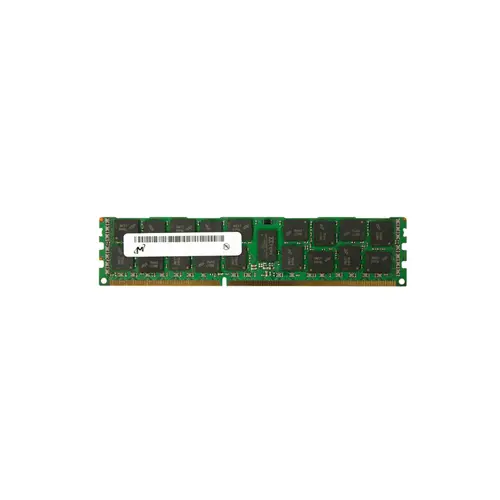
This registered DDR3L-1600 RDIMM’s dual-rank x8 organization enhances server memory bandwidth via rank interleaving, while integrated ECC and a registered signal type ensure data integrity and stable operation under heavy load. It is ideally suited for virtualization platforms and in-memory databases on legacy enterprise servers that demand reliable, low-voltage (1.35V) 8GB capacity expansions.
1. ECC protection detects and corrects single-bit memory errors on the fly, preserving data integrity for mission-critical database and financial transaction workloads.
2. Registered signal buffering stabilizes command and address lines under heavy load, enabling large-scale virtualization hosts to reliably support dozens of VMs without signal degradation.
3. Dual Rank x8 organization leverages rank interleaving to overlap data accesses, sustaining higher effective throughput for memory-intensive in-memory analytics and HPC tasks.
4. Low-voltage operation shrinks the power envelope per DIMM, directly cutting energy and cooling costs in dense rack-scale server deployments.
5. High-speed DDR3-1600 data rate feeds each CPU core with sufficient bandwidth, preventing memory bottlenecks during concurrent virtual machine and container orchestration.
The MT18KSF1G72PDZ-1G6E1HF is an 8GB DDR3-1600 Registered ECC DIMM, purpose-built for server and enterprise environments. Its ECC technology actively detects and corrects single-bit memory errors, a critical defense against silent data corruption in always-on systems. For a virtualized cluster running multiple VMs on a hypervisor, a random bit flip in guest memory can crash a production database or corrupt a live transaction; ECC turns that catastrophe into a transparent, logged correction, preserving uptime and data trust. The registered buffer stabilizes signal integrity when populating multiple DIMMs per channel, allowing a dense server with 12 or 24 slots to run stably at full capacity—essential for memory-hungry in-memory databases like SAP HANA or large Redis caches. Operating at a low 1.35V, this module reduces thermal load and power draw across a fleet of servers, directly lowering datacenter cooling costs and improving energy efficiency per virtual machine. Its dual-rank x8 organization increases bank-level parallelism, delivering higher effective bandwidth under concurrent workloads. In a consolidated virtualized environment where dozens of VMs compete for memory access, that rank interleaving minimizes latency spikes, keeping your OLTP query response times consistently fast and your cluster scaling predictably.
General Virtualization
For a virtualization host running multiple VMs, density and reliability are key. Populate all memory channels symmetrically with identical 8GB RDIMMs to maximize capacity while maintaining balanced memory access. A typical dual-socket server benefits from at least 64–128GB using these modules, ensuring smooth operation of mixed workloads without NUMA bottlenecks.
In-Memory Database
In-memory databases demand high capacity coupled with data integrity to hold entire datasets in RAM. Deploy 12 or more of these 8GB registered ECC modules (96GB+) across all available slots, leveraging their error correction to prevent silent data corruption. Prioritize ranks per channel to sustain low latency under heavy read/write streams, crucial for real-time analytics.
High-Performance Computing (HPC)
HPC clusters rely on aggregate memory bandwidth for parallel computation. Configure the server with one dual-rank 8GB RDIMM per channel to achieve balanced bandwidth without exceeding rank limits. For memory-bound simulations, fully populate the board—often 16–24 modules—to deliver high capacity and consistent throughput, while 1.35V operation reduces thermal overhead in dense rack deployments.
Tested server memory, compatible with Dell PowerEdge R720, HPE ProLiant DL380p Gen8, Lenovo ThinkServer RD630.
Q: Can I mix this MT18KSF1G72PDZ-1G6E1HF with other memory modules of different brands or speeds?
A: Mixing is strongly discouraged for ECC Registered DIMMs. Mismatched speed, rank, or chip organization can cause timing conflicts and parity errors. Always install identical modules per channel to maintain certified reliability.
Q: Is this memory compatible with my system?
A: This DDR3L-1600 Registered DIMM supports Intel Xeon E5/C600 series and select AMD G34/C32 platforms with 240-pin sockets. Verify your server board accepts low-voltage 1.35V ECC RDIMMs; it is not for desktops or notebooks.
Q: What is the recommended DIMM population order for optimal performance?
A: Consult your server manual. Generally, populate identical DIMMs per channel, filling slots farthest from the CPU first. For multi-CPU boards, balance equal capacity across all processor memory banks to maximize interleaving.
Q: Does this module support overclocking or XMP profiles?
A: No. Enterprise RDIMMs adhere strictly to JEDEC DDR3-1600/PC3-12800 at CL11 for 24/7 data integrity. Overclocking or XMP is disabled in server BIOS to ensure stability and prevent silent data corruption.
Q: What warranty and typical failure rate can I expect?
A: This module includes a 1-year warranty. Enterprise memory under proper cooling and power conditions typically demonstrates an annualized failure rate below 0.5%, far exceeding consumer-grade reliability standards.