











 Secure payments
Standard refund policy
Trade Assurance
Secure payments
Standard refund policy
Trade Assurance
| Product Type | Memory Module |
|---|---|
| Memory Capacity | 8 GB |
| Memory Technology | DDR3 |
| Product Voltage | 1.35V |
| RAM Speed | 1600MHz |
| RAM Standard | DDR3-1600/PC3-12800 |
| Error Identifying | ECC |
| Signal Type | Registered |
| Column Access Strobe (CAS) | CL11 |
| Rank | Dual Rank x8 |
| Quantity of Pins | 240-pin |
| RAM Genre | RDIMM |
This 8GB DDR3-1600 Registered ECC RDIMM is engineered for entry-level servers and virtualization platforms running memory-reliant workloads such as hypervisors or small in-memory databases, where data integrity and uptime are paramount. Its dual-rank x8 organization leverages rank interleaving to improve bandwidth efficiency, while the registered signal topology stabilizes multi-DIMM configurations and the 1.35V low-voltage operation reduces thermal overhead without sacrificing CL11 response latency.
1. ECC memory detects and corrects single-bit errors in real time, preventing silent data corruption that could silently invalidate transactional databases or hypervisor state in always-on servers.
2. Registered signal buffering stabilizes high-capacity memory configurations, enabling seamless scaling to large DIMM populations without compromising motherboard signal integrity under constant enterprise workloads.
3. Dual-rank organization increases bank-level parallelism per channel, boosting effective bandwidth utilization and keeping latency predictable for dense virtual machine consolidation.
4. Low-voltage operation curbs overall rack-level power draw and thermal output, directly contributing to lower cooling overhead and extended component lifespan in data center environments.
5. A mainstream transfer rate of the DDR3 generation provides a reliable balance of throughput and compatibility, sustaining steady I/O for legacy server platforms still running critical line-of-business applications.
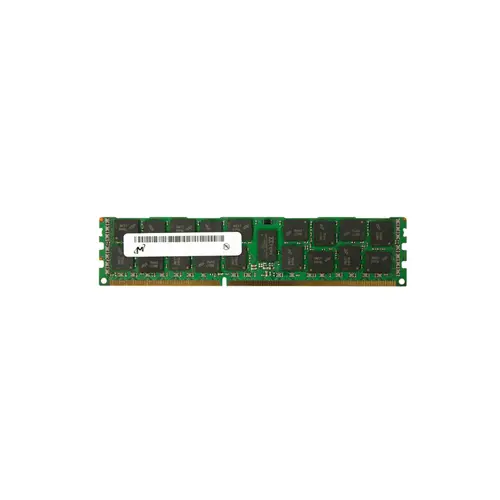
As a registered DDR3L-1600 module, the Micron MT18KSF1G72PDZ-1G6E1HG is built for servers where reliability and efficiency directly impact business outcomes. Its ECC technology actively corrects single-bit errors, preventing silent data corruption that could crash a virtualization cluster or poison an in-memory database. The registered buffer decouples the memory bus from the DRAM load, allowing you to populate multiple DIMMs per channel without signal degradation—essential when you need to maximize memory capacity for a dense VMware or Hyper-V host. The dual-rank x8 organization interleaves two sets of ranks, hiding precharge latencies and boosting sustained bandwidth. For in-memory databases like Redis, this translates into faster transaction processing. Finally, operating at 1.35V instead of 1.5V reduces power consumption and thermal output significantly, shrinking cooling overhead in a data center. For virtualized environments and performance-critical database caching, this module ensures resilient, responsive, and energy-conscious operation.
This 8GB DDR3L-1600 Registered ECC DIMM targets server platforms. Capacity recommendations for common workloads follow.
General Virtualization
Populate all memory channels for balanced bandwidth in virtualized environments. Use one DIMM per channel; a dual-socket server with four channels per CPU yields 64GB using eight modules—good for a small VM footprint. Add identical DIMMs to scale while keeping channel/rank symmetry for NUMA.
In-Memory Database
Fill every slot to maximize capacity and rank interleaving. Populate two dual-rank 8GB DIMMs per channel—16GB per channel, up to 192GB in a 24-slot system—for moderate in-memory databases with ECC. The 1.35V reduces power, but plan for larger DIMMs as data grows.
High-Performance Computing
For HPC, prioritize bandwidth and low power. Install one DIMM per channel to run at full 1600MT/s without rank-induced drops. An eight-DIMM (64GB) dual-socket node delivers balanced throughput, and 1.35V cuts cluster power—ideal for parallel jobs and latency-sensitive simulations.
Rigorously tested server memory, compatible with Dell PowerEdge R720, R620, HP ProLiant DL380p Gen8, and more.
Q: Can I mix this MT18KSF1G72PDZ-1G6E1HG with other memory modules of different brands or speeds?
A: Mixing RDIMMs is not recommended. Even with identical specs, brand or speed mismatches may cause POST failures or instability on server platforms. Use identical part numbers for guaranteed compatibility.
Q: Is this memory compatible with my system?
A: This DDR3L RDIMM is designed for servers with Intel Xeon E5-2400/2600 v1/v2 or AMD Opteron 6300 series. Verify your board supports 1.35V, 1600MT/s, and registered ECC modules.
Q: What is the recommended DIMM population order for optimal performance?
A: Install identical DIMMs per channel in sets of 2 or 4, starting with the slots furthest from the CPU. Follow your server's manual for balanced memory population to maximize interleaving.
Q: Does this module support overclocking or XMP profiles?
A: No. This is a JEDEC-compliant registered ECC module for server stability. It does not support XMP or overclocking, as reliable error correction requires strictly defined timings.
Q: What warranty and typical failure rate can I expect?
A: This Micron module includes a 1-year warranty. Enterprise RDIMMs have an extremely low annualized failure rate (AFR), typically under 0.5%, thanks to rigorous screening and ECC protection.