











 Secure payments
Standard refund policy
Trade Assurance
Secure payments
Standard refund policy
Trade Assurance
| Product Type | Memory Module |
|---|---|
| Compliance Standards | RoHS |
| Memory Capacity | 8 GB |
| Memory Technology | DDR3 |
| Product Voltage | 1.35V |
| RAM Speed | 1600MHz |
| RAM Standard | DDR3-1600/PC3-12800 |
| Error Identifying | ECC |
| Signal Type | Registered |
| Column Access Strobe (CAS) | CL11 |
| Rank | Dual Rank x8 |
| Quantity of Pins | 240-pin |
| RAM Genre | RDIMM |
This 8GB DDR3-1600 RDIMM, operating at a low 1.35V with ECC and registered signaling, is purpose‑built for server platforms running virtualized environments or memory‑intensive workloads like in‑memory databases where data integrity is paramount. Its dual‑rank x8 organization and CL11 latency leverage rank interleaving to boost sustained throughput, while the registered buffer maintains signal stability across dense multi‑DIMM configurations.
1. ECC error correction detects and corrects single-bit memory faults in real time, preserving transactional integrity for mission-critical databases and financial services running nonstop.
2. Registered signal buffering decouples the memory bus load from the controller, allowing stable population of all channels for large-scale virtualization hosts without signal degradation.
3. Dual Rank x8 organization enables interleaved bank access, boosting sustained throughput and reducing stalls when hosting dense containers or VDI sessions.
4. 1.35V low-voltage operation cuts per-module energy draw and thermal output, directly shrinking cooling costs and power budgets in multi-rack data center environments.
5. 8GB module capacity provides a cost-effective density building block, letting IT architects scale precise memory footprints for mid-tier application servers and private cloud nodes.
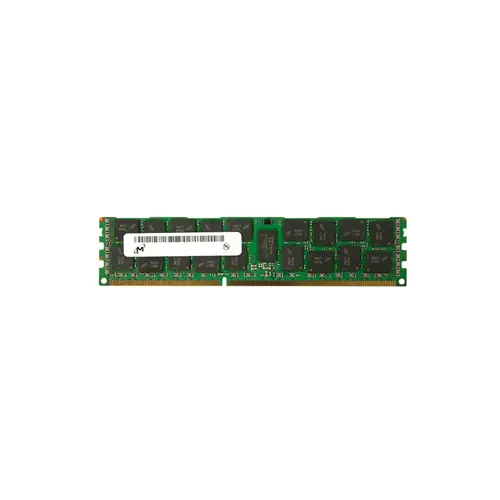
Designed specifically for enterprise servers, the Micron MT18KSF1G72PDZ-1G6P1 is an 8GB DDR3-1600 Registered RDIMM that transforms how your infrastructure handles mission‑critical workloads. Its ECC technology continuously detects and corrects single‑bit memory errors, a silent threat that can corrupt financial transactions or crash an entire virtualized cluster. In a dense VMware or Hyper‑V environment running dozens of virtual machines, that protection means the difference between uninterrupted uptime and a 3 a.m. pager alert caused by a stray cosmic particle flipping a memory cell.
The Registered architecture buffers command and address signals, allowing the server to populate all 24 DIMM slots without compromising signal integrity. For an in‑memory database like SAP HANA or Redis, this translates directly into being able to deploy massive, stable memory pools where every gigabyte is reliably addressable. Meanwhile, the Dual Rank x8 organization interleaves data across two internal ranks, delivering the sustained bandwidth necessary to keep multiple CPU cores fed during peak query loads. And because it operates at just 1.35V, the module significantly reduces power consumption across a rack of servers, lowering both your energy bill and thermal stress on critical components without sacrificing the 1600MHz speed your applications demand. This isn’t just a memory upgrade; it’s a resilience and performance foundation for your data center.
This 8GB DDR3L-1600 RDIMM is a server-class memory module featuring ECC and registered buffering. Use the following capacity planning guidelines for typical server workloads.
General Virtualization
Begin with a minimum of four modules (32 GB) distributed equally across the platform’s memory channels to sustain moderate VM density and consistent access. For larger consolidation hosts, scale to eight or sixteen modules (64–128 GB), keeping identical DIMMs per CPU socket to preserve balanced memory latency and ECC integrity.
In-Memory Database
Maximize total capacity by populating all available DIMM slots. A baseline of eight modules (64 GB) supports small in-memory datasets, while sixteen or more modules (128 GB+) handle demanding caching and real-time analytics. The registered architecture maintains signal stability at high densities, and dual-rank x8 organization helps deliver predictable performance under full load.
High Performance Computing
Install one DIMM per memory channel (for example, eight modules in an eight-channel server) to achieve peak bandwidth, yielding 64 GB that is well-suited for many HPC codes. If larger capacity is required, deploy two DIMMs per channel, but be aware of possible speed reductions; always match ranks and latencies per channel to keep access times deterministic.
Rigorously tested and validated for Dell PowerEdge R620/R720, HP ProLiant DL380p Gen8, and compatible servers.
Q: Can I mix this MT18KSF1G72PDZ-1G6P1 with other memory modules of different brands or speeds?
A: Mixing different brands or speeds is not recommended for RDIMM servers. It may cause signal integrity issues, forcing all modules to the lowest common speed and potentially compromising ECC functionality.
Q: Is this memory compatible with my server system?
A: This DDR3-1600 Registered ECC module is designed for dual-processor platforms like Intel Xeon E5-2600 v1/v2 or AMD Opteron 6300 series. Verify that your server board supports 1.35V, 240-pin RDIMMs.
Q: What is the recommended DIMM population order for optimal performance?
A: Populate identical modules per channel, starting with the slots furthest from the CPU. For dual-socket boards, balance capacity across both processors. Always follow the server manufacturer's memory population guide.
Q: Does this module support overclocking or XMP profiles?
A: No. This is an enterprise-grade Registered ECC DIMM that adheres strictly to JEDEC DDR3-1600 standards. It does not support overclocking or XMP, as stability and data integrity are paramount.
Q: What warranty and typical failure rate can I expect?
A: This Micron module comes with a 1-year warranty. Built with ECC and rigorous testing, it delivers an extremely low annualized failure rate, ideal for 24/7 mission-critical server environments.