











 Secure payments
Standard refund policy
Trade Assurance
Secure payments
Standard refund policy
Trade Assurance
| Product Type | Memory Module |
|---|---|
| Compliance Standards | RoHS |
| Memory Capacity | 4 GB |
| Memory Technology | DDR3 |
| Product Voltage | 1.35V |
| RAM Speed | 1333MHz |
| RAM Standard | DDR3-1333/PC3-10600 |
| Error Identifying | ECC |
| Signal Type | Registered |
| Column Access Strobe (CAS) | CL9 |
| Rank | Dual Rank x8 |
| Quantity of Pins | 240-pin |
| RAM Genre | RDIMM |
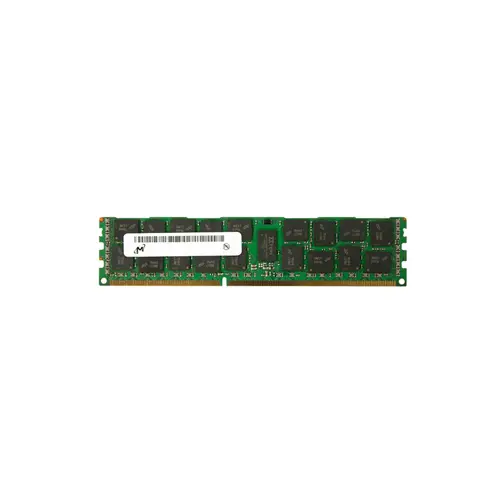
This RDIMM is an ECC Registered DDR3-1333 module engineered for legacy server platforms, offering the data integrity and signal stability essential for memory-intensive workloads such as virtualization and in-memory databases. Its 1.35V low-voltage operation reduces power consumption, while the dual-rank x8 configuration and CL9 latency provide a favorable balance of capacity and responsiveness in multi-DIMM deployments.
1. ECC protection catches and corrects single-bit memory errors in real time, preserving data integrity for financial ledgers and virtualized databases that cannot tolerate silent corruption.
2. Registered signal buffering stabilizes command and address lines across high-density memory banks, enabling reliable multi-DIMM configurations essential for scale-up enterprise servers.
3. Dual Rank x8 interleaving maximizes channel utilization by overlapping access cycles, delivering sustained throughput that keeps latency-sensitive workloads responsive under heavy consolidation.
4. 1.35V low-voltage operation reduces overall power draw and cooling overhead in dense rack deployments, directly lowering facility OPEX without sacrificing reliability.
5. 1333MT/s data rate balances cost-efficiency with solid bandwidth, making it a pragmatic choice for mainstream application servers and virtualized environments where stable, predictable performance matters more than peak speed.
When you are running a virtualization cluster hosting dozens of critical VMs, a single undetected bit-flip in memory can silently corrupt transactional data or crash an entire node. The Micron MT18KSF51272PDZ-1G4D1DD is an RDIMM engineered precisely to eliminate that risk. Its ECC technology continuously detects and corrects single-bit errors, meaning your hypervisor stays stable and your data retains integrity even under 24/7 load. The registered design buffers command and address signals, allowing the server motherboard to reliably populate all memory channels without signal degradation; for your in-memory database like Redis or SAP HANA, this translates to confidently scaling to higher capacities without crashes or boot failures. The dual-rank x8 organization interleaves accesses across two internal ranks, effectively boosting bandwidth during concurrent queries—a virtualized SQL Server environment responds noticeably faster. Operating at 1.35V instead of the standard 1.5V, this DDR3L module reduces thermal stress and cumulative power draw across a fully populated rack, which lowers cooling costs and extends hardware longevity in a densely packed data center.
Capacity Planning Guide for DDR3-1333 ECC Registered RDIMM (4GB)
This module is a server‑grade DDR3‑1333 Registered ECC DIMM operating at 1.35 V. Its ECC and registered signaling make it suitable for stability‑sensitive, multi‑slot server platforms. Capacity planning must account for the small 4 GB density, which limits per‑channel scalability in modern virtualization or memory‑intensive workloads.
General Virtualization
With only 4 GB per DIMM, populate all available memory channels evenly to maximize bandwidth while keeping a realistic VM density. In a dual‑socket platform with three channels per CPU, installing twelve 4 GB modules yields 48 GB—suited for light workloads like small web servers or lab environments. For production virtualization, consider larger DIMMs; these 4 GB modules are best used to expand existing low‑density configurations when budget is tight.
In‑Memory Database
In‑memory databases crave both capacity and low latency. Use the maximum number of identical 4 GB RDIMMs to hit the platform’s channel count, ensuring balanced ranks for optimal interleaving. At 4 GB per stick, a realistic ceiling is 64–96 GB, limiting datasets to modest sizes. This configuration works for development or caching layers, but production analytical databases will quickly outgrow it.
High Performance Computing
HPC nodes benefit from ECC and registered DIMMs for resilience, but 4 GB capacity constrains per‑node memory. Deploy these modules in fully populated, balanced channels (e.g., 12 x 4 GB = 48 GB per dual‑socket node) for bandwidth‑sensitive single‑precision codes. This suits lightweight compute nodes or cluster expansion where adding more nodes compensates for per‑node memory limits.
This rigorously tested server memory is compatible with Dell PowerEdge R720, HP DL380p G8, and Lenovo RD630 systems.
Q: Can I mix this MT18KSF51272PDZ-1G4D1DD with other memory modules of different brands or speeds?
A: Mixing RDIMMs from different brands or speeds is strongly discouraged. Variations in timing, rank, and voltage can compromise signal integrity and cause server instability. Population homogeneity is essential for validated enterprise reliability.
Q: Is this memory compatible with my system? Which Intel or AMD platforms are supported?
A: This DDR3-1333 ECC Registered DIMM is designed for servers using Intel Xeon E5-2400/2600 v1/v2 or AMD Opteron 6300/8300 series platforms. Please verify your motherboard QVL for RDIMM support.
Q: What is the recommended DIMM population order for optimal performance?
A: Always follow your server board’s specific memory population guide. Generally, populate identical DIMMs per channel starting from the farthest slot from the CPU. Balanced configurations across all memory channels ensure maximum bandwidth.
Q: Does this module support overclocking or XMP profiles?
A: No. This module runs exclusively at JEDEC standard DDR3-1333 (PC3-10600) with CL9 timings. RDIMMs used in server environments do not support overclocking or XMP, prioritizing stability and error-free operation.
Q: What warranty and typical failure rate can I expect?
A: This product includes a 1-year warranty. As a rigorously tested enterprise RDIMM, the annualized failure rate (AFR) is typically below 0.5%, reflecting high reliability for critical workloads.