











 Secure payments
Standard refund policy
Trade Assurance
Secure payments
Standard refund policy
Trade Assurance
| Product Type | Memory Module |
|---|---|
| Compliance Standards | RoHS |
| Memory Capacity | 4 GB |
| Memory Technology | DDR3 |
| Product Voltage | 1.35V |
| RAM Speed | 1333MHz |
| RAM Standard | DDR3-1333/PC3-10600 |
| Error Identifying | ECC |
| Signal Type | Registered |
| Column Access Strobe (CAS) | CL9 |
| Rank | Dual Rank x8 |
| Quantity of Pins | 240-pin |
| RAM Genre | RDIMM |
Designed for legacy server platforms, this 4 GB DDR3-1333 Registered DIMM with ECC delivers the data integrity and signal stability required by memory-intensive workloads such as virtualization hosts and in-memory databases. Its dual-rank x8 organization maximizes interleaving performance while the 1.35 V low-voltage operation reduces power consumption in dense, always-on data-center deployments.
1. ECC error correction detects and corrects single-bit memory faults, preventing silent data corruption that could compromise financial transactions or database integrity in always-on servers.
2. Registered signal type buffers the command and address lines, maintaining signal integrity across fully populated memory channels in dense rack server deployments.
3. Dual Rank x8 organization maximizes bank-level parallelism, sustaining consistent bandwidth under heavy virtualization when multiple VMs contend for memory resources.
4. 1333MHz clock speed delivers balanced throughput for DDR3-generation servers, efficiently handling concurrent requests in web hosting and mid-tier application workloads.
5. 1.35V low-voltage operation cuts overall thermal envelope and power consumption in multi-DIMM configurations, directly reducing cooling overhead in energy-conscious data centers.
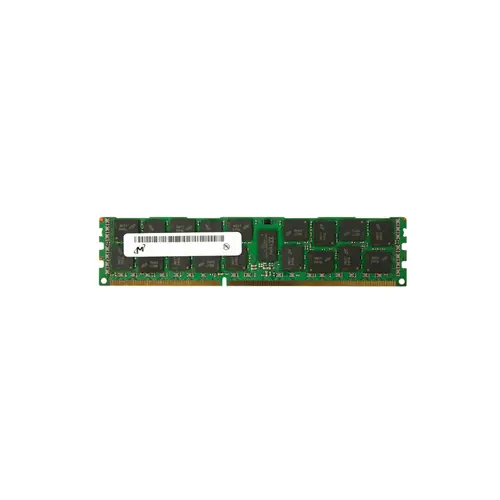
Targeting enterprise servers and workstations, the Micron MT18KSF51272PDZ-1G4M1FF is a 4GB DDR3-1333 Registered DIMM engineered for mission-critical environments where failure is not an option. Its defining characteristics directly address the real-world pain points of IT infrastructure.
First, integrated ECC continuously detects and corrects single-bit memory errors caused by background radiation, a silent threat that can corrupt financial transactions or silently flip a virtualization hypervisor’s state. With Registered logic buffering the address and command lines, this RDIMM stabilizes signal integrity across fully populated memory banks, allowing you to confidently scale your VMware ESXi cluster to dozens of VMs without boot failures or random crashes. The low 1.35V operating voltage compounds this reliability: in a 24/7 in-memory database like SAP HANA deployment, it slashes thermal load and power consumption per node, reducing cooling strain and total cost of ownership. Finally, its dual-rank x8 organization interleaves memory accesses for higher effective bandwidth. When your Redis instance handles millions of concurrent queries, this architectural detail minimizes latency and prevents throughput saturation, delivering the deterministic performance that keeps real-time analytics responsive.
Capacity Planning Guide for DDR3 Registered ECC Memory (4GB RDIMM)
This module is a low-voltage (1.35V) DDR3-1333 Registered ECC DIMM, designed exclusively for servers and workstations that require data integrity and stability under sustained loads. Below are capacity and configuration recommendations for typical server workloads.
General Virtualization
Virtualized hosts demand ample memory headroom to avoid swapping. Deploy six to eight of these 4GB RDIMMs per CPU socket (24–32GB total) to comfortably run 10–15 light-to-moderate VMs. Populate all memory channels evenly to maintain balanced interleaving and consistent performance under multi-tenant workloads.
In-Memory Database
Low-latency databases like Redis or Memcached thrive on capacity and reliability. Populate all available DIMM slots — typically 12 or 16 modules per server — to reach 48–64GB of total memory. Configuring mirrored channels or sparing modes provides an extra layer of data protection without sacrificing the deterministic latency ECC memory offers.
High-Performance Computing (HPC)
HPC applications are often bandwidth-sensitive. Install at least one DIMM per memory channel (e.g., four identical 4GB RDIMMs per socket on a quad-channel platform) to maximize aggregate throughput. For larger working sets, use two DIMMs per channel while adhering to the platform’s population order, keeping DDR3-1333 speed intact for consistent floating-point performance.
This rigorously tested server memory works with Dell PowerEdge R720, R620, HP DL380p Gen8, and other DDR3 RDIMM platforms.
Q: Can I mix this MT18KSF51272PDZ-1G4M1FF with other memory modules of different brands or speeds?
A: Mixing RDIMMs of different brands or speeds is not recommended. The memory controller will downclock all modules to the lowest common speed, and mismatched configurations may cause stability issues or unbootable states on server platforms.
Q: Is this memory compatible with my system? Which Intel or AMD server platforms are supported?
A: This DDR3-1333 Registered ECC module is compatible with Intel Xeon E5/E3 v1/v2 platforms using C600-series chipsets and AMD Opteron 3200/4200/6200 series. Verify your server board supports 1.35V RDIMMs with 240-pin slots.
Q: What is the recommended DIMM population order for optimal performance?
A: For dual-socket servers, populate identical RDIMMs in matching slots per channel, typically starting with the farthest DIMM slot from the processor. Always follow the memory population guidelines in your server's technical manual to maintain balanced interleaving.
Q: Does this module support overclocking or XMP profiles?
A: No. This is a server-grade Registered ECC DIMM operating at standard JEDEC-compliant DDR3-1333 CL9 timings. It does not support XMP profiles or overclocking, prioritizing data integrity and platform stability over performance tuning.
Q: What warranty and typical failure rate can I expect for this module?
A: This module is covered by a 1-year warranty. Enterprise RDIMMs exhibit a typical annualized failure rate below 0.2% under standard operating conditions, assuming proper thermal management and adherence to voltage specifications.