











 Secure payments
Standard refund policy
Trade Assurance
Secure payments
Standard refund policy
Trade Assurance
| Product Type | Memory Module |
|---|---|
| Memory Capacity | 4 GB |
| Memory Technology | DDR3 |
| Product Voltage | 1.35V |
| RAM Speed | 1333MHz |
| RAM Standard | DDR3-1333/PC3-10600 |
| Error Identifying | ECC |
| Signal Type | Registered |
| Column Access Strobe (CAS) | CL9 |
| Rank | Single Rank x4 |
| Quantity of Pins | 240-pin |
| RAM Genre | RDIMM |
This DDR3-1333 Registered ECC RDIMM is optimized for entry-level servers and virtualization hosts where data integrity and stable operation under moderate loads are critical. Its single-rank x4 organization with CL9 latency and 1.35V low-power operation delivers efficient, error-corrected memory bandwidth ideal for small-scale memory databases and virtual machine deployments requiring 24/7 reliability.
1. Registered architecture buffers command and address signals, maintaining signal integrity across high-density server memory configurations and preventing data access errors under sustained load.
2. ECC actively corrects single-bit memory faults in real time, preserving transactional accuracy for critical enterprise applications like databases and financial systems.
3. Low-voltage operation reduces power draw and thermal stress inside dense rack environments, directly lowering facility cooling costs and improving long-term hardware reliability.
4. Single Rank x4 organization provides fine-grained error containment and simplified electrical loading, enabling more predictable fail-over behavior in fault-resilient server designs.
5. Tight CAS latency shortens memory fetch turnaround, delivering faster response for latency-sensitive virtualization workloads and in-memory caching tiers.
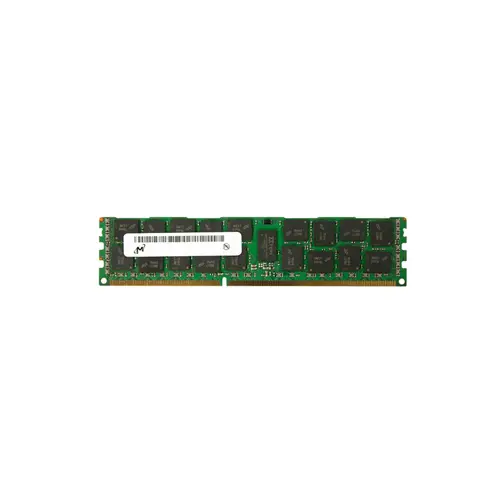
The Micron MT18KSF51272PZ-1G4K1HE is a DDR3L Registered DIMM purpose-built for server environments where data integrity and continuous uptime are non-negotiable. In a virtualized cluster running dozens of VMs, its hardware ECC silently corrects single-bit errors caused by background radiation, directly preventing silent data corruption that could crash hypervisors or corrupt databases without warning. The registered signal buffer actively reduces electrical loading on the memory controller, allowing you to populate all 24 DIMM slots across multiple channels with rock-solid stability—essential for memory-dense virtualization farms. Moreover, its 1.35V low-voltage operation sharply cuts power draw and waste heat inside crowded racks, trimming cooling overhead and extending the service life of nearby components. When applied as an in-memory database cache for applications like Redis, the single-rank x4 organization and CL9 low latency work in tandem to accelerate random data access under high concurrency, so transactional queries complete faster and with lower jitter. Each design element converges to harden mission-critical workloads: ECC for truth, registered buffering for scalable capacity, low voltage for operational efficiency, and an optimized rank architecture for responsive performance. This module translates directly into fewer outages, reduced operational cost, and a tangible competitive edge for data-driven enterprises.
General Virtualization
For lightweight virtualized environments, a single 4 GB RDIMM is only sufficient for a few small VMs. We recommend populating at least four identical modules for 16 GB total, enabling moderate density with memory interleaving. Deploy 8–12 modules across all memory channels to balance cost and VM density, and always use identical registered DIMMs to maintain ECC and signal integrity.
In-Memory Database
In-memory databases demand capacity and fault tolerance, making a 4 GB module a building block for larger sets. Start with six to eight modules (24–32 GB) in a balanced channel configuration and scale up to the platform’s limit using as many identical low-voltage RDIMMs as possible. The ECC and registered signaling protect data integrity under sustained high-speed workloads.
High-Performance Computing
HPC clusters benefit from populating all memory channels to maximize bandwidth. A 4 GB RDIMM serves as a granular unit: install one module per channel (e.g., eight modules for 32 GB) to fully utilize the processor ’s memory bandwidth while keeping latency uniform. Single-rank x4 modules like this one help achieve high frequency and excellent command rate stability in dense compute nodes.
Stringently tested server RDIMM, compatible with Dell PowerEdge R710, HP DL380 G7, and more.
Q: Can I mix this MT18KSF51272PZ-1G4K1HE with other memory modules of different brands or speeds?
A: Mixing is not recommended. For registered ECC server memory, all modules should share identical speed, rank, and timings to avoid signal integrity issues and potential system instability.
Q: Is this memory compatible with my system?
A: It is compatible with servers using Intel Xeon E5-2600/E5-2400 series or AMD Opteron 4300/6300 platforms that support DDR3 ECC Registered DIMMs. Verify your motherboard’s QVL for confirmation.
Q: What is the recommended DIMM population order for optimal performance?
A: Follow your server board’s population guide. Typically, populate identical DIMMs per channel starting with the farthest slot from the CPU (e.g., A1, B1, C1) to maintain balanced multi-channel memory access.
Q: Does this module support overclocking or XMP profiles?
A: No. This is a JEDEC-compliant registered ECC module designed for stability, not overclocking. It does not support XMP profiles and operates solely at its rated speed of DDR3-1333.
Q: What warranty and typical failure rate can I expect?
A: This module carries a 1-year warranty. As an enterprise-grade RDIMM, it offers exceptionally high MTBF and a typical annualized failure rate well below 0.5% under specified conditions.