











 Secure payments
Standard refund policy
Trade Assurance
Secure payments
Standard refund policy
Trade Assurance
| Product Type | Memory Module |
|---|---|
| Compliance Standards | RoHS |
| Memory Capacity | 4 GB |
| Memory Technology | DDR3 |
| Product Voltage | 1.35V |
| RAM Speed | 1333MHz |
| RAM Standard | DDR3-1333/PC3-10600 |
| Error Identifying | ECC |
| Signal Type | Registered |
| Column Access Strobe (CAS) | CL9 |
| Rank | Single Rank x4 |
| Quantity of Pins | 240-pin |
| RAM Genre | RDIMM |
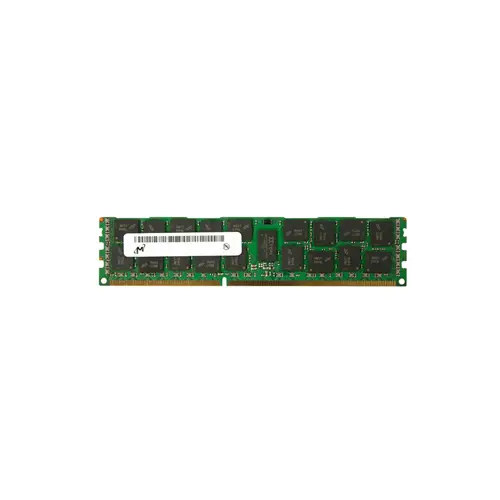
This Micron 4GB DDR3-1333 RDIMM, operating at a low 1.35V with ECC and registered signal integrity, is engineered specifically for entry-level server platforms where data reliability in virtualized environments or light memory-database workloads is non-negotiable. Its single-rank x4 organization and CL9 latency provide a balance of reduced bus loading and predictable timing, ensuring stable operation in dual-socket configurations that demand persistent data accuracy.
1. ECC protection actively corrects single-bit errors in real time, preventing silent data corruption that could crash virtualized workloads and compromise financial or medical records.
2. The registered buffer decouples the DRAM from the memory controller, enabling fully populated channels across multiple DIMMs so that large-scale virtualization hosts maintain reliable signal timing under heavy load.
3. Operating at a low 1.35 volts reduces thermal dissipation in dense rack enclosures, directly cutting facility power draw and allowing sustained performance without throttling in always‑on data centers.
4. Single Rank x4 organization uses x4‑width DRAM chips to deliver the lowest per‑rank electrical loading, ensuring clean command‑address bus signaling when multiple RDIMMs collaborate in a single channel.
5. DDR3‑1333 throughput supplies the balanced bandwidth needed for legacy enterprise platforms, keeping mid‑tier database transactions and light containerized services responsive while avoiding costly platform overhauls.
The Micron MT18KSF51272PZ-1G4M1HE is a server-class RDIMM engineered to solve the real-world reliability and efficiency challenges facing data centers. Its four defining characteristics work in concert to protect your critical workloads. The Error Correcting Code (ECC) is your first line of defense against silent data corruption; in a virtualized cluster, a single uncorrected bit-flip in a hypervisor can cascade into multiple VM failures, causing costly outages. For memory-intensive applications like in-memory databases, the Registered buffer chip decouples the memory controller from direct load, allowing you to fully populate high-capacity configurations without signal degradation—vital when terabytes of hot data must remain instantly accessible. Energy efficiency is tackled by the 1.35V low-voltage design, which cuts power consumption by up to 20% versus standard 1.5V modules, reducing both operating expense and thermal stress in dense racks. Finally, the balanced DDR3-1333 speed with CL9 latency provides the deterministic response time that online transaction processing systems demand. This delivers rock-solid stability, seamless scalability, and a lower total cost of ownership.
General Virtualization
For light to moderate virtualization workloads, a balanced configuration using these 4 GB Registered ECC DDR3L modules is cost‑effective. Install six or eight identical modules (24–32 GB total) in a dual‑socket server to populate one DIMM per channel and maintain memory bandwidth while providing enough headroom for a dozen typical VMs. Stick to identical RDIMMs to preserve error correction and avoid mixing ranks that could degrade performance.
In-Memory Database
In‑memory databases demand low latency and high reliability, making these CL9 ECC RDIMMs a solid foundation for small Redis or Memcached instances. Equip each memory channel with a single 4 GB module—three or four per CPU—to reach 12–16 GB of protected cache capacity. For larger datasets, scale horizontally across nodes rather than filling all slots with small DIMMs, as the limited 4 GB density would create excessive CPU overhead from many ranks.
High‑Performance Computing (HPC)
In memory‑bandwidth‑bound HPC clusters, these 1.35 V 1333 MHz modules can be used in fully‑populated, balanced configurations to minimize power draw per node. Plan for one DIMM per channel across all processors, yielding 12–16 GB per node for lightweight parallel tasks such as CFD post‑processing. If per‑core memory capacity is insufficient, consider replacing these with higher‑density RDIMMs rather than mixing capacities, which would forfeit the uniform access guarantees needed by MPI jobs.
Rigorously tested for servers, compatible with Dell PowerEdge R720, HPE ProLiant DL380p Gen8, and Lenovo System x3650 M4.
Q: Can I mix this MT18KSF51272PZ-1G4M1HE with other memory modules of different brands or speeds?
A: Mixing RDIMMs of different brands, speeds, or ranks is not recommended. Disparate modules force the memory controller to run at the lowest common speed and may cause signal integrity issues, jeopardizing platform stability.
Q: Is this memory compatible with my system?
A: This module is compatible with server platforms supporting DDR3-1333 Registered ECC memory, such as Intel Xeon E5-2400/E5-2600 v1/v2 or AMD Opteron 4300/6300 series. Verify your board requires 1.35V RDIMMs.
Q: What is the recommended DIMM population order for optimal performance?
A: To maximize memory interleaving, populate identical modules per channel starting with the slots farthest from the CPU. Balance capacity evenly across all memory channels as dictated by your server’s manual.
Q: Does this module support overclocking or XMP profiles?
A: No. This Registered ECC module is designed for mission-critical servers and adheres strictly to JEDEC DDR3-1333 standards. It does not support XMP, overclocking, or voltage adjustments beyond its specified 1.35V.
Q: What warranty and typical failure rate can I expect?
A: This module includes a 1-year warranty. As an enterprise-grade RDIMM, it delivers an annualized failure rate typically well below 0.5%, ensuring high reliability in 24/7 data center environments.