











 Secure payments
Standard refund policy
Trade Assurance
Secure payments
Standard refund policy
Trade Assurance
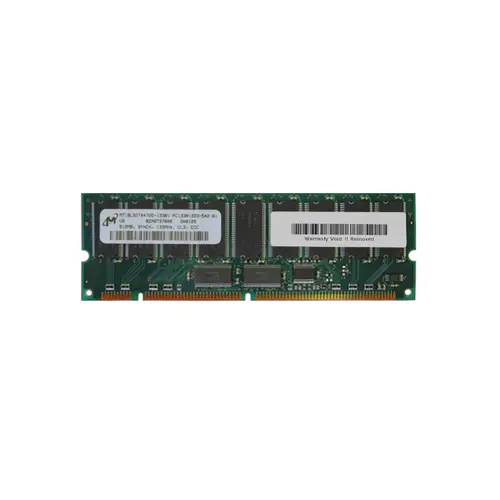
| Model | MT18LSDT6472G-133B1 |
|---|---|
| Product Type | Memory Module |
| Compliance Standards | RoHS |
| Memory Capacity | 512 MB |
| Product Voltage | 3.3V |
| RAM Speed | 133MHz |
| Error Identifying | ECC |
| Signal Type | Registered |
| Column Access Strobe (CAS) | CL3 |
| Quantity of Pins | 168-pin |
| RAM Genre | RDIMM |
This Registered ECC DIMM with CL3 latency delivers rock-solid data integrity for legacy server platforms, making it ideal for mission-critical applications like small-scale virtualization or memory-resident databases where even single-bit errors are unacceptable. The 168-pin RDIMM’s registered signal buffering ensures stable operation on older multi-slot server boards, extending the useful life of DDR-generation infrastructure while maintaining full RoHS compliance.
1. Registered signal buffering ensures signal integrity across multiple DIMM slots, allowing the server to scale memory capacity for larger databases without compromising stability.
2. ECC memory protection proactively detects and corrects single-bit errors, which is non-negotiable for financial transactions and long-running computational workloads.
3. The moderate clock speed delivers consistent, synchronous throughput perfectly matched to legacy enterprise applications that prioritize reliability over peak bandwidth.
4. A low CAS latency setting reduces the processor’s wait states, yielding faster data access that enhances the responsiveness of directory services and light caching roles.
5. This base capacity serves as a dependable foundation for dedicated network appliances and embedded controllers where purpose-built software requires a lean, stable memory footprint.
The Micron MT18LSDT6472G-133B1 is a registered ECC DIMM engineered for servers that simply cannot tolerate downtime. In a virtualization cluster, multiple guest machines share physical resources, so any undetected bit flip can cascade into corrupted databases or hypervisor crashes, taking dozens of services offline. The Error Correction Code on this module actively scrubs and corrects single-bit errors in real time, preserving data integrity far beyond what unbuffered memory can promise. Meanwhile, the registered signal buffer stabilizes the command and address lines when multiple DIMMs populate the same channel. This directly benefits in-memory databases like Redis or SAP HANA: as you scale capacity by populating every available slot, registered logic prevents signal degradation and ensures deterministic performance under heavy read-heavy workloads. The conservative 133 MHz clock with CL3 latency keeps timing margins relaxed, which is vital for legacy mission-critical systems that must run uninterrupted for years. When your business relies on consistent transactional throughput, this module delivers the error resilience and electrical stability that turn server memory from a commodity into a reliability anchor.
This module is a server-grade 512 MB ECC Registered SDRAM DIMM (168-pin, 3.3 V, 133 MHz). Capacity planning must exploit its data integrity while acknowledging the severe density constraint.
General Virtualization
Populate all DIMM slots (commonly eight) with identical 512 MB RDIMMs to reach a maximum of 4 GB. Install matched pairs across memory banks to enable ECC scrubbing and dual-channel interleaving. This minimal configuration can only host a single lightweight test VM—production virtualization demands far larger modern RDIMMs.
In-Memory Database
Even a fully populated 8-slot server provides only 4 GB, barely enough for tiny proof-of-concept datasets. Fill every slot with same-revision registered DIMMs to preserve signal integrity. For any real workload, plan an immediate transition to high-density DDR4 or DDR5 RDIMM platforms.
High-Performance Computing (HPC)
Deploy identical 512 MB modules in pairs per channel (e.g., four DIMMs in a 2-channel board) to maximize bandwidth through interleaving. The 133 MHz speed severely limits throughput, but registered ECC corrects single-bit errors during extended parallel runs. This setup is acceptable exclusively for validation or command nodes, not for compute-intensive clusters.
This rigorously tested server RDIMM is validated for Dell PowerEdge 2550, HP ProLiant DL380 G1, IBM x340—verify compatibility.
Q: Can I mix this MT18LSDT6472G-133B1 with other memory modules of different brands or speeds?
A: Mixing brands or speeds is not recommended for server memory. It can cause signal integrity issues, ECC errors, and system instability. Use identical Registered ECC modules to maintain validated reliability.
Q: Is this memory compatible with my Intel or AMD server platform?
A: This 512MB PC133 Registered ECC SDRAM fits legacy server boards with 168-pin slots. Confirm your server uses chipsets like Intel 440BX/GX or equivalent AMD platforms supporting 3.3V buffered DIMMs.
Q: What is the recommended DIMM population order for optimal performance?
A: Populate DIMMs in matched pairs per the server manual, starting with the primary bank. For systems supporting interleaving, fill identical sets across channels to maintain ECC and peak throughput.
Q: Does this module support overclocking or XMP profiles?
A: No. As a Registered ECC server DIMM, it adheres strictly to JEDEC CL3 specifications. Overclocking is prohibited to safeguard data integrity, which is essential for enterprise and mission-critical workloads.
Q: What warranty and typical failure rate can I expect?
A: This module includes a 1-year warranty. Typical failure rates are exceptionally low due to rigorous production testing. For servers, additional memory RAS features like sparing or mirroring are recommended.