











 Secure payments
Standard refund policy
Trade Assurance
Secure payments
Standard refund policy
Trade Assurance
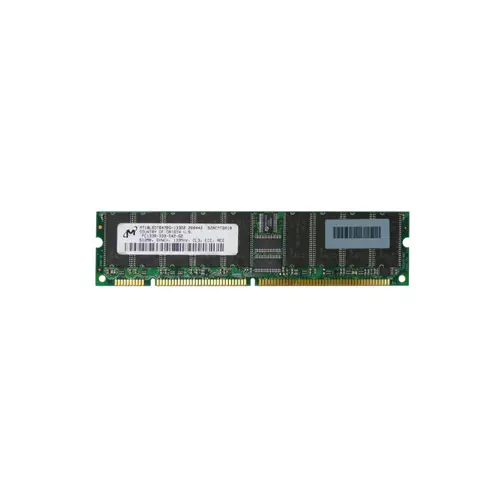
| Model | MT18LSDT6472G-133D2 |
|---|---|
| Product Type | Memory Module |
| Compliance Standards | RoHS |
| Memory Capacity | 512 MB |
| Product Voltage | 3.3V |
| RAM Speed | 133MHz |
| Error Identifying | ECC |
| Signal Type | Registered |
| Column Access Strobe (CAS) | CL3 |
| Quantity of Pins | 168-pin |
| RAM Genre | RDIMM |
This registered ECC DIMM with a low CAS latency of 3 is engineered for legacy server platforms requiring uncompromising data integrity, making it ideally suited for mission-critical workloads such as virtualization hosts and in-memory databases on aging but stable infrastructure. Its 168-pin PC133 architecture and 3.3V operation deliver stable, error-correcting performance in multi-slot configurations, ensuring reliable memory subsystem scaling where registered signaling minimizes electrical loading.
1. Half-gigabyte capacity suits dedicated server appliances and lightweight virtualized workloads, optimizing resource allocation without oversubscribing.
2. PC133 synchronous operation guarantees compatible, jitter-free timing in legacy enterprise systems where uninterrupted uptime is critical.
3. ECC protection transparently corrects single-bit memory errors in-flight, essential for financial transaction processing and sensitive database operations.
4. Registered buffering enables stable multi-rank server memory architectures, preserving signal integrity across fully populated motherboards.
5. Three-cycle CAS latency minimizes read delays, giving a low-latency edge to single-threaded enterprise services and rapid system boot processes.
The MT18LSDT6472G-133D2 is a server-grade Registered DIMM, defined by four critical attributes: ECC error correction, Registered signal buffering, CAS latency of 3, and its robust 168-pin 3.3V design. These are not mere specifications; they directly resolve pain points in virtualized clusters and in-memory databases. In a dense virtualization host, a single-bit memory error can silently corrupt a virtual machine’s state or a hypervisor page. ECC detects and corrects that flip instantly, preserving workload integrity without downtime. Simultaneously, the Registered buffer re-drives address and command signals, allowing you to populate every slot with 512 MB modules without signal degradation. This stability is vital when dozens of VMs compete for memory bandwidth. For an in-memory database like Redis or SAP HANA, the same buffered architecture maintains clean signal paths under sustained, high-frequency access, while CL3 latency minimizes the delay between a column address strobe and data retrieval, accelerating transaction processing. The 168-pin form factor and 3.3V operating envelope guarantee reliable drop-in compatibility in legacy server boards, eliminating electrical mismatches. For you, the IT administrator, this translates directly into reduced silent data corruption, unwavering stability under full load, and predictable low-latency performance where business continuity is non-negotiable.
General Virtualization
For legacy server platforms using MT18LSDT6472G-133D2 modules, virtualization demands large memory pools. Since each Registered ECC DIMM provides only 512 MB, you need to fully populate all available 168-pin slots to maximize capacity. A typical dual-socket server from that era with 8 slots can reach 4 GB, but even that is minimal — plan to aggregate multiple hosts if running several VMs and rely on memory overcommit cautiously due to the small footprint.
In-Memory Database
In-memory databases require all active datasets to fit into RAM, making capacity planning critical with 512 MB modules. You must size the total memory exactly to your dataset, adding overhead for database structures. Deploying the maximum supported number of modules is essential — for example, 16 such DIMMs yield 8 GB, only suitable for very small test instances. Configure memory interleaving and use all channels uniformly to reduce latency, but be prepared that this hardware severely limits in-memory workloads.
High-Performance Computing (HPC)
HPC workloads need high bandwidth and low latency, but 133 MHz Registered ECC SDRAM is a major bottleneck. With 512 MB DIMMs, you should install modules in matched sets across all memory channels to enable maximum interleaving and avoid performance gaps. Plan the node count carefully: even a modest cluster node with 8 GB (16 modules) will struggle, so consider distributed computing models that minimize per-node memory requirements, streaming data rather than holding it all resident.
Server-grade Registered ECC SDRAM rigorously tested for compatibility with Dell PowerEdge 2550, HP ProLiant DL380 G1, and IBM x330.
Q: Can I mix this MT18LSDT6472G-133D2 with other memory modules of different brands or speeds?
A: Mixing is not advised. Different brands or speeds can cause signal conflicts and ECC errors. To ensure reliability and uptime, install identical Registered ECC modules matched by timing, speed, and organization.
Q: Is this memory compatible with my system?
A: This 168-pin Registered ECC SDRAM DIMM targets legacy servers. Confirm your Intel or AMD platform explicitly supports 3.3V, 133MHz, CL3 RDIMMs. Check the board’s qualified vendor list for this exact part.
Q: What is the recommended DIMM population order for optimal performance?
A: Populate in matched pairs starting with the primary bank, usually slots 1 and 2. Follow your system board manual for proper interleaving. Incorrect order may disable ECC or degrade memory bandwidth.
Q: Does this module support overclocking or XMP profiles?
A: No. This server Registered ECC module operates at strict JEDEC-defined 133MHz timings. Overclocking and XMP are not supported; the design prioritizes data integrity and 24/7 stability over performance tuning.
Q: What warranty and typical failure rate can I expect?
A: It includes a 1-year warranty. Enterprise-grade components like this exhibit very low failure rates under proper thermal and voltage conditions. ECC further guards against data corruption, reducing in-field failures.