











 Secure payments
Standard refund policy
Trade Assurance
Secure payments
Standard refund policy
Trade Assurance
| Model | MT18VDDF6472G-335C3 |
|---|---|
| Product Type | Memory Module |
| Compliance Standards | RoHS |
| Memory Capacity | 512 MB |
| Memory Technology | DDR |
| Product Voltage | 2.5V |
| RAM Speed | 333MHz |
| RAM Standard | DDR-333/PC-2700 |
| Error Identifying | ECC |
| Signal Type | Registered |
| Column Access Strobe (CAS) | CL2.5 |
| Rank | Single Rank x4 |
| Quantity of Pins | 184-pin |
| RAM Genre | RDIMM |
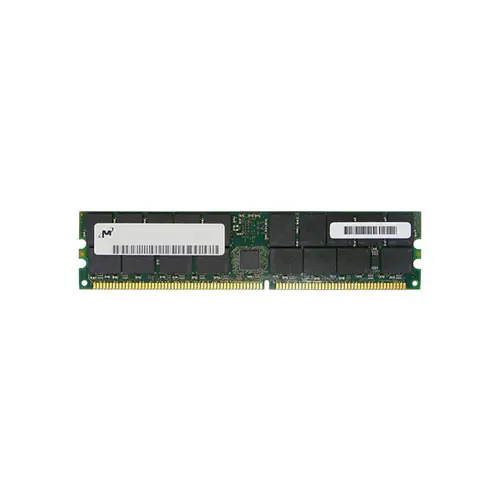
Designed for legacy server platforms, this 512 MB DDR-333 Registered ECC module ensures data integrity in memory-critical workloads such as virtualization and in-memory databases. Its single-rank x4 organization and CL2.5 latency deliver stable signal integrity and low access latency on 184-pin RDIMM-compatible systems.
1. ECC memory detects and corrects single-bit errors silently, preserving financial and transactional data integrity across always-on server fleets.
2. Registered signal buffering decouples the memory bus from chip loading, enabling dense population for virtualization hosts without compromising signal stability.
3. Single Rank x4 organization keeps electrical loading low while feeding the memory channel with enough parallelism to sustain heavy multi-VM throughput.
4. A CAS latency trimmed to just two and a half cycles reduces access delay, giving latency-sensitive enterprise applications a measurable query response advantage.
5. The PC-2700 bandwidth provides steady, predictable throughput for mid-tier server workloads, ensuring legacy platforms handle concurrent network services without I/O stalls.
For server environments like virtualized clusters or in-memory databases, the MT18VDDF6472G-335C3 module turns technical specifications into mission-critical reliability. The ECC technology silently corrects single-bit memory errors in real time, preventing silent data corruption that could crash hypervisors or corrupt financial records during a database transaction. Every uncorrected bit flip in a virtualization host risks cascading VM failures; with ECC, your uptime stays intact and your data remains accurate. The registered buffering architecture stabilizes signal integrity when multiple DIMMs populate a server board, so you can scale up memory capacity without worrying about electrical loading that would otherwise cause sporadic system hangs during peak query loads. Its single rank x4 organization and CL2.5 latency improve command scheduling efficiency, delivering predictable bandwidth for latency-sensitive operations like Redis lookups or live migration of virtual machines. While 512 MB capacity seems modest today, in dense 1U appliances running lightweight Linux containers or dedicated caching nodes, this module provides a compact, power-efficient path to adding just the right amount of resilient memory. You are not simply buying RAM; you are investing in the consistency and fault tolerance that enterprise workloads demand around the clock.
General Virtualization
For general virtualization, configure the system with at least eight of these 512 MB registered ECC modules (4 GB total). Install them in identical matched pairs across memory channels to enable interleaving and maintain stable multi-VM operation. The ECC capability guards against transient errors, which is critical when multiple guest systems share the same physical resources.
In-Memory Database
To support an in-memory database, populate every available DIMM slot with these 512 MB RDIMMs to maximize capacity—a sixteen-module configuration delivers 8 GB of protected memory. Use modules of identical rank, speed, and CAS latency to preserve signal integrity on the registered bus. Enable memory mirroring or sparing in the BIOS if the database requires absolute resilience against uncorrectable errors.
High-Performance Computing (HPC)
HPC workloads benefit from balanced memory channels and reliable ECC; install two or four modules per channel symmetrically, building a minimum 2 GB per node with four modules. The single-rank x4 organization and registered signaling reduce electrical loading, sustaining stable 333 MHz operation during sustained numerical workloads. Uniform module population ensures consistent bandwidth, while ECC guards against silent data corruption throughout long compute runs.
Rigorously tested server memory. Compatible with Dell PowerEdge 2650, HP ProLiant DL380 G4, IBM xSeries 346, and similar DDR-333 systems.
Q: Can I mix this MT18VDDF6472G-335C3 with other memory modules of different brands or speeds?
A: Mixing is not recommended. This Registered ECC module requires identical ranks and timings for stable synchronization. Mismatched speeds force all modules to the lowest common speed, often causing POST failures on server platforms.
Q: Is this memory compatible with my system?
A: It suits servers with DDR-333 Registered ECC support. Please verify your motherboard requires 184-pin RDIMMs, supports 2.5V operation, and matches the single-rank x4 organization. Confirm with your Intel or AMD server chipset qualified vendor list.
Q: What is the recommended DIMM population order for optimal performance?
A: Populate memory channels in matched pairs. Start with the slots farthest from the CPU, following your server board's manual. Keep ranks and capacities identical per channel to maintain interleaving and minimize latency on registered configurations.
Q: Does this module support overclocking or XMP profiles?
A: No. This is a JEDEC-compliant Registered ECC module designed for server reliability, not overclocking. It has no XMP profiles. Operating beyond the 333MHz/CL2.5 specification risks data integrity and voids warranty.
Q: What warranty and typical failure rate can I expect?
A: This module includes a one-year warranty. The typical annualized failure rate is extremely low, generally below 0.2% under proper operating conditions, thanks to ECC protection and stringent server-grade binning processes.