











 Secure payments
Standard refund policy
Trade Assurance
Secure payments
Standard refund policy
Trade Assurance
| Model | MT18VDVF12872DY-335F1 |
|---|---|
| Product Type | Memory Module |
| Compliance Standards | RoHS,CE,WEEE |
| Memory Capacity | 1 GB |
| Memory Technology | DDR |
| Product Voltage | 2.5V |
| RAM Speed | 333MHz |
| RAM Standard | DDR-333/PC-2700 |
| Error Identifying | ECC |
| Signal Type | Registered |
| Column Access Strobe (CAS) | CL2.5 |
| Rank | Dual Rank x8 |
| Quantity of Pins | 184-pin |
| RAM Genre | RDIMM |
This registered ECC DDR-333 module is ideally suited for legacy single- or dual-processor servers running memory-intensive workloads such as virtualization, entry-level database caching, and light in-memory analytics. Its dual-rank x8 organization with CL2.5 latency maximizes bank-interleaved throughput on aging platforms while the registered buffer and ECC ensure signal integrity and end-to-end data reliability in always-on environments.
1. ECC protection catches and corrects single-bit memory errors in real time, preserving data integrity for mission-critical database and financial transaction servers.
2. Registered signal buffering stabilizes command and address lines under fully loaded memory channels, enabling reliable scaling for dense virtualization hosts.
3. Dual Rank x8 organization interleaves accesses across internal banks, sustaining elevated throughput to reduce latency spikes during concurrent virtual machine operations.
4. The one-gigabyte capacity matches the lightweight memory footprint of dedicated appliance OS instances or embedded branch-office server roles without wasting power.
5. PC-2700 bandwidth with a tight CAS latency accelerates data fetches for latency-sensitive workloads, supporting consistent response times in entry-level enterprise environments.
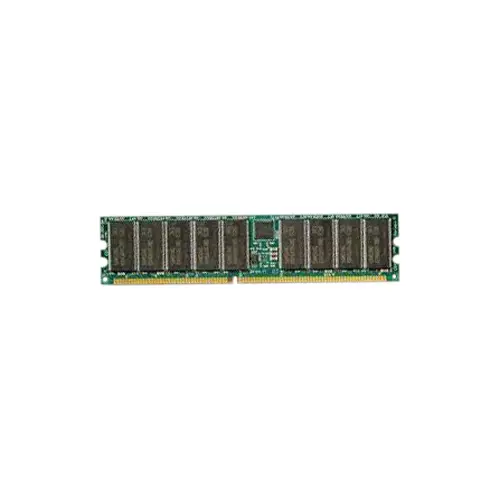
The MT18VDVF12872DY-335F1 is a server-class RDIMM engineered for always-on infrastructure. Its ECC, registered architecture, dual-rank layout, and CL2.5 latency directly resolve critical stability and performance demands. In a virtualized cluster, ECC silently corrects single-bit errors caused by background radiation, protecting hypervisor memory and preventing cascading VM failures that would otherwise strand your workloads. The on-die registers re-drive address and command signals, letting you fully populate all 184-pin slots without signal degradation—vital when consolidating dozens of virtual machines that require a large, dependable memory pool. For an in-memory database like Redis, the dual-rank x8 configuration enables rank interleaving, boosting sustained bandwidth by allowing concurrent operations across ranks. Paired with a low CL2.5 CAS latency, this minimizes access delay and accelerates transaction throughput, shaving critical microseconds off every query. These four engineering choices ensure your memory subsystem never becomes the bottleneck in data-intensive, 24/7 environments where accuracy and uptime are non-negotiable.
General Virtualization
This registered ECC DDR-333 module suits older single-socket or dual-socket servers. For light virtualization hosts, install a minimum of 8 identical 1 GB modules (8 GB total) to run a few small VMs; a fully populated 16-DIMM configuration (16 GB) improves consolidation of legacy workloads. Always populate memory banks in matched pairs to maintain balanced access and ensure error correction coverage.
In-Memory Database
In-memory databases require capacity and data integrity, which ECC registration provides. Fill every available DIMM slot—typically up to 16 modules—to achieve 16 GB of total memory, the realistic ceiling for this generation. This amount suits modest in-memory caches or small Redis/MySQL instances but is insufficient for modern large-scale analytics, so limit use to auxiliary database roles or entry-level trial deployments.
High-Performance Computing
HPC clusters running on period-correct nodes benefit from dual-channel symmetry. Equip systems with an even number of modules, such as 8 or 16 units, to enable memory interleaving and maximize bandwidth at PC-2700 speeds. Because per-core memory allocation is constrained, deploy multiple nodes with fully populated banks and leverage job schedulers that pin processes near local memory, minimizing latency penalties from the older DDR-333 interface.
Rigorously tested server memory, compatible with Dell PowerEdge 2850, HP DL380 G4, IBM x346.
Q: Can I mix this MT18VDVF12872DY-335F1 with other memory modules of different brands or speeds?
A: Mixing is not recommended for server Registered ECC memory. Mismatched brands or speeds can cause signal integrity issues and system instability. Always install identical p/n modules.
Q: Is this memory compatible with my Intel or AMD server platform?
A: Compatible with servers supporting 184-pin DDR-333 Registered ECC modules, such as Intel E7500/E7520 or AMD-8000 chipset platforms. Verify system requires PC-2700 RDIMMs.
Q: What is the recommended DIMM population order for optimal performance?
A: Follow motherboard guidelines. Typically populate slots farthest from CPU first, matching pairs across channels for dual-bank interleaving, always using identical rank configurations.
Q: Does this module support overclocking or XMP profiles?
A: No. As a server-grade RDIMM, it strictly adheres to JEDEC DDR-333 standards for data integrity and 24/7 stability. Overclocking or XMP is not supported.
Q: What warranty and typical failure rate can I expect?
A: This module carries a 1-year warranty. Premium server memory exhibits very low failure rates under design specifications, ensuring long-term mission-critical reliability in compatible systems.