











 Secure payments
Standard refund policy
Trade Assurance
Secure payments
Standard refund policy
Trade Assurance
| Product Type | Memory Module |
|---|---|
| Compliance Standards | RoHS |
| Memory Capacity | 8 GB |
| Memory Technology | DDR2 |
| Product Voltage | 1.8V |
| RAM Speed | 667MHz |
| RAM Standard | DDR2-667/PC2-5300 |
| Error Identifying | ECC |
| Signal Type | Registered |
| Column Access Strobe (CAS) | CL5 |
| Rank | Dual Rank x4 |
| Quantity of Pins | 240-pin |
| RAM Genre | RDIMM |
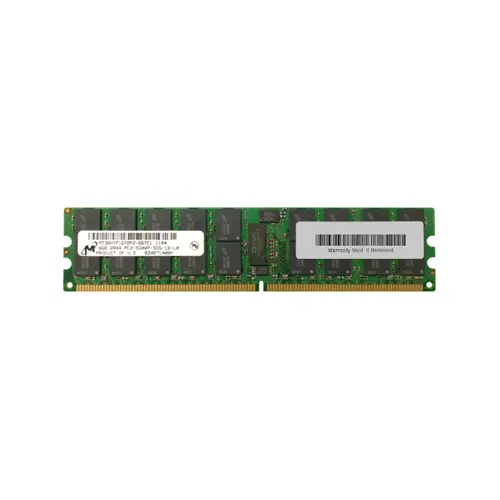
This Micron 8 GB DDR2-667 RDIMM with ECC and registered signaling is purpose-built for legacy server platforms, ensuring data integrity and system stability under sustained memory workloads such as virtualization and memory-resident databases. Its dual-rank x4 configuration with CL5 latency and 1.8 V operation provides a balanced combination of signal integrity and moderate access speed, making it a reliable choice for maintaining aging, mission-critical enterprise servers.
1. ECC protection corrects single-bit memory errors in real time, safeguarding data integrity for transactional databases that demand uninterrupted accuracy in enterprise data centers.
2. Registered buffering stabilizes signal integrity across fully populated server boards, enabling reliable operation under heavy memory workloads without sacrificing performance.
3. Dual Rank x4 organization keeps memory channels fully engaged through rank interleaving, which accelerates data access for multiple concurrent virtual machines.
4. The 8GB capacity provides ample headroom to consolidate more virtual guests per physical host, maximizing server ROI in dense virtualization clusters.
5. 667MHz operation delivers sufficient throughput for legacy server applications that require consistent bandwidth under sustained, multi-threaded processing loads.
When you are managing a virtualized cluster or running an in‑memory database, memory errors are not an inconvenience—they are a direct threat to business continuity. The Micron MT36HTF1G72PZ-667C1, an 8GB DDR2-667 Registered ECC DIMM, brings four critical capabilities that protect your workloads. First, ECC error correction continuously detects and corrects single‑bit flips caused by background radiation or electrical noise. In a hypervisor hosting dozens of virtual machines, an uncorrected error can silently corrupt a database page or crash an entire host; ECC ensures your data remains accurate without taking servers offline. Second, the registered architecture buffers the command and address lines, stabilizing signal integrity when you fully populate all memory channels. This lets you scale to large total capacities—essential for dense VMware or Hyper‑V clusters—without timing failures. Third, the dual‑rank design with x4‑organized DRAM chips improves data throughput by interleaving accesses between ranks. For a memory‑resident database like Redis or SAP HANA, that means lower latency and more transactions per second under heavy concurrency. Finally, the standard 1.8V operating voltage and 240‑pin RDIMM form factor guarantee seamless integration into legacy DDR2 enterprise platforms, maximizing your hardware investment while meeting RoHS compliance requirements. These features translate directly into reduced downtime, validated data integrity, and consistent performance under the most demanding multi‑tenant workloads.
General Virtualization
For light to moderate virtualization hosts, a balanced configuration of 12–16 modules (96–128 GB) arranged across all memory channels ensures adequate capacity for multiple VMs. Given the 8 GB RDIMMs and registered ECC, populate identical modules in matched sets to maintain interleaving and maximize throughput. Avoid mixing ranks or speeds to prevent downgraded clock rates.
In-Memory Database
In-memory databases demand both capacity and fault tolerance. Deploy the maximum supported modules—often 18 or 24 per server—to reach 144–192 GB, keeping data sets entirely in RAM. Use dual‑rank x4 modules for superior signal integrity and enable advanced ECC features like SDDC. This approach reduces latency spikes and guards against single‑bit errors in critical transaction logs.
High-Performance Computing
HPC clusters benefit from memory bandwidth rather than sheer capacity per node. Populate all memory channels with one RDIMM per channel (typically 6 or 8 modules) to hit peak bandwidth at 667 MHz. The 8 GB RDIMMs offer a favorable price‑per‑gigabyte for scale‑out deployments, while registered ECC protects long‑running parallel jobs from silent data corruption.
Rigorously validated server memory, compatible with Dell PowerEdge R805, HP DL385 G2, Sun Fire X4200 M2.
Q: Can I mix this MT36HTF1G72PZ-667C1 with other memory modules of different brands or speeds?
A: Mixing this registered ECC DDR2 RDIMM with different brands or speeds is not recommended. Inconsistent ranks, timings, or voltage may cause instability, POST failures, or ECC errors in server platforms.
Q: Is this memory compatible with my server? Which Intel or AMD platforms are supported?
A: This 240-pin DDR2-667 Registered ECC DIMM is designed for dual-socket and multi-socket servers using Intel 5000/5400 series or AMD Socket F chipsets. Verify if your board requires 1.8V RDIMMs and supports x4 organized DRAM.
Q: What is the recommended DIMM population order for optimal performance on my server board?
A: Populate identical RDIMMs per memory channel, starting with the slot farthest from the CPU. On most servers with dual-rank x4 modules, install in matched pairs across channels to enable 128-bit ECC and maximize interleaving.
Q: Does this module support overclocking or XMP profiles?
A: No. As a JEDEC-compliant server-class registered DIMM with ECC, it operates only at standard DDR2-667 with CL5 timing. Overclocking, XMP, or voltage adjustments are not supported and would compromise data integrity.
Q: What warranty and typical failure rate can I expect for this memory?
A: This module includes a 1-year warranty. Enterprise DDR2 RDIMMs typically exhibit an annualized failure rate well below 0.5% when operated at specified voltage and temperature, ensuring reliable 24/7 server uptime.